Showing posts with label Queen Victoria. Show all posts

Friday, November 07, 2014

Crowns through the Ages

This week I visited the Tower of London to see both the World War I poppy installation and also to go on a tour of the Tower itself. My favourite part of the day (other than seeing the extraordinary and poignant poppy display) was an exhibition called Crowns through the Ages. These spanned the Georgian and Victorian eras and it was fascinating to see them.

The earliest crown on display had been worn by George I at his coronation in 1714. George decided
to have a new crown made as Charles II’s crown from 1661 was in a poor state of repair and George also wanted to make a statement of “new dynasty, new crown.” It was set with stones of glass and paste rather than precious jewels but in 1727 these were removed and diamonds were hired especially for the coronation of George II. I was fascinated to see how many diamonds they had brought in for this purpose and wondered where you would source such a huge pile of precious stones!  I could imagine the lenders counting them in and counting them out again very carefully.

George III recycled the crown but his son George IV had a new diamond crown made for his coronation. It was the most lavish in the collection (why does that not surprise me?!) but again the diamonds were borrowed and although George was determined that the government should buy them he failed to convince parliament that it was worth the expense. Because of the frugal tradition of hiring rather than buying the gems, most of the crowns in the exhibition were therefore set with false stones or were just empty frames, which was interesting to see but rather sad.


My favourite crown was that of a Queen Consort, Adelaide, wife of William IV. This had been made especially for he coronation in 1831 because the previous crown, that of Mary of Modena, second wife of James II, was considered too “theatrical.” Adelaide’s crown was a gorgeous, rich scarlet velvet that looked beautiful with the silver. The other thing that struck me from looking at Adelaide’s crown and that of Queen Victoria was what small heads they must have had!

Wednesday, March 05, 2014

Princess Louise: Queen Victoria’s rebellious and artistic daughter


I’ve just read Lucinda Hawksley’s fascinating biography: ‘The Mystery of Princess Louise: Queen Victoria’s Rebellious Daughter’. I often pass The Princess Louise pub going down High Holborn in London and I was intrigued. Who was she, and why was a pub named after her? 

Princess Louise (1848-1939) was Victoria and Albert’s sixth child and fourth daughter, and arguably, the most popular of the royal progeny. Beautiful, intelligent and artistic, she was friends with artists, such as Whistler and Gabriel Rossetti, and the composer Arthur Sullivan.

She was herself a successful sculptor and her statue of Queen Victoria sits in front of Kensington Palace where the queen had spent her childhood, and where the princess herself had a sculpture studio. The words H. R. H. Princess Louise sculpt can just be made out at the base of the statue.  

In her eventful life, she championed various progressive campaigns for women’s rights. She knew and supported Josephine Butler and Elizabeth Garrett, for example, and was actively involved with a large number of charitable institutions helping the poor, including founding the Princess Louise Hospital for Children in North Kensington, then a poverty-stricken part of London. 

When, in 1878, her husband, the Marquess of Lorne, became Governor General of Canada, Louise supported progressive initiatives there, too.

 
The public saw her as delightfully unstuffy. She refused to marry into a German royal family like most of her siblings. Instead, she insisted that she would marry ‘a Britisher’, a declaration that was viewed as patriotic as well as romantic when the Franco-Prussian war broke out in 1870 and everything German became deeply unpopular. 

When Louise married the handsome Marquess of Lorne in 1871, the press went wild and portrayed it as a true love match. As one enthusiastic journalist wrote: ‘A perfect sympathy of taste in literature and music, and all the elegant accomplishments of refined life between the young couple, forms the basis of the ardent attachment which happily exists between them.’

Sadly, this was so much hooey. Evidence here is circumstantial but it seems likely that Lorne’s sexuality was directed towards his own sex. There were no children and, in later life, the couple lived largely apart.

Officially, though, the couple were happily in love. I myself have a 19th century screen with portraits of Princess Louise and her handsome husband (now sadly damaged), which the screen’s original owner  chose to stick on.  
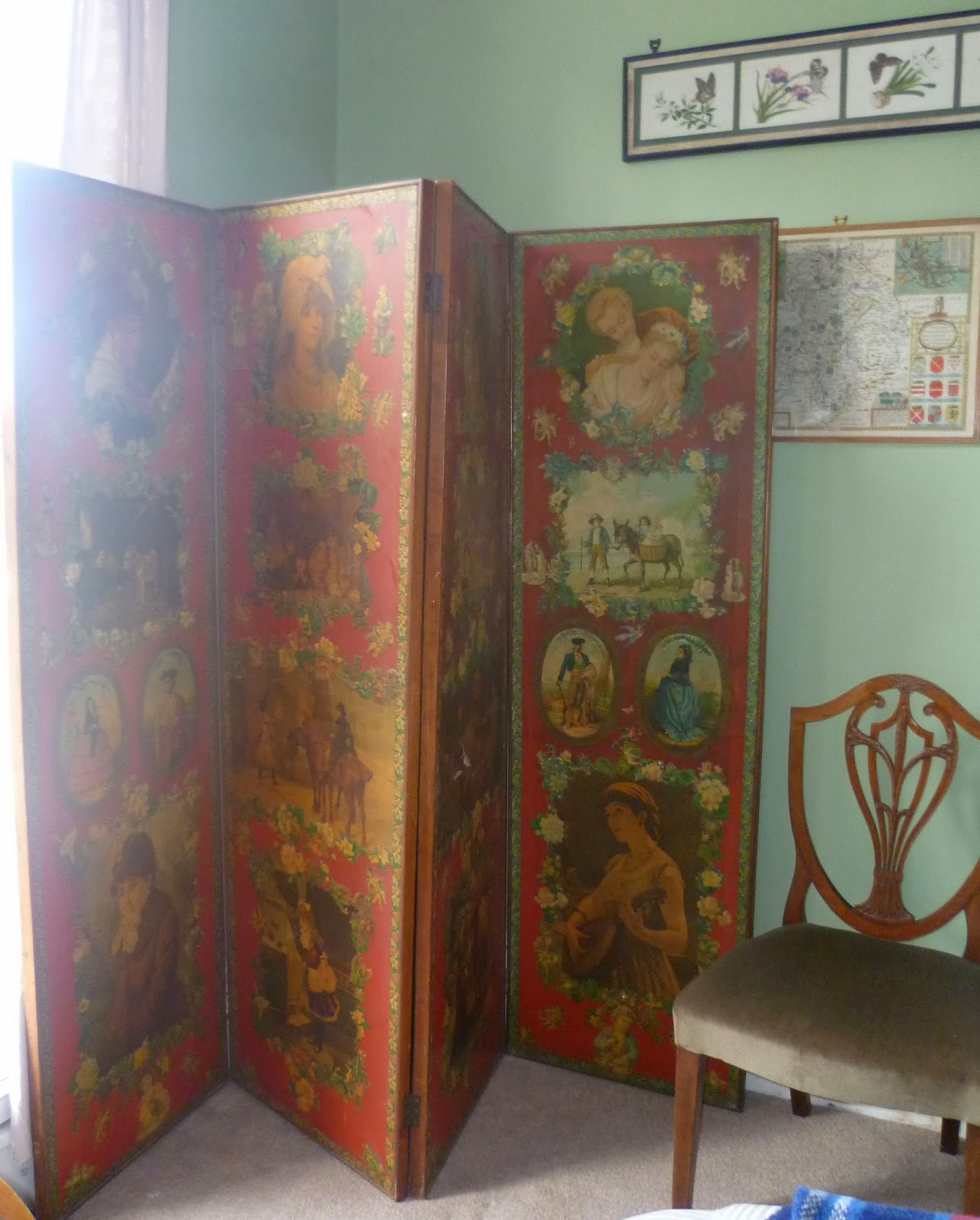
  
So why did Louise marry the marquess? Intriguingly, much of her private life is shrouded in mystery. Rumours have abounded since the 1860s about her having had a hidden illegitimate child, and her possible long-term sexual relationship with the sculptor Joseph Boehm. The Royal Archives’ Princess Louise’s files are closed, as are those in her husband’s castle of Inveraray. As Lucinda Hawksley’s biography puts it, ‘The decision to hide away (Louise’s) files indicates very strongly that there is something in them that the archivists, even in the twenty-first century, feel the need to conceal.’  

This seems to me a huge pity. Louise did not have an easy life – none of Victoria’s daughters did - but she was obviously a woman of considerable strength of character as well as being artistically talented and one who fought hard for her chosen causes. We are living in the 21st century and, in my view, allowing Princess Louise’s life to be properly studied would  enhance her reputation as a remarkable woman.  


Elizabeth Hawksley


Monday, July 19, 2010

Cuture Shock


Just now I am researching for a book set entirely in India in the late 18thc and writing a trilogy which begins there in the early 19thc, so the British experience is very much on my mind. A visit to the fabulous recent exhibition at the National Portrait Gallery - The Indian Portrait - gave a fascinating insight into the life, and mind-set, of the earlier British inhabitants, the officers of the East India Company who seem to have thrown themselves whole-heartedly into princely Indian culture.

A portrait of William Fullerton (c1764) shows him reclining on a terrace smoking a huqqa, just like many of the Indian noblemen in the exhibition. Fullerton is wearing his wig and black tricorne hat, his crimson coat and knee breeeches - he must have been sweltering! - but a similar scene depicting John Wombwell in the late 18thc shows him wearing Indian dress and he seems very comfortable sitting cross-legged with his pillows and huqqa.

The picture at the top is from a collection of old prints of India showing the life of these East India Company officials. This one reclines at his ease in a completely European setting - furniture, globe, even his tall hat left on the table. And yet he is listening with drowsy pleasure to a quartet of local musicians.

These earlier Europeans seem to have adapted well to life in India - if they lived long enough. When they succumbed to disease or the heat they even adapted the funery monuments of home to their new life, as this graceful figure on a tomb in St John's Chuch, Kolkata shows. Many took Indian wives, some converted to Islam or Hinduism without causing adverse comment, most seem to have adopted Indian dress for much of the time.

The culture shock must have been extreme but the approach appears to have been one of curiosity and interest as they settled down to trade, sending back the silks and embroideries, the Kashmir shawls, the ivory and gems that adorned the ladies of Georgian Society back home. What did they make of scenes such as this of the Red Fort in Delhi in a cloud of Black Kite?

You cannot romanticise their presence, of course. The British East India Company were in India to make money - and they did, in staggering quantities, while enjoying all the privileges of the princely rulers and without, it seems, a thought for the ordinary people. But I cannot help liking them far more than the Victorians who followed them and condemned their adoption of local ways and shunned the wives and children of their marriages.

I'll leave you with this image of Empire - Queen Victoria dominating the scene in front of the Victoria Memorial in Kolkata.


Louise Allen