
This enjoyable exhibition, which opened recently at The
Queen’s Gallery, celebrates the arrival of the Hanoverian dynasty in Britain.
When the Stuart Queen Anne died in 1714, Parliament had a
problem. They did not want, James, Anne’s Catholic half-brother, brought up in
exile in ancient régime France,
as king.

Photo: George I by Godfrey Kneller
18th century Britain
was a prosperous nation, proud of its liberalism and freedom of speech.
Parliament saw the country as modern and forward-thinking. They wanted a
constitutional Protestant monarch without any of the ‘Divine Right of Kings’
nonsense which had so be-devilled the Stuarts.
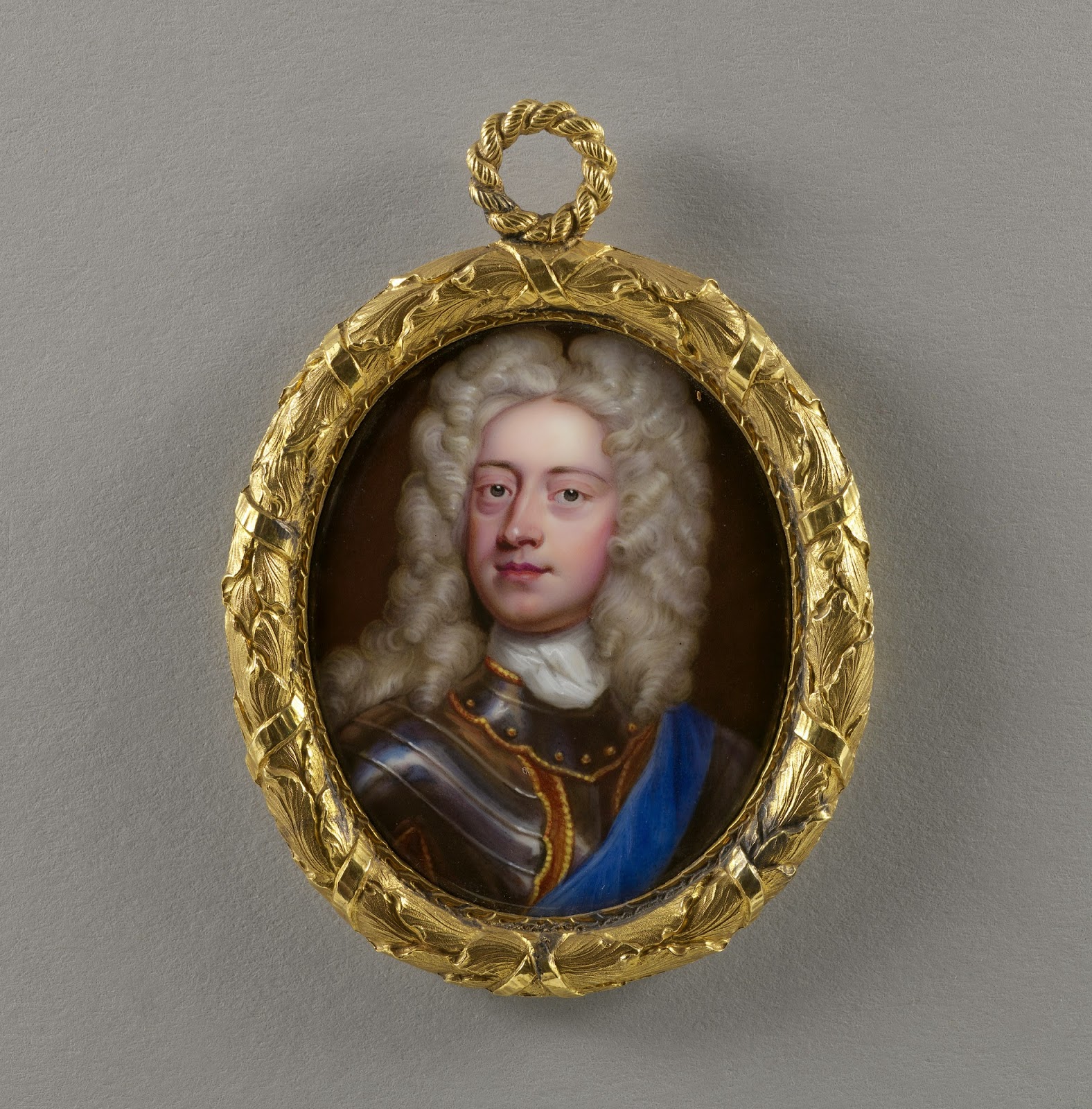
Photo: George II by Christian Friedrich Zinke 1717
Parliament trawled through the family tree and found the
staunchly Protestant George, Elector of Hanover. He was directly descended from
the Protestant Princess Elizabeth, sister of King Charles I, who had become
‘the Winter Queen’ of Bohemia. Elizabeth’s
daughter, Sophia, who married the Elector of Hanover, was George I’s mother.
(Those of you who are Rupert of the Rhine
fans might like to know that Rupert was Sophia’s brother - and thus George I’s
uncle. I do like it when things link up!)

Photo: The Neptune Centrepiece att. to Nicholas Sprimont 1741/2
In 1714, George I, together with his eldest son, arrived in England.
George I (born 1660) was already in his fifties, and his son in his early
thirties. Neither spoke very good English. They were worthy, undoubtedly
Protestant, and would, Parliament hoped, let it get on with governing the
country. On the other hand, they had an image problem; they lacked the Stuart
charisma. This was something that Bonnie Prince Charlie, James’s son, would try to
exploit in the future.

Photo: Queen Caroline, Consort of George II, by John Michael Rysbrack, c.1739
So, how did George I and George II present themselves to
their new subjects? Sensibly, they kept things low-key. They did not go in for
an extravagant Stuart-type court, for example. Instead, they sponsored
composers like Handel, supported the setting up of the Chelsea Porcelain
Works, and encouraged scientific enquiry – there are some beautiful botanical
prints on display. Their new art collection, in the splendid crimson and gold
gallery, shows that they also wanted to be seen as art connoisseurs.

Photo: Chelsea Porcelain plate
Various Hanoverian royals swim into focus; the highly
intelligent Queen Caroline, wife of George II, for example. She was friends
with the philosopher, Leibniz; she admired John Locke, Robert Boyle and Isaac
Newton; and she considered herself ‘the promoter of enlightened ideas.’ Why
have we forgotten her?

Photo: The Music Party: Frederick, Prince of Wales with his sisters, Philippe Mercier, 1733
Caroline’s cultured eldest son, Frederick, Prince of Wales,
was a keen and discerning art collector. Frederick
died before his father, so he never became king; his son, George III, inherited
the throne instead. Another of Caroline’s sons, William Augustus, Duke of
Cumberland, was a highly competent military commander. The duke’s plan for the
battle of Culloden (1746) and other memorabilia of the campaign are on display.
I really enjoyed this fascinating and wide-ranging
exhibition. It is on at The Queen’s Gallery, 11th April – 12th October, 2014.
Images courtesy of: Royal Collection Trust / © Her Majesty Queen Elizabeth II 2014.
Elizabeth Hawksley

