
 "You should have gone to Cromer, my dear, if you went anywhere.
Perry was a week at Cromer once, and he holds it to be the best
of all the sea-bathing places. A fine open sea, he says, and very
pure air. And, by what I understand, you might have had lodgings there
quite away from the sea – a quarter of a mile off – very comfortable…”
Mr Woodhouse advises on sea bathing in Jane Austen’s Emma.
of all the sea-bathing places. A fine open sea, he says, and very
pure air. And, by what I understand, you might have had lodgings there
quite away from the sea – a quarter of a mile off – very comfortable…”
Mr Woodhouse advises on sea bathing in Jane Austen’s Emma.
We took advantage of a sunny day last week to have a walk there so I checked the Pevsner architectural guide first and discovered its late 18th century fame. Mr Pratt, author of Gleanings in England (1794) is enthusiastic about the surrounding area but critical of the town itself which has “mediocre buildings and foot-piercing streets.” He obviously ran foul of the Norfolk
Thomas Potts’ Gazetteer of 1810 tells us that Cromer as a “straggling place without form or order” with 676 inhabitants. “It is chiefly inhabited by fishermen; who catch great quantities of crabs and lobsters from May to October.” Cromer crabs, flourishing on the unique chalk reef just offshore, are still a famous local delicacy. Potts goes on, “It has for some years past, been a summer resort of much genteel company, on account of its conveniences for sea-bathing, and the pleasantness and beauty of the surrounding country.”

There was a bathing house on the beach, long since vanished, and of course, bathing machines in abundance. Pratt says “…the Beach itself is an object of particular attraction. It is broad, firm and smooth, I think, beyond any I have seen.” And Cromer beach is still just as he described it, as you can see in this chilly picture.

The little amateur sketch with two bathing machines at the top of this post is of somewhere on the South coast I think, not at Cromer, but the machines are just the same kind with their umbrella-like hood at the front to protect the modesty of the ladies and to screen them from the sight of the men, who always insisted in bathing naked.

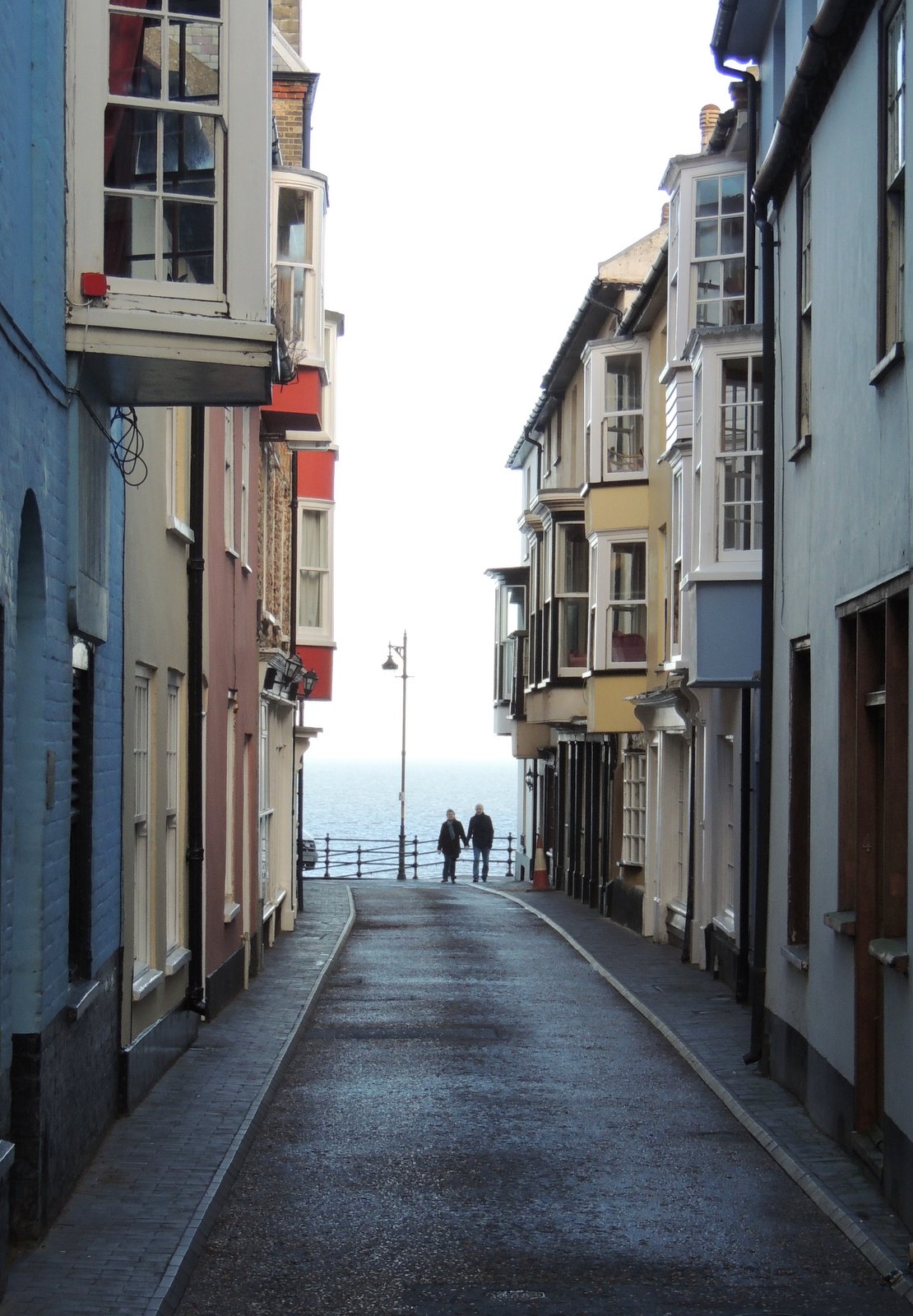 There is not much obviously left of Georgian Cromer, but the Albion Hotel is of that date, although it now has a Victorian pub frontage. The view of the beach was taken from The Crescent, shown here, an elegant terrace of the Regency period that would have been much in demand by the more prosperous visitors. In contrast,
Have you ever been led to explore anywhere - other than Bath
Louise Allen


