Showing posts with label Georgian. Show all posts

Friday, August 10, 2018

Singles or Doubles? Melinda Hammond Ponders Romance Covers...


With the release of our latest Regency Romantics Box set, A Summer of Dukes, I have been thinking about covers recently and wondering just what readers – and authors – prefer. Perhaps a single gentleman on the cover is favourite, our "Duke" certainly seems perfectly at home in the picture above, doesn't he?  And the cover of The Ton's Most Notorious Rake, my current Sarah Mallory Regency, has a very handsome hunk gracing the cover.  
Yet the recent Italian version of the same book features a painting of an actual scene from the book and I find I quite like that, too, or perhaps it is just the author in me kicking in, because I like to think that someone has read the book!


And I have now received foreign copies of two of my Sarah Mallory books from the Scandalous Arrandales Series – Lithuania, in fact! – plus The Duke's Secret Heir in German, and they ALL have couples on the covers.


To balance this, several of my own Georgian or Regency Romances have pictures of the heroine on the cover, including these two:-


 So, do you prefer to see a couple on a romance cover, or a single man or woman? Or perhaps it depends on the title  or the story? I confess that I don't think I have a preference,  but I am always intrigued to know what my publishers will choose next!

Do let me know what you think.

Happy reading
Melinda Hammond /Sarah Mallory

Tuesday, July 10, 2018

Lucasta, Gainsborough and the Long Regency


Publishing a new book (albeit a revised one) is always exciting, but searching for a new cover for Lucasta, my latest Melinda Hammond to be re-published on Kindle, turned up a fascinating true story that is the equal of any fiction.


You may be asking yourself why I have included a Georgian romantic adventure in this blog for Regency authors. Lucasta is set in 1780 and it can be argued that this was at the very beginning of a period known as the Long Regency, which covers a much wider time-span than the actual time the Prince of Wales was Regent (1811 – 1820). Generally, the Long Regency stretches from the late 18th century, when the Prince of Wales was coming into his own as a both a fashionable and a political figure, until 1837, when Victoria became Queen (and merited a historical period all to herself)

GEORGE IV

Lucasta is set around the 1780s, just before the French Revolution and the huge changes in society and fashion that followed. When I needed a cover for the e-book, it made sense to go to the leading artists of the day for my inspiration. And I came across this:
The Honourable Mary Graham of Balgowan by Thomas Gainsborough (1727 – 1788)

 You can see how alike it is to my own cover (included at the end of this blog), which the talented Jane Dixon Smith designed for me.  The original portrait is now in the National Galleries of Scotland. It was painted after 1777, so it fits with the setting of my story (even if the style was influenced by the 17th century painter Van Dyck, so the costume and setting has echoes of an earlier period). When I looked a little deeper into the history of this painting, however, I discovered that the lady's own life was equally as interesting as any fiction.

The Hon Mary Cathcart was born in 1757, the daughter of a Scottish baronet who was at the time Ambassador to Catherine the Great. She was born in Russia and spent her early years there, but returned to England when she was "of marriageable age".  She was married at the age of 17 to a Perthshire landowner, Thomas Graham, in 1774. It is said that he was so love-struck that when she forgot to bring with her the jewels she wanted to wear at a ball, he rode 90 miles to fetch her jewel box.

She suffered from  consumption and her husband took her to Brighton in an attempt to improve her health. It was there she met Georgiana the Duchess of Devonshire and they became life long friends (and possibly even lovers). Gainsborough adored her and painted her three times, including the version shown above, which was exhibited to great acclaim at the RA in 1777.

Mary's health continued to be a concern and her husband took her to the Mediterranean in the hope that a warmer climate would prove beneficial, but she died onboard ship, off the coast near Nice, in 1792. Thomas brought her body back through France, which was by then in the grip of revolution, but his party was accosted by French soldiers and Thomas was forced to stand by and watch while they broke into the coffin and violated his wife's body. He had planned to bury her in France, but after this appalling incident he decided to bring her home: she now lies buried in the mausoleum which he built in the churchyard at Methven.
Thomas never recovered from this outrage and could not look at the portrait again. He hung it with white muslin and later passed it to her sister. Thomas then spent the rest of his life in the army, fighting the French. In the mid 19th century, the portrait was bequeathed to the National Gallery by one her descendants on condition that it never leaves Scotland, and it has been there ever since.

It is a fascinating story, and one that I might never have learned had I not decided that this lady would make a perfect model for my eponymous heroine.

 Happy reading!

Melinda Hammond / Sarah Mallory

Lucasta is now available on Kindle


Tuesday, January 03, 2017

A NEW YEAR & A NEW STORY… INSPIRATION FROM THE ARMCHAIR


HAPPY NEW YEAR! I hope you all have a wonderful 2017, full of laughter and happiness and lots of lovely reading!  I am still in the holiday mood so I thought I'd kick off 2017 with a little bit of whimsy and share with you a few secrets about how I begin a new story.
Just before Christmas I finished writing my last Sarah Mallory novel, so I have had the festive break to mull over ideas for a brand new historical romance.  I really love this part of the process, when I have the writer's equivalent of a blank canvas, just waiting to be filled with daydreams and ideas.  This is the point where I indulge in a little armchair research, looking through magazines, books and images to decide on how my hero and heroine will look, where they will live and what they will do, etc.  Nothing is set in stone at this point, even the characters' names could change, but I thought you might enjoy coming on this little journey with me….


First of all there are the characters. I have a gentleman whose nickname is Russ. I decided he should be a Corinthian – a fashionable Regency sportsman.  Russ is also a dangerous rake. He is rich, possibly titled,  and is more used to fighting off women than chasing them.  I imagine him looking a bit like Rufus Sewell,…..


My heroine for this story is a young widow, Molly. She has had a tough time (but I am not going into that now, it would spoil the story) so she appears quite serious, although there is a spirited lady hidden beneath her sober appearance. There is a hint of this in the fact that she cannot quite control her unruly dark curls. So perhaps a mix of these two ladies.....


Then there is setting. Is it going to be an adventure story, set on a rugged coast,

perhaps a Gothic mystery with an old ruined castle….


No. this story is set in a village or small town, where one of the large local properties has just changed hands, and the new owner has brought a large party there for the hunting season.  So - I need to choose a house – something Palladian like Stourhead, perhaps,

or older,


My mind is tending towards something like this, Beningbrough, possibly because I think the story is going to be set in the north of England and this lovely property would suit very well.

And if we are in the north, then perhaps it will be winter, and my characters will have to travel through the snow…..
Or if it is summer, perhaps my characters might have reason to visit the ice house. In one of my books (Winter Inheritance) a villain shuts the heroine in an icehouse in an attempt to kill her, so I won’t be using that scenario, but I might have Molly and Russ meeting up there, and there is a lovely example at Stourhead.


Or, perhaps a trip to Harrogate, to take the waters (they would visit the Sulphur Well, which until 1842 was covered by this temple, which now sits over the Tewit Well)

and they might stay at the Queens Head, the fashionable coaching inn (which is still there, although it has had a change of name).


So you see what fun I can have without ever leaving my chair?  Of course there is a lot of research to be done when I get down to planning the story in more detail, but for now I can let my imagination wander as I decide on the people, places and scenes that I want to fit into this book.
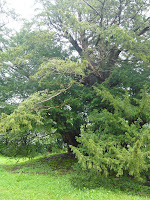
At present, I have only written an opening scene, when Molly is dreaming. She is a child again,  hiding in a tree from her brother (who will never find her, because he does not believe girls can climb trees).  Now, some time ago I visited Ashbrittle, in Somerset and saw this beautiful ancient yew tree. It would make the perfect hiding place for Molly, so that is my inspiration for the first scene.
.


Now all I have to do is write the rest of the  book…..
Happy reading, everyone!

Melinda Hammond / Sarah Mallory

While you are waiting for the next Sarah Mallory novel, perhaps you might like to try The Wayward Miss Wyckenham. First published by Robert Hale as the Belles Dames Club, this is a sparkling Georgian romance, sure to cheer up a long winter evening!

Saturday, September 03, 2016

Sneak Preview THE DUKE & THE DEBUTANTE by Melinda Hammond


So, September is here, the summer holidays are over and we are looking forward to autumn, with those longer nights when it is lovely to curl up in a chair with a good book (although, to be honest, I can curl up with a good book any time of year!)

So I thought this month I would give you a sneak preview of a revised Georgian Romance that I am publishing on Kindle later this month. The Duke and the Debutante was one of my first historical romances but it is still one of my favourites, the story of spirited Melissa Langham, who crosses swords with the rich and powerful Duke of Aldringham.  They meet in Bath, and I have given below an extract, where they dance together for the first time.  This is the new cover, too, which I hope you like.


          Upon the beat, the duke took her hand and almost from the first steps, Melissa forgot everything except the music. They skipped and gestured, pirouetted and passed each other with grace­ful ease, their steps perfectly aligned. It was exhilarating, to be so at one with a partner and Melissa wondered how it could be that strangers should move so well together. As the courante drew towards its conclusion she found herself wanting to prolong the moment. The last notes died away, they saluted one another and as she rose from her curtsy the duke reached for her hand.
'Will you stay for the minuet?'
Melissa knew she should refuse. She should go back to Lady Fryer, but for the life of her she could not summon up the will to do so. Almost without realizing it she took his proffered hand and remained on the dance floor.
The music swelled and rolled against her senses. Melissa lifted her eyes to the duke's face and could not look away. He circled around her, his intense blue gaze hold­ing her in thrall so that she was only dimly aware of the other couples dancing around them. Her body was no longer her own, it moved and swayed to the same rhythm as her partner's. When he stepped up to her, the white lace on her corsage brushed against his black velvet coat. He led her round, first one way then the other, his eyes never leav­ing her face. She was lost, time stood still, when the dance ended he held her a prisoner with the intensity of his gaze and she did not even notice that the music had ended and made no move to leave.
The musicians struck up again, another minuet, and still they danced. Melissa did not hear the murmurs of disapproval from some of the matrons sitting on the benches, nor did she notice Lady Fryer fidgeting uneasily on the edge of the dancefloor. She was caught in a world outside time, aware only of her part­ner, the sinuous elegance of his movements as they followed the steps of the minuet and the way her own body swayed and circled around him while the lilting music flowed about her. They were like two birds performing some ritual courtship, their bodies expressing a primeval language she barely understood.
The duke took her hand and led her back to their original positions, bowing as the music ended. Melissa curtsied mechani­cally to her partner. She felt dazed, shaken by what had occurred and she looked up, searching his face. There was a smile lurking in his hard eyes, a warmth that was oddly reassuring. It told her he knew exactly what had occurred during the dances and she was about to speak, to ask him to explain what had happened when another voice broke in.
'Well, well, very nice, my dear, but time is pressing. Your aunt mistook the day, there is another engagement. Come along Melissa, I am sure the duke won't ... your servant, your Grace!'
In a flurry of half-finished sentences, Sir Joseph caught Melissa's arm and almost dragged her away. The spell was broken, Melissa looked back to see the duke had not moved from the dancefloor. He was still smiling, but it was not the warm, intimate look they had shared a moment earlier. It was a smile that made a chill shiver run the length of her spine.
'Uncle, what is it?' She struggled to find her voice. 'What has happened, is my aunt ill?'
Trying to collect her scattered wits, Melissa ques­tioned her uncle, but he merely shook his head and hurried her out of the ballroom. Lady Fryer was waiting at the door and turned to follow them. Outside, the cool of the summer night quickly washed away the remains of Melissa's stupor and as Sir Joseph hurried them through the warm streets she pulled her arm free from his grasp, demanding to know what was wrong.
'I'll tell you what is wrong, miss,' declared Sir Joseph furiously, 'you have given every tattlemonger in Bath enough fodder for a month!'
'What?'
'To dance with only one man all night, and that man the Duke of Aldringham! You are ruined, child, ruined! And you, madam. What were you about to allow Melissa to meet such a man?'
'Indeed I did not know his reputation!' cried Lady Fryer, breathless with the effort of keeping up with her husband. 'Pray you sir, slow your pace, for we are attracting even more unwanted attention by this unseemly haste.'
'Thank God I decided to look in upon you before going on to supper. Heaven knows where it was leading, with the man blatantly seducing the girl in the middle of the dance floor.'
'Is that what he was doing?' she asked, remembering. It had not felt like seduction. More like heaven.
 (c) Melinda Hammond


The Duke & the Debutante will be published on Kindle very shortly, so do look out for it.

Happy Reading!

Melinda Hammond /Sarah Mallory

By Sarah Mallory:
The Outcast's Redemption - pub. Harlequin July 2016


Saturday, February 07, 2015

The Georgian Shell House at Hatfield Forest

A few weeks ago we visited Hatfield Forest, which is a rare survival of a medieval royal hunting forest. I love woods and forests because they so often have a real sense of history; the ancient trees like living sculptures, the sense of timelessness that you get when you walk between them.

Hatfield Forest was in existence at the time of the Domesday Book in 1086. Fallow deer were introduced in 1100 from Europe and their descendents still roam the woods today. Rabbits were another “foreign” introduction and a warren was set up in the woods to provide meat and fur.

In the 18th century the forest was sold to the Houblon family, wealthy merchants and financiers from
the City of London. In keeping with the fashions of the day, Jacob Houblon had a part of the forest landscaped. He built the Georgian Shell House and the lake, surrounding it with exotic, non-native trees.

The Shell House is now the exhibition centre for the estate. It was originally built as a picnic house overlooking the lake and was decorated with flints and with British and tropical shells. Most of the shells were from the West Indies as these were used as ballast in the holds of slave ships. The decoration includes a bird sculpted out of oyster shells and blue glass, coral and coloured sands.

At this time there was a craze for collecting and purchasing shells and using them to decorate grottoes and garden features. The building of a picnic house was also a part of the 18th century fashion for elaborate buildings in the landscape whether they were fishing temples, cold plunge baths, pavilions or grand arches. In the summer the Shell House provided a wonderful place for the family to picnic, fish and go boating. Grand parties were also held
there. It offers an insight into the leisured lifestyle of the Georgian upper classes. It is rumoured that the ghost of Laeticia Houblon, who decorated the Shell House, can sometimes be seen in and around the property! It must have taken her months to create such a detailed piece of art.

I actually found the shell decoration rather dark and not particularly appealing although I think that may be because after 250 years it has been very worn by the weather, and the bird motif was a bit sinister to my eyes! So I don't think I will be decorating my house like that any time soon, but as an example of the fashion for shell decorations in the 18th century it was well worth a visit.


Wednesday, August 13, 2014

Covent Garden


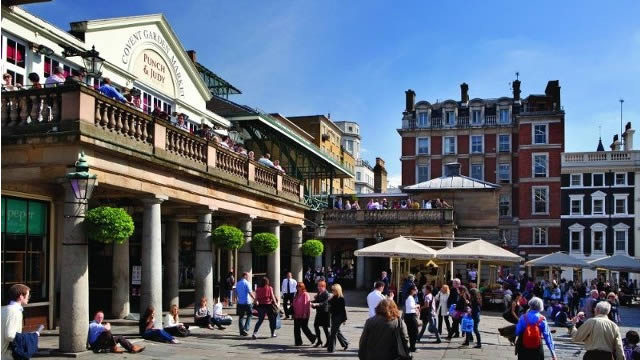
Many of my books feature a very small part of London—Covent Garden and the area around it. I love Covent Garden. These days you can browse among the stalls in the piazza and listen to opera singers busking. The stores in the square and the streets are a mixture of modern chains like Swarovski and Monsoon, and small boutiques. It’s eternally popular, and always thronged with people. Street performers add more fun, and the Transport Museum is right there.
It’s always been that way, since the piazza was built in the seventeenth century. It was intended to be a gracious square to house the rich and high class of London, but very few ever lived there. They were already moving further west, and so the piazza was a bit of a white elephant for a while. Then the market moved in and until the late twentieth century, many Londoners bought their fruit and vegetables in the early morning. When the market was moved out of town, the traders moved in.
One side of the square is dominated by the Royal Opera House. A few years ago, in its expansion, the megalith that is the opera house demolished the site of Tom’s Coffee House, to make room. Tom’s was always a disreputable place, where prostitutes met their customers, but since Tom King and his wife banned all sexual goings-on in the building, the authorities could never make a prosecution stick.
Covent Garden was the center of the sex trade in London. The houses bordering the square, the streets nearby and the ramshackle stalls that used to line the central building were full of prostitutes, madams, and people who catered to the sex trade, like the condom sellers and the sex toy sellers. But it was still hugely popular with the rich and wealthy. The male half, at any rate.
Anyone thinking that they were staid and respectable in the past, needs to read one of the guides published at the time, or the scurrilous naughty pamphlets, the advertising bills, the accounts of court cases involving the denizens of the place and even “Fanny Hill.” In the days when there was no reliable contraception, they had to get inventive!
I set a scene in “Rogue in Red Velvet” there, and on a visit to London I took masses of photographs of the house I picked to set the scene. My respectable widow heroine, Connie, is drugged and put up for sale at one of the mock-auctions there. Alex is forced to rescue her and then devise a scheme to restore her reputation! It was a great excuse to visit the place again!
Richard and Rose also had dealings there in “Maiden Lane,” which is a narrow street close to the Garden and contains one of the oldest restaurants in London.
Of course, also nearby you can find Drury Lane Theatre and Bow Street Magistrate’s Court. Further north was the “rookery” of Seven Dials, where no respectable person ventured, for fear of being stripped, robbed and even murdered, so you had to watch your step!

You can read more about Rogue in Red Velvet here: http://www.kensingtonbooks.com/book.aspx/30512 

Thursday, May 15, 2014

Georgian costumes at Berrington Hall

Berrington Hall, Herefordshire (c) Joanna Maitland

Berrington Hall in Herefordshire is a gem of a house designed by Henry Holland with gardens by Capability Brown. It is really worth a visit, perhaps for those on the way to the RNA Conference in Telford in the second week of July.

Berrington Hall, grounds with lake (c) Joanna Maitland

This year, Berrington Hall is really pushing the boat out for visitors who are interested in the Georgian Period.

Berrington has a fantastic costume collection of its own but this summer, there are additions. From now until the end of June, there's an exhibition of costumes from the film The Duchess.


Embroidered waistcoat (c) Joanna Maitland
Also from now till the end of June, you can see how Georgian gentlemen dressed and behaved. There's an exhibition of gentlemen's waistcoats and accessories and I can guarantee that embroidery lovers will be amazed at the stunning workmanship (workwomanship?) on the waistcoats. They are absolutely beautiful and my photo does not begin to do justice to this one.


If you're lucky enough to be able to visit on 14th or 15th June, you can also see how gentlemen settled their differences. In other words - duelling - whether with swords or pistols.


On various dates in the second half of June there are also carriage displays including driving.


Then, in July and August - more convenient for those going to the RNA conference - there is an exhibition called "Big Bottoms and Small Waists". Not my title, I assure you!

It is, as you'll have guessed, an exhibition of undergarments. Fascinating and maybe even a little risqué.

Berrington hall, rear courtyard (c) Joanna Maitland

Details of Berrington Hall are here and details of the events and timings are here. I do hope you will find time to go. It is a magical house.  Complete with resplendent guardian in the rear courtyard.


Courtyard guardian in full fig!  (c) Joanna Maitland

Joanna
visit Joanna's website

Wednesday, July 03, 2013

Revenge and Romance


Revenge has formed the basis of stories for hundreds of years, from the blood-filled Jacobean revenge tragedies to modern day films, taking in opera and stage shows along the way. I love a good revenge story, although I know some readers are not so keen.  But one person's revenge could be another's justice, and justice for a wronged woman in the brutal Georgian era was hard to come by.


In my Melinda Hammond novel, LADY VENGEANCE, Elinor is wronged by a group of very powerful men. They take their cruel pleasure and think nothing more of it, but eight years later  their deeds come back to aunt them.  This is (so far) the darkest of my Melinda Hammond novels, and it is a stirring adventure story of politics and plots, dark deeds and love, and  a mysterious, fiery ruby - the bloodstone - which is Elinor's link with a past she cannot forget.


My latest Sarah Mallory, BOUGHT FOR REVENGE (published in August) is a very different revenge story.
It is set in the "enlightened" world of the Regency, two years after Waterloo and it is the man, Lucas Blackstone, who thinks he has been wronged and is determined to exact his own kind of justice.
However, he finds that plotting his revenge against an unseen, inhuman enemy is very different from carrying out his plans to harm a gentle old man and his beautiful daughter. All too soon Lucas finds the defensive walls he has built around his heart are beginning to crumble.

Anyone who has read my books will know I am a romantic, so in both stories it is love that wins the day, but  I did enjoy exploring these two scenarios with their very different heroines. I would love to hear which you prefer.


Melinda Hammond / Sarah Mallory

Lady Vengeance - pub. in e-book format by Regency Reads, Hardback by Robert Hale Ltd
Bought for Revenge - pub. August 2013 by Harlequin Historical

,

Wednesday, November 02, 2011

The Geffrye Museum

.
Tucked away near Shoreditch is the Geffrye Museum. It doesn't look like a museum from the outside, it looks like a long, graceful Georgian almshouse set in a pleasant garden - which is what it used to be.

Today, it is a lively, vibrant space housing interiors-through-the-ages. You walk from a hall in 1630


past a drawing room in 1830 right up to rooms on the more recent past. It is fascinating to see how tastes change - and how growing affluence is reflected in the furnishings.

There is more to the museum than just a collection of rooms, however - small gardens outside also reflect the changing times with different plantings and different designs.

Fascinating - well worth a visit.

Jan Jones

Friday, August 19, 2011

Mirror Magic

Mirror, mirror on the wall... Mirrors have powerful fascination for most people and I find myself drawn right into those with their old glass still intact, like this fabulous 18thc example from the Assembly Rooms in King's Lynn.

I stood in front of it for long minutes, mesmerised by the silver shimmer of the old glass, half expecting the scene behind me of the Mayor greeting visitors to turn into a Georgian ball in full swing with an orchestra in the gallery, candlelight, the chaperones' corner and, of course, a handsome man walking towards me...

Not all mirrors are as beautiful. The "mirror" once owned by Elizabeth I's astrologer Dr John Dee, is actually a polished obsidian Aztec cult object, one of the curiosities reaching Europe during the 16th century. Dee used it as a "shew-stone" to see visions of the future and you can see it at the British Museum and catch an eerie glimpse of your own reflection, even if you cannot see the future in it.

Much more charming is this little late 18thc enamel patch box. I bought it because of the charming couple on the lid and the motto "Sweets the Love That meets Return" but I was thrilled to find it still has its tiny mirror in the lid.

How many women have peeped into that tiny mirror - only 4cm wide?

The fact that it has survived, albeit cracked, suggests it was treasured after the fashion for wearing paches on the face had long gone.
Was a little surreptitious rouge or rice powder concealed in it? Or tiny sweetmeats, or perhaps pills? Or was it just a pretty trifle to keep in a reticule to take out and check one's appearance or spy over one's shoulder at what was happening in the room behind?

Is there a mirror that has intrigued, or even frightened you? Tell me about it - there is a prize of a signed copy of one of my latest books - your choice - to the writer of a comment chosen at random. (Check out this post on Friday 26th August and I'll announce the winner)

Louise Allen
Ravished By the Rake (UK August 2011)
Practical Widow to Passionate Mistress (US August 2011)