
Mine
– dating it by costume – is roughly 1870s, and the young lady (for I’m sure it
was a young lady) who once owned my screen chose to paste pictures which
unwittingly demonstrates how rigid gender roles were at the time. Many of her
pictures emphasize the importance of sons; daughters are there only in admiring
roles. I found myself wondering if this reflected her own life.

New suit
The
picture above shows a small boy standing on his mother’s dressing-table,
holding her hand. One foot is negligently crossed over the other and he is
looking, with some complacency it must be said, at his reflection. He wears a
sailor suit with long trousers, known as a Man-of-War suit, and his hair is cut
short.
According
to the Cunningtons’ Handbook of English
Costume in the 19th Century, ‘Small boys between 3 and 6 years of age might wear tunics with white
frilled drawers showing beneath them.’ And a number of fond mamas refused
to cut a baby son’s hair – Elizabeth Barrett Browning among them. Her poor
son, Pen, was forced to keep his hair long until his mother’s death, when he
was twelve.
The
boy in the picture has, fortunately, been spared the indignity of long curls and he obviously feels
the importance of his new status: a sailor suit with long trousers (and a suitably manly name) and his baby curls cut
off. His older sister stands by the dressing table looking wistfully up at him.
No sailor costume for her.

It’s a boy!
This
picture depicts a nurse showing the new baby – obviously a boy – to his five
sisters. There is no need for a caption; the importance of the occasion is
obvious. This is the baby that
matters – now Papa will be happy. The girls, all dressed much the same, are merely decorative adjuncts.
My
next picture shows the return of an elder brother from boarding school. He has
a fresh open face and he is smiling to see his sisters and younger brother
again. His school trunk on the floor plainly shows that he is home for the
holidays. The younger brother (in his sailor suit) looks up wistfully. One day, it will be his turn to go to a proper school. Again, adoring sisters
crowd round.
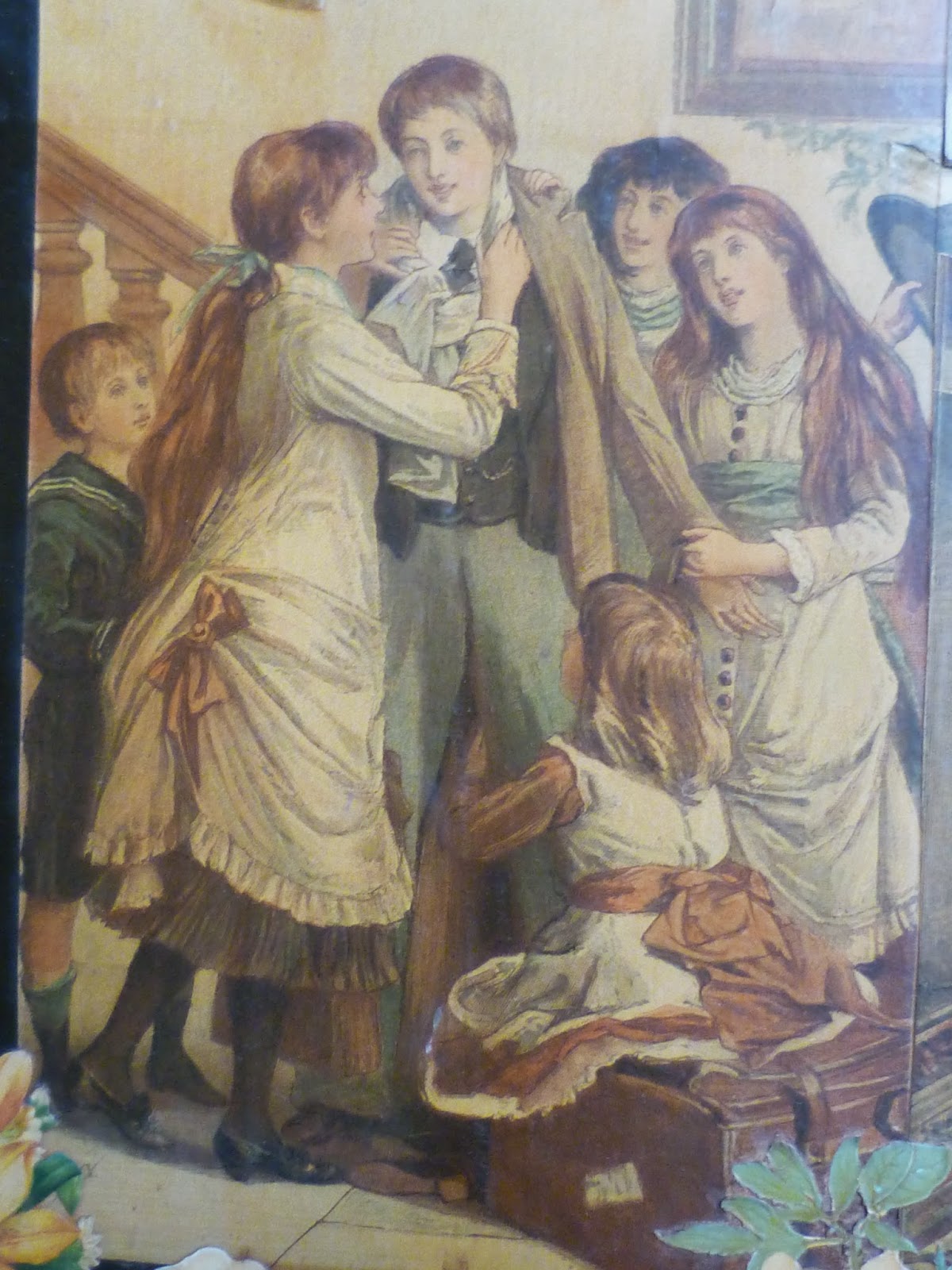
Back from
school
What
strikes me is that the boys in the pictures are going somewhere; they are moving on – symbolized by the sailor suit
and the school trunk. The girls have no useful role to play, apart from that of
marriage and bringing future boys into the world. They don’t go to boarding school; they will have a governess at
home.
To
what could a daughter aspire? Nothing much, according to my screen. There are a
number of oval cartouches decorating the borders showing Latin lovers with the
man serenading his lady. Tellingly, one lady is behind a grille – and her lover
is reaching inside the bars to kiss her hand or, perhaps, to pass her a note.
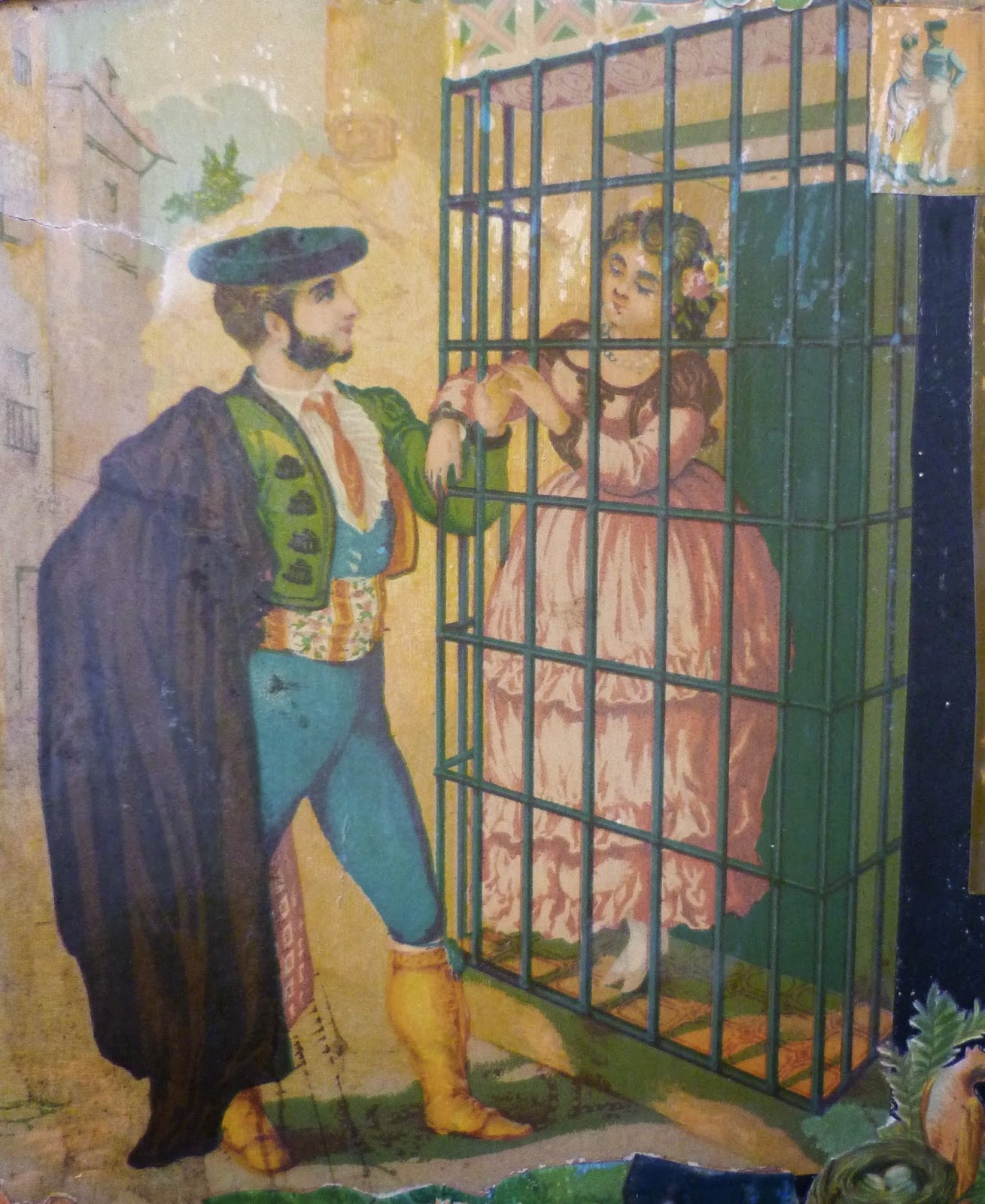
Behind the
grille
Apart
from showing the importance of sons, the other major theme of my screen is
romantic love. Alas, there are no pictures of girls being proactive, apart from
a lovelorn lady posting a letter into a hole in a tree.

Love letter
There
are plenty of stories on my screen but none are very positive for girls. The
more I looked at the screen, the more I feared that the young lady who owned it
had bought into the prevailing view that girls were to be Angels in the House,
delicate creatures whose husbands would protect them from the rough outside
world.

Sleigh Ride
The
picture of the sleigh ride, for example, shows three young Cavaliers in 17th
century costume (and they are certainly not Roundheads!) pulling a sleigh
carrying a pretty little girl carrying a little dog. On the front of the
sleigh, a carved cupid is about to shoot an arrow at one of the boys. The
inference is obvious – shades of Lydia Bennet tenderly flirting with six young
officers at once. You can see where my young lady’s fantasies are going.
Almost the entire screen is devoted to pictures showing the importance of the male sex; and romance appears to be the young lady's sole interest. I just hope her personal story had a happier ending than Lydia’s with Wickham.
Elizabeth
Hawksley

