Monday, June 07, 2010

The ancient laws that inspired the Brides of Fortune Trilogy

I’m thrilled that my Brides of Fortune trilogy is being published in the UK starting with Confessions of a Duchess this month. The covers for the US and UK versions of the series are very different but I love both styles.

When I was sorting out some files recently I came across the notes I made before I started writing the series back in 2007. The spark for the whole trilogy idea came from an article I read in a national newspaper. A businessman had bought the title of Lord of the Manor of a village in Kent. Once installed, he discovered that there were various ancient rights and privileges associated with the title. He decided to revive these and put forward the idea, amongst other things, that people should pay to walk their dogs on the village green and to park in front of the village shop. Not surprisingly there was an outcry from the villagers, who objected to this high-handed behaviour on the part of their new “lord”!

This gave me the idea for the “Dames’ Tax” whereby all unmarried women in the village of Fortune’s Folly are obliged to give half of their wealth to the lord of the manor if they do not marry within six months of him coming into the title. Whilst I freely admit that the Dames’ Tax was pure invention on my part, I did research various other real taxes existing at the time. These included the tax on dogs, which was in force until 1882, the tax on male servants, abolished 1852, and the tax on racehorses, which only ceased in 1874. These were all taxes paid on a national basis.

Most local taxes, known as “scots” were abolished in England after the Restoration of the Monarchy in 1660, so in order for Sir Montague Fortune’s revival of local taxes to have any historical authenticity I had to find a way in which his village might be exempt. One way that presented itself was for Fortune’s Folly to have been a church enclave where the abolition did not apply. Thus the series starts with Sir Montague discovering to his glee that the abbey church in Fortune’s Folly had exemption from the 1660 abolition.

Many of the medieval taxes were paid to the church and naturally many others were weighted heavily in favour of the lord. However the Fortune’s Folly villagers, to get their own back for Sir Montague’s greed, in turn revive those taxes that give them the advantage: Pontage, by which they charge a fee to cross the bridge in the village, pannage, the right to let their pigs roam in the lord’s woods, and foldage, sending their sheep to manure Sir Montague’s beautiful rose gardens!

Probably the most well known of the early taxes was the droit de seigneur. In England this was known as the amober, the sum paid to the Lord of the Manor to waive his right to sleep with the bride the night before her wedding. William the Conqueror was famously supposed to have been conceived after the droit de seigneur was invoked.

Book 3 of the series, The Undoing of a Lady, is inspired by this idea, but with a twist. It is the Lady of the Manor who exercises her ancient rights, kidnapping the hero to stop the wedding!
It fascinated me that some of the ancient laws and taxes are still legal in the UK today. Mostly these are laws such as wood penny, which is still applicable where I live: for the payment of a nominal penny a year to the local landowner we have the right to take his wood for our fire. Other laws and taxes serve as great inspiration for story ideas but I would not want to see them revived…

Wednesday, June 02, 2010

Rediscovered Delights.


Those who follow my occasional tweets will know I have recently moved all my books into brand new bookcases (oh the bliss of having enough shelf space – until I buy more books that is). In the process I have rediscovered a few gems, books I have acquired over the years and while they cannot really be justified under the serious heading of “research”, they are certainly fun to read!

For example, there’s a lovely little book from 1950 entitled “The Book of Queer Stories” (one wouldn't perhaps use that title now) featuring delightfully odd little tales from the likes of G K Chesterton, H G Wells and Robert Louis Stevenson(and what is it about these writers that they had to have a third name or initial? Perhaps I should be Melinda H Hammond, or Sarah Jayne Mallory... but I digress)

Also, I found an interesting little tome from about 1980 called “Where There’s a Will” by Robert S Menchin. Now this can be classed (loosely) as research, since it contains fascinating extracts from wills written over the centuries (including one written on a tractor mud-guard by a dying farmer and another scratched onto an eggshell).


I liked the nineteenth century Englishman who left his wife “one shilling, in recompense of her having picked my pocket of sixty guineas and taken up money in my name, without my leave or license" and another who left his wife just five shillings. “It is sufficient for her to get drunk for the last time at my expense.”

John Aylett's will was proved in 1781. He wanted his executors to "lay out five guineas in the purchase a picture of a viper biting the benevolent hand of the person who saved him from perishing in the snow……and…. in memory of me, present it to Edward Bearcroft, Esq. a King’s Counsel, whereby he may have frequent opportunities for contemplating on it.This I direct to be presented to him in lieu of a legacy of three thousand pounds which I had, by a former will, now revoked and burnt, left him.”

And finally there’s the case of Charles Millar, a Canadian who left a large part of his estate “...to the Mother who has…given birth in Toronto to the greatest number of children.” Eventually four Toronto mothers, each with nine children, shared the prize of $568, 106 (and one of the poor women declared that she was now going to start practicing birth control!)

Wills are often used in plots, but in future I shall not be worried if I include one - however implausible the reader may consider my fiction, this little book proves that fact can often be even more bizarre.

Melinda Hammond/Sarah Mallory


Monday, May 31, 2010

Exciting news

Mr Darcy, Vampyre has been nominated in the Best Austen inspired book published in 2009 in the Jane Austen Awards! There are six different categories for the annual awards and I'm utterly delighted to be nominated. So if you'd like to vote, just click here! Voting closes at the end of June, and the winners will be announced online, in the press and in the Jane Austen's Regency World Magazine on July 14


The categories are:
Your Favourite Emma Woodhouse
Your Favourite Mr. Knightley
Best Austen inspired book Published in 2009
Your Favourite Jane Austen Blog
Favourite of Jane Austen’s Minor Works
Favourite Regency Rogue

Have fun!

Amanda Grange

Saturday, May 29, 2010

The Stolen Bride


The reissuing of my early traditional Regency romances continues with The Stolen Bride.

(The other covers for this series have been excellent, but I'm not keen on this one. For starters, it's set in gentle countryside, not amid dark hills. Randal, well, he's not at all Regency, is he, and looks very young. Sophie's a pretty minx with short reddish curls. Sometimes the art department gets it right, sometimes.... For contrast I'm sharing below the cover to the next book, Emily and the Dark Angel, which will be out in October. Almost perfect.)

In Lord Wraybourne's Betrothed, we meet Lady Sophie Kyle, young, pretty, and madly in love with her brother's friend, Lord Randal Ashby. Randal, a rake nearly ten years older than she, is carefully avoiding entanglement -- until a dramatic night of danger and death leaves them in a compromising situation.

Now, Sophie and Randal are soon to be married, but all is not well. Randal is avoiding her, and Sophie is struggling to find the courage to set him free. After all, he was forced into the betrothal.

Here's a snippet from early in the book, taken from a dining scene, seen through the eyes of a visitor to Tyne Towers.

Sophie was about to respond to this sibling taunt,but Randal turned her head and laid a finger on her lips. “Behave yourself,” he said with a smile.

“Behave yourself, behave yourself!” Sophie hissed.“That’s all you ever say to me these days.”

Silence fell and the whole table turned to listen.


Randal looked at her, unperturbed. “Do you know that the hippopotamus bleeds itself?” he said.

“What?” Sophie gaped.

“If it has overindulged on grass,” said Randal, lounging back in his chair, “or fish, or whatever a hippopotamus eats, it pierces itself with a sharp reed. When it has bled enough, it patches itself with mud. Read it somewhere. May I help you to more carrots, Sophie?”

“You’re mad,” said Sophie, rather flushed. “What has all that to do with anything?”

“I said something to you other than ‘behave yourself.” He kissed a finger and
brushed it lightly over her lips.

“Randal, behave yourself,” said the duchess firmly, causing a general laugh as everyone picked up their conversations.

Beth however viewed the lovers with concern. She understood Jane’s uneasiness. Something was certainly not right in that quarter.


This reissue is published by Penguin/NAL in New York, and available with free delivery worldwide from the Book Depository.

For more information about my recent and upcoming books, please visit my web site.

Best wishes,

Jo

Thursday, May 27, 2010

Letters from a Regency Lady


My very dearest Friend
It is with a heavy heart that I write to tell you that my stay in Bath is almost an an end. My husband insists that I return home instantly. I fear that if I defy him he will come to fetch me himself. I do not know what he has heard for I thought we had been discreet, but the tone of his missive was such that I think he suspects something. Do not fear for me, my very dear one. I must tell you that just one night in your arms was worth anything he may do. I wish that he might divorce me but I think he would think too much of the scandal.

I have not as yet heard back from my brother. I had hoped he might lend me his support but without it I do not dare to risk all. I know that Mama would not speak to me again if I fell into disgrace but I might bear that. However, I could not bear to lose my brother's respect and affection. I believe I must return to London and I do not know how long it may be before we see each other again, other than in company. It will be hard for I have known such happiness here with you. I know that I have betrayed my marriage vows but I believe it was not so very wicked in the circumstances.

Forgive me for not having the courage to fly with you to Italy.
Lest this should fall into the wrong hands I shall simply sign it as you speak of me.
Your own true love and loving friend.

PS
I add this in haste. I have just heard that my darling brother has been taken with a fever. He was taken ill on his way north and lies ill at an inn. I must go to him at once. I shall not inform Melton. If you wish to come to me at the King's Head in Lincoln I shall await you with hope.
Yours H. XXX

Tuesday, May 25, 2010

Persuasion, a film location, and a reading

Last Thursday evening I was invited along by Helen Wilkinson of P and P tours to come and do a reading of Willoughby's Return to a group she was leading on their Persuasion/Sense and Sensibility tour. Most exciting was the fact that the house I was to be giving my talk in was the very one they used in the BBC 1995 version of Persuasion which is a favourite film of mine. The house is stunningly beautiful and is also a B&B so you can actually stay in the house where Amanda Root and Ciaran Hinds played Captain Wentworth and Anne Elliot. Here is a link to a website about the house:Bathwick Gardens
I was invited to supper beforehand which was taken in the dining room. Apparently, the BBC painted the walls especially for the film - the swags of fabric you can see in the photo are painted - a wonderful trompe l'oeil. Everyone had dressed for dinner and all looked so gorgeous - quite a few ladies, and two very brave gentlemen! I also met Hazel Jones, the author of Jane Austen and Marriage - click here for her website which has information on Jane Austen courses that she runs.
We made our way upstairs to the splendid drawing room afterwards passing a large window on the stairs which I recognised (and its view) from the film. The drawing room is beautiful with so many lovely features from the floor length windows to the fireplace. I was made very welcome by everyone and had a really lovely time even though I felt very nervous. I enjoy reading aloud very much and always used to love reading to my children and to the pupils I used to teach. I realised how much I miss it - now my children are grown up and I no longer teach - I really would like to do readings more often.
After a mug of hot chocolate I left them all watching Persuasion in the very room where Captain Wentworth tells Sir Walter that he wishes to marry Anne. I only wished I could be joining them on their further travels!
Thank you so much Helen, I do hope you'll ask me again!
Jane Odiwe

Friday, May 21, 2010

The Gothic novel and historical romance

I'm reading A Sicilian Romance again at the moment. It's a Gothic novel by Mrs Radcliff, first published in 1790, and it started me thinking about the ways in which Emily Bronte both uses and transforms typical Gothic elements in Wuthering Heights. (And if you're wondering where Wuthering Heights comes in, I came across this article in USA Today courtesy of procrastinating on Austenblog.)

The Gothic novels that Jane Austen read used to give themselves credibility by pretending to be true. They might start with the narrator discovering a ruined castle in some far flung corner of Europe (or at least far flung to their average reader), and then learning about the history of the castle, or perhaps they would include something in the title such as "The mysteries of Udolpho, a romance, founded on facts."

Emily Bronte stays true to this tradition in a sense by starting Wuthering Heights with a framing sequence where Mr Lockwood is forced to take a holiday for the good of his health, and whilst he's there he learns the history of the inhabitants of the neighbouring Wuthering Heights. But instead of setting her novel in Italy or somewhere similarly distant, she set it in Yorkshire, her home, a radical departure from tradition.

She couldn't have chosen a better location. With its wild landscape and its remoteness - not in miles, perhaps, but in ease of travel - from mass civilisation, Wuthering Heights is as isolated as a castle in Italy.
Her characters, too, both follow and explode the Gothic tradition. She has a version of the cruel father whose imperious behaviour leads to his wife's early death (Mrs Earnshaw being forced to take in Heathcliff), and she has the devoted servant (Vincent in A Sicilian Romance) in Joseph. His grumblings in Yorkshire dialect are as incomprehensible to most English readers as anything in Italian.

But in her use of the supernatural, the static nature of the novel - no wild flights in the night, or long walking tours - and in the characters of Cathy and Heathcliff, she flew against tradition and made the Gothic novel her own.

Typical Gothic heroines were sweet, beautiful, persecuted and prone to fainting. Not so Catherine Earnshaw, who is stubborn, wilful, passionate and pro-active. Whilst typical Gothic heroines are used to being forced into distasteful marriages with wealthy men, Cathy all but arranges her own convenient marriage to help Heathcliff.

Heathcliff, too, is nothing like a typical Gothic hero. He isn't full of manly grace, he doesn't play the lute or sing sweetly. This hero is more like a demon, incorporating some of the elements of the traditional Gothic villain. Indeed, there are suggestions that he is a demon, with no one knowing anything about his background before the age of about 4, and Mrs Earnshaw saying he comes from the devil. Then, too, there are echoes of a hobgoblin or changeling child in the fact that he 'replaces' the Earnshaws dead son, also called Heathcliff. Traces of Britsih folk lore permeate the book.

In traditional Gothics, the apparently supernatural elements turn out to have a rational explanation, rather like in Scooby Doo. But in Wuthering Heights there are no such explanations, and the supernatural elements form some of the most powerful scenes in the book. In fact, there are no explanations or apologies for the book at all, it just is.

Emily Bronte did something few writers ever do. She wrote exactly what she wanted to write, in exactly the way she wanted to write it, and it shows in the commitment of every word. The writing is full on and passionate, like an exhilarating storm.

But she was not just a writer of thunder and lightning, she was also a writer of delicacy and beauty, too. In the end, the storm of Wuthering Heights blows itself out. The last paragraph, with Earnshaw visiting the graves of Cathy and Heathcliff, is, to me, one of the most lyrically beautiful paragraphs in English literature. The flow and rhythm of the words is lovely. Although it's usually said that a picture paints a thousand words, these few words paint more than any picture could ever do:

I lingered round them, under that benign sky: watched the moths fluttering among the heath and hare-bells; listened to the soft wind breathing through the grass; and wondered how anyone could ever imagine unquiet slumbers for the sleepers in that quiet earth.

As a reader, I love those words. As a writer, I wonder how many hours she had to slave over them to get them just right.

In Wuthering Heights, Emily Bronte didn't just write a compelling historical romance, she transformed the Gothic novel and brought it home.

Amanda Grange

‘Correspondence between a Mother and her Daughter at School’


I’ve had this book by Ann Taylor (1817) for years but never opened it, thinking that it would be unreadable. I was wrong. In Ann Taylor’s DNB entry she is credited with ‘an enquiring mind and a flair for writing,’ and her guides for young ladies contain ‘sound maternal advice, together with an eye for detail and a striking gift for narrative.’ This small book of 146 pages bears this out.

The story is simple: fifteen-year-old Laura, intelligent, home-sick and naïve, is sent to Mrs W’s boarding school and exchanges letters with her mother, a sort of Marmee March. Her letters of advice to Laura could, from a writer’s point of view, easily be a recipe for disaster – over-pious and priggish, say. Instead, they come across as affectionate, moral but not sanctimonious, and practical.

Laura’s various fellow pupils have real characters (the picture above is of Laura and her friend, Grace). Over-friendly Jessy takes a grateful Laura under her wing when she first arrives but, on further acquaintance, proves to be possessive and jealous. The parvenu Miss Biggins is initially an object of scorn, being showily and richly dressed but virtually illiterate. In Mrs W’s exercise on ‘Thoughts’, Miss Biggins writes: ‘Them that has’nt (sic) any patience, can never have no learning.’ The girls all laugh but Mrs W rebukes them. Miss Biggins’ sentence, she says, has a simple, honest sincerity; the grammar and punctuation will improve with time. Laura must learn to look beneath the surface.

Meanwhile, her mother has the orphaned daughter of a much-loved friend to stay. Charlotte is an heiress, educated at a fashionable school, and with a very high opinion of herself. She falls ill with a dangerous fever and that, together with Laura’s mother’s wise ministrations, brings her to her senses.

The book ends a year later with Laura about to enter the adult world. Like Fanny Burney’s Evelina, her principles are sound and she has learned to judge her own sex truly. But is she equipped to cope with the opposite sex? I think there’s a story here.

This is exactly the sort of book a Regency heroine might be given by her mother, and Mrs W’s school reminds me of the school Anne Elliot attended where she was befriended by Mrs Smith. There are also traces of Jessy’s giddy, fashion-loving friends in the two Misses Beaufort in Jane Austen’s ‘Sanditon’; and the snooty Charlotte reminded me of Caroline Bingley.

I’m glad I finally got round to reading it.

Elizabeth Hawksley

Wednesday, May 19, 2010

Shipboard Romance - and a Regency Continuity

Does anyone else wake up at 5am worrying about their characters? I'm working on a trilogy where the three books are linked by the wreck on the Isles of Scilly of an East Indiaman homeward-bound from Calcutta. The other morning, brooding on my heroine, I moved to the spare bedroom at so I could drink tea and mutter without disturbing my DH.

Still not getting anywhere, and restless, I got out of bed and looked at the bookcase.

There was a slim green volume with no dustjacket that I did not recognise: Sophie Cassmajor by Margery Sharp, published in 1934. I must have bought it second hand ages ago and never read it. When I opened it there was this enchanting sketch of a Regency lady leaning on a ship's rail. I dived back into bed and read avidly while my tea went cold.

Sophie - young, innocent and obedient - is on board ship - heading for India and an arranged marriage, just as the heroine on my second book was doing, but in the opposite direction. Her maid languishes from a broken heart, but Sophie, her emotions never touched by love, does not understand - until she meets one of the passengers, a handsome young man...

I won't give away any more of the plot of this beautifully written, atmospheric and enigmatic novella, although Sophie's story is still haunting me. I wish I could follow her to India and find out what happens to her. When I Googled Margery Sharp I discovered that she is the same person as the author of many children's books, including The Rescuers, as well as numerous novels for adults. The gorgeous drawings are by Anna Zinkeisen.

So now my East Indiaman has been wrecked and my cast of characters are - literally - all at sea and at the mercy of the fates and the Cornish rocks.

I should be writing but I am seriously distracted by the arrival of all eight volumes of the UK edition Regency Silk & Scandal, the continuity for which I wrote books one and seven (The Lord & the Wayward Lady and The Officer and the Proper Lady).

The Lord and the Wayward Lady is out in June and here is the full set, spine out, showing the lovely covers. The Uk edition is also special because each volume has additinal material from our researches - from the streets of fashionable Mayfair, to recipes for a Regency picnic on the eve of Waterloo to gypsy lore.


Louise Allen

Monday, May 17, 2010

The Blue Anchor


In my last post I promised to tell you the colourful history of two of Helston's old inns. The Blue Anchor, here on the left, has what is perhaps the oldest private brewery in the country situated at the back next to the skittle alley. The inn was originally a monk's rest house. In the C15th it became a tavern and the monks' honey mead evolved into the now famous (or notorious!) Spingo ales available in three strengths. It's not certain what part the ales played in the inn's lurid history. But in 1717 the landlord died of stab wounds after trying to break up an argument. In 1791, two soldiers, Ben Willoughby and John Taylor got into a fight. While trying to break it up the landlord had his skull fractured with a bayonet, for which Willoughby was hanged at Bodmin. In 1828 a man died after falling into the well, then in 1849 landlord James Judd was found hanged in the skittle alley.
Higher up the street is The Angel Hotel, built in the C16 and at one time the Godolphin family's town house. Supposedly named in honour of the Archangel Michael - the parish church is St Michael's - and an inn/hotel since the mid 1700s, it has also seen service as an excise office, a temporary gaol for smugglers, and a post house from which mail was collected for carriage to Falmouth and Truro. With cock-fighting a major attraction, it was a venue for society balls and meetings; justices dined here following bench sittings at the courtroom above the old market house; and Coinage officials stayed there. The most dramatic event in its long history occurred late one Thursday night in the spring of 1975. Sent to bed by the landlord after a bitter argument, the barman, ex-navy and a heavy drinker, returned to the bar brandishing an automatic and firing indiscriminately. As he tried to protect the barmaids, the landlord took five bullets in the chest and died on his way to hospital. The barman was charged with manslaughter and served seven years in prison. After he was released he married and ran a pub in Devon with his wife named as licensee. Nowadays the locally brewed ales are appreciated by partisan crowds on Pub Quiz nights, skittle and darts competitions, beer festivals, thirsty folk singers and the occasional daring tourist.
Jane Jackson. www.janejackson.net

Saturday, May 15, 2010

The Regency is Following Me About!

A couple of weeks ago, I made my first ever visit to the Republic of Ireland. A bit late, you may think, considering so many of my ancestors came from there.


It was intended to be purely a holiday, but it didn’t work out like that at all. Soon my camera was clicking, and I was filling my notebook.


First of all, we were doing the standard tourist thing, taking one of those open-topped double-decker buses round Dublin. We stopped off at Phoenix Park. And what did I find there?


This is the absolutely enormous obelisk to the Duke of Wellington. There’s a figure at the bottom in my picture to give you a sense of scale. The obelisk is 63 metres high. (Nelson’s Column in Trafalgar Square is a mere 51.659 metres.) It was begun in 1817 but apparently wasn’t finished until 1861 because Wellington fell out of favour.


At the base, it has some fine bronzes of battle scenes, as you can see, as well as a hymn of praise to Wellington himself. The inscription, in Latin and English, is:


Asia and Europe, saved by thee, proclaim invincible in war thy deathless name. Now, round thy brow the civic oak we twine, that every earthly glory may be thine.


A little over the top, possibly, to modern ears?


The obelisk wasn’t the only historical site in Dublin that reminded me of Wellington. I found this, too. It’s the plaque commemorating Wellington’s birthplace on the wall of what is now the Merrion Hotel, just a few steps away from the National Gallery.


The Merrion Hotel is reckoned to be the best hotel in Dublin. It has been created out of four Georgian terrace houses, opposite the Government Buildings. The interior is splendidly done, preserving much of the period detail. It also includes a very large collection of modern art, much of it Irish, including some striking sculptures in the courtyard garden.


The truth was that, having gone on holiday, I had temporarily shut off my historical author’s brain and completely forgotten that Wellington was born in Ireland. Dublin reminded me, with some force. However, Wellington did not consider himself an Irishman, it appears. When asked if he was, he is reported to have said, “Being born in a stable does not make one a horse”.


Joanna

http://www.joannamaitland.com/


Thursday, May 13, 2010

How accurate does a historical romance have to be?

This is a bit of a grumble, so be warned!
At this year’s Romantic Times Booklovers’ Convention, I picked up half a dozen historical romances to read. At these conventions, free books abound, and it’s a great opportunity to try a new author. Some conventioneers come home with 60 books, so my haul of 20 was quite modest. I have weight restrictions to think about, and in any case, I read mostly in ebook these days.
The historicals didn’t come home with me. I read at least three chapters of each one, and skimmed some of them to the end in the vain hope that they might improve. They were from big publishers and small houses, and no, I’m not going to name them, because I think they’re representative of what is happening in some parts of the market. And some sell in the thousands.
They’re misnamed. They’re not historicals. Please stop calling them that. At this point I’ll pause, because some people might enjoy these books and the last thing I want to do is to spoil your enjoyment. If you feel that way, leave now, because the rest of this post won't interest you. Trust me.
This is my plea for more good historical romances, so that I can start reading them again.
While paranormal romances are sometimes seen in British bookstores, as are Harlequins and some contemporary writers, historicals are rarely, if ever, seen. They don’t travel. The mistakes made in these books are so elementary, they’re almost offensive. No, strike the “almost.” To take a few of the more frequently used errors –
Another book featuring a duke, and I swear I’ll scream. There were only around 25 dukes in the Regency period. They weren’t always the most powerful peer, it didn’t work like that. A marquis or an earl or a humble Mr. could be more important in terms of wealth, power and political influence.
A duchess is never called “my lady.” She’s “your grace,” or even “ma’am.”
Peers can’t give away their titles. Before the 1960’s they couldn’t resign a title, either. Once a duke, always a duke.
Peers had jobs, often complicated. It involved husbandry, financial management, politics and legal concerns. It was a full time job, more akin to being a CEO or chairman of the board than pure privilege.
If a woman slept around, or lost her reputation, especially if she were unmarried, that was it. She was disgraced, gone. That didn't mean that they didn't do it, and some didn't care, but they did pay for their behaviour. It's the author's job to get around these problems in a plausible way, such as making the woman masked, or unlikely to enter polite society, but she couldn't go from whorehouse to duchess and be accepted by society. It never happened. And if she wasn't accepted, that could be a serious business impediment to her husband. And, of course, it would affect their children, too.
No more Regency spies. Please, especially the aristocratic kind. Spying wasn't an honourable profession until the advent of James Bond. It involved lying and cheating, and no gentleman would do that, not even with the enemy.
Inappropriate names. Regency dukes called Taylor and Tanner. Heroines called Shirley and Vivien. The first two were possible if the hero took his mother’s surname as his first name, but to me they sound wrong, more like cowboys. The second two were men’s names in the Regency. That is annoying because the name is repeated throughout the book, and so it’s not just one error, it’s there throughout.
There are many who who argue that historicals don’t have to be accurate. You’re right, they don’t have to be. There’s no law that says so, and editors generally don't insist on it. It’s largely up to the writer. But please, could they be called “historical fantasy” or something of that nature? Then I’d know they weren’t for me, and others would sweep them up by the thousand.
I’ve heard various arguments against using accurate history. One is that we can never know everything about history. No, but there’s no reason to stop trying, or to throw everything out. Some facts are known and immutable. Others are less well known. Yet more aren’t known. But by a careful study of the times, the attitudes and all the background information, a lot can be inferred.
Another argument is that too much history can drown the romance, and bore the reader. That is called an infodump and whatever the genre, it’s best avoided, whether it’s the history of a country house or the way a space ship works.
And I’ve heard that readers don’t care. Why should they? Indeed, why should they, but intelligent readers know when something is “off.” Many readers of Regency romances are knowledgeable and will not hesitate to correct an author. Some will avoid buying the “wallpaper historicals” or “Regency lite,” and that could be a restriction of the market. It certainly shuts some readers out. As long as a publisher reaches its target sales, and while the author is regularly achieving that and more, nobody is concerned, but the historical could be even more successful if history was used in the stories.
It’s also a matter of respect. I would love to see the romance genre given a bit more respect, but even amongst writers of other genres, it’s disparaged and put down. The inaccurate hsitoricals just provide fodder for the arguments that romance is frivolous and throwaway genre. I’ve read some profound and moving books in the romance genre, where the quality is easily as good as anything produced elsewhere.
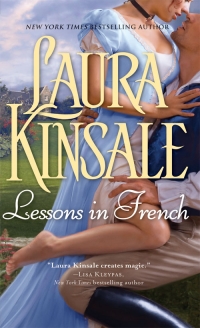
And let’s end on a positive note. I’m thrilled to be writing here, along with authors I respect and enjoy. And I was also thrilled when, earlier this year, Laura Kinsale released her first book in years. “Lessons in French” continues her wonderful books, and long may she continue to write. There are great writers of moving, breathtaking historical romance out there, and thank the gods of publishing for it.
This post was inspired by a discussion on a private yahoo list about accuracy. Authors Elizabeth Chadwick and Sharon Kay Penman added superb posts, and while SKP’s reply has to remain private, Chadwick gave permission to quote her post. So here’s a bit of it, because there’s no way I can improve on her words, nor would I want to.

“You do as much background research as you can, both the narrow and the broad into the person their lifestyle and the times in which they lived. If there's not a lot available about them, then you research the people who interacted with them - their lifestyles and the people who in turn interacted with them.
"You dig and then you dig some more. This way you build up the layers in the picture and get a feel for what's right and what's not. When I was researching A Place Beyond Courage, there were half a dozen differing and sometimes conflicting accounts of the Empress fleeing Winchester and what happened on the road, with various people appearing in different places. I had to make an executive decision based on reading all the accounts and piece together a plausible series of events. A great deal of this didn't go into the novel, but the accounts gave a solid platform to my thought processes.
"If you do the research in enough depth, your story will have the integrity that does history, you, and the reader justice. How you utilise your research in the novel is down to your personal skills as a writer. Both story and history need to come alive for the reader and shine. No one can be 100% accurate and as writers our imagination is perhaps the most essential tool in our kit, but integrity matters I think. If you are writing about someone who actually lived, then you keep as close to their personality as you can and portray their world as it actually was - or as close as you can get, and that includes attitudes as well as furniture. If your characters are imaginary then the same.”

I believe that history is there, not for our entertainment, but for us to be proud of. If we write a book set in a certain period, then it should respect its origins and try to be true to the time it's set in.
Thanks for listening.

Sunday, May 09, 2010

Starting points.

Yesterday I appeared with four other RNA writers at Chelmsford library. The panel were in the middle of answering a question from the audience, about where we find our inspiration, when the fire alarm went off.
It wasn't a drill, it was a genuine alarm and sixty or so people were efficiently directed into the street. We were obliged to move away from the building in case the glass exploded; at the pelican crossing, much to the surprise of the traffic,we all trooped across. Those of us without coats huddled under a bus shelter; it was raining and cold, and it wasn't until some 15 minutes later we were told we could return.
Chelmsford library is part of County Hall, and we were allowed into the huge vestibule which serves both places.
Immediately our eyes were drawn to an unfortunate bride, beautiful in a strapless white dress, clutching her bouquet; there were three identically dressed adult bridesmaids and three children -- the children were sitting on the steps and they all looked miserable and cold. There was no sign of the groom or best man amongst those waiting.
As Maureen Lee, Jean Fullerton, Fay Cunningham,Sheila Norton and myself shivered our way back to the upstairs room to resume our talk we discussed this fleeting image as a starting point for a story.
Fay, who writes crime, said the husband to be had been knocked down in a planned hit and run. Sheila suggested the bride had been about to marry the wrong man and the right man appeared in the foyer, Maureen thought the fire alarm had been set off by a disgruntled ex-girlfriend in order to ruin the big day. Jean and I, the historical novelists, imagined the shivering girl was part of a bridal party locked out of a church, jilted by her fiance who had absconded with her settlement.
If we actually wrote the story there would be five completely different versions although we'd all had the same stimulus.
I would like to thank those that organised the event for us at Chelmsford, they were friendly and helpful and the cakes were delicious. Back on the diet this morning!!
Fenella Miller

Friday, May 07, 2010

Historical Romance comes to Ham House!

The news this week that Harlequin Mills & Boon has teamed up with the National Trust to offer a historical romance set at Ham House is exciting for all those of us who enjoy historical romance, stately homes and the two together. The book, Scandalous Innocent by Juliet Landon, is a commemorative novel marking 400 years of Ham House but it is hoped that this will be just the first in a series of joint Mills & Boon and National Trust books. There’s a lot of potential!

Of course using a particular house as inspiration for the setting of a historical romance is something that many authors have done plenty of times before. Joanna Maitland, Elizabeth Rolls and I used an adapted version of Ashdown House as the setting for our anthology A Regency Invitation. I also used Ashdown to stand in as Delaval in The Penniless Bride. In the book the heroine thought it was quite an unusual building (ugly was the word she used!) The hero was most offended to hear his family home dismissed thus!

The difference with the current HMB/National Trust collaboration is that the house is specifically named and the story features as characters real people who lived there. On its website the National Trust suggests Dunham Massey, Montacute and Plas Newydd as other properties where love stories might provide the potential for a book. I'm sure we could come up with other suggestions of our own! Again I think Ashdown House would be perfect since it is said that the house was built expressly for “the love of a woman who never lived to see it,” Elizabeth of Bohemia, the Winter Queen, by her devoted cavalier William, First Earl of Craven. Or, if we want something from the Georgian period there is the Beautiful Lady Craven (as she styled herself!) with her rather racy love affairs. And a generation later we have the Regency Earl of Craven, soldier and rakehell, who married an actress. Plenty of material there – and how I would love to write those stories! I imagine that my colleagues on this blog must also be brimming with ideas of houses and characters that would suit these books.

So what do you think? Is the collaboration a good way of getting more National Trust members to read historical romance and of interesting historical romance readers in visiting National Trust properties? Is there a particular house anywhere in the world that you would like to see featured in a romance? Or a particular love story you would like to see told?

Thursday, May 06, 2010

The Bellerophon: Napoleon's Last Stage

Last Saturday I attended the regional chapter meeting of the Romantic Novelists’ Association in which I was fortunate enough to hear an informative talk by my fellow UK Historical blogger, Nicola Cornick. The topic was the legend of the hero, and one of the aspects she discussed was the way real-life heroes contribute to creating their own legend.

The talk reminded me of a scene in my novel, The Darcy Cousins,
in which Georgiana and her cousin Clarissa take a trip to Plymouth Sound to catch a glimpse of Napoleon on board The Bellerophon, where he was held after surrendering to Captain Maitland.

When they arrive in Plymouth, it’s almost impossible for them to procure a boat, since the sea around The Bellerophon is packed with other spectators eager to catch a glimpse of the defeated emperor. Georgiana and her party consider it a stroke of good fortune when they are finally able to make use of a fisherman’s boat, even though it reeks of fish.

Captain Maitland describes the crowd on one particular day, the 30th of July 1815, as “a crush” – with over one thousand boats surrounding the ship, and each boat containing at least eight people. At least eight thousand people surrounding the boat! But those weren’t the only spectators. The shore was crammed with people using opera glasses or telescopes to try and spot “Boney.”

Napoleon played to the crowd by establishing a time for his appearance: 6:30 in the evening. The crew played along by holding up boards containing periodic “updates” that described Napoleon’s actions. The whole affair was in fact a huge media event – whether it was a letter by Napoleon protesting his treatment that was “leaked” to the press, or Sir Charles Lock Eastlake’s painting of Napoleon on board the ship, which was immediately exhibited to enormous success. In an age when there was no photography and no television, the painting served to provide the public with that “eyewitness” account for those who were not there to see Napoleon themselves.

It was Napoleon’s last chance to play in front of an audience. A few days later, he was transferred to The Northumberland, and taken to St Helena where his only audience were a few hundred people and a desolate rock.

Monica Fairview

Monday, May 03, 2010

THE EARL'S RUNAWAY BRIDE


My latest Sarah Mallory is now available in paperback in North America! This is the cover for the paperback, which I like as much as the British hardback cover below. What do you think? Felicity and Nathan's story was "born" while I was on a tour of northern Spain, retracing the steps of the British Army's retreat to Corunna in January 1809. We stayed in comfortable Paradours with good food and all amenites, but the hardships suffered by the troops during that harsh winter 200 years ago were brutal. They were hotly pursued across the mountains by the French and had to travel fast with little food or rest. The confusion and panic in Corunna at that time must have been very great, and perfectly possible for a young couple to become separated. I have put more details of my trip to Corunna on my website at www.sarahmallory.com. Below you can read the first chapter of The Earl's Runaway Bride.


EXTRACT:
Felicity was angry, blazingly angry. All her terror and anxiety at being alone and penniless in a strange country was forgotten, superseded by rage that the portmanteau packed with her last remaining possessions had been snatched away from her. Without a second thought she gave chase, following the ragged Spaniard in his leather waistcoat away from the Plaza and into a maze of narrow alleys that crowded about the harbour at Corunna. She did not stop, even when a sudden gust of wind caught her bonnet and tore it off her head she ran on, determined to regain her property. Only when they neared the harbour and she found herself in an unfamiliar square bounded by warehouses did she realise the danger.
She saw her bag handed to a young boy who ran off with it while the thief turned to face her, an evil grin splitting his face. Felicity stopped. A quick glance over her shoulder revealed two more menacing figures blocking her escape. Felicity summoned up every ounce of authority to say haughtily, 'That is my bag. Give it back to me now and we shall say no more about this.'
The response was a rough hand on her back, pushing her forwards. She stumbled and fell to her knees. Quickly she scrambled up, twisting away as one of the men reached out to grab her. There was only the one man in front of her; if she could get past him – with a guttural laugh he caught her by her hair and yanked her back, throwing her into the arms of his two accomplices. Felicity fought wildly but it was impossible to shake off their iron grip. They held her fast as the little man with his yellow teeth and stinking breath came close, leering at her as he ripped open her pelisse.
She closed her eyes, trying to blot out their cruel laughter and ugly jests. Then she heard another voice; slow, deep and distinctly British.
'Move away from the lady, my good fellows.'
Felicity's eyes flew open. Beyond the thief stood a tall British officer, resplendent in his scarlet tunic. He looked completely at his ease, regarding the scene with a slightly detached air, but when her tormentor pulled a wicked-looking knife from his belt the officer grinned.
'I asked you politely,' he said, drawing his sword. 'But now I really must insist.'
With a roar the two men holding Felicity released her and rushed forward to join their comrade. She backed against the wall and watched the red-coated officer swiftly despatch her attackers. He moved with surprising speed and agility. A flick of his sword cut across the first man's wrist and the knife fell from his useless fingers. A second man screamed as that wicked blade slashed his arm and when the officer turned his attention to the third, the man took to his heels and fled, swiftly followed by his companions.
The officer wiped his blade and put it away. Sunlight sliced through a narrow gap between the houses and caught the soldier in a sudden shaft of light. His hair gleamed like polished mahogany in the sunshine and he was grinning down at her, amusement shining in his deep brown eyes as if the last few minutes had been some entertaining sport rather than a desperate fight. He was, she realised in a flash, the embodiment of the hero she had always dreamed of.
'Are you hurt, madam?'
His voice was deep and warm, wrapping around her like velvet. She shook her head.
'I – do not think so. Who are you?'
'Major Nathan Carraway, at your service.'


Sarah Mallory/Melinda Hammond

Thursday, April 29, 2010

The heroic three leaders

The UK Election comes into its final week before polling, and the third and final televised leaders' debate is on this evening. There have been comments that the TV debates have made the election even more about personalities than policies but on the other hand policies have been raised and discussed between the party leaders in front of millions of people: the electorate.

(Elections in Regency times were more straightforward: very few had the vote, and most voted as instructed by their local aristocracy.)

In the past week I've been conducting my own straw poll among female friends: which historical romantic heroes could the party leaders best portray?

Gordon Brown seems to be closest to those in the Byronic mould: dark, brooding, and even a little menancing. "He's definitely Heathcliffe," one friend said. "All that hidden passion we've not yet seen."

"Are you sure Mr Rochester isn't a better fit?" I argued.

"Maybe Cyrano de Bergerac, or even Max de Winter," another suggested.

Meanwhile David Cameron has more sharply divided opinion. "This is a difficult one," one friend said. "He can be both serious yet also fun-loving. Perhaps he would be a good Mr Bingley, or Henry Tilney."

"You mean lightweight?" another friend came in with. "He's a token hero to be accepted at face value. We don't really know what's behind it. Like Luke Skywalker."

"Luke Skywalker is not an historical romance hero," I pointed out. "Can we stay on topic?"

"He's my Mr Darcy for sure. Tall, handsome-" third friend came in with.

"No, Clegg is Darcy!" Friend number one. "He could give Colin Firth a run for his money."

It seems she's not the first person to liken Nick Clegg to Colin Firth as Darcy.

"I think Nick Clegg would be a good Dr Who..."

"Can we please stay on topic!"

--> Readers, what do you think the roles for Brown, Cameron and Clegg would be in historical romance?

Kate Allan

Wednesday, April 28, 2010

Regency Letters Five


05. April 1816
From Lady Horatia Melton to her husband

Dear Melton
I hope that this letter finds you in good health. I fear that I cannot yet tell you when I may return to London. My sister is still in low spirits and my mother has had a chill. I believe I must stay with them for at least another month.

You may have seen Robert while he was in London. He has just visited with us and was in good health and spirits. I am happy to tell you that he met a young lady he admired. Miss Susanne Smith is just sixteen and not really out but he was able to be of service to her when her hat blew off in a sudden gust of wind. It turns out he knows her older brother well and has been invited to spend his next leave with them. Of course Susanne is much too young to think of an engagement yet but Robert has some years yet to serve and I daresay in another three or four years – if they continue to like one another – we may have some interesting news.

I ask you to forgive any neglect on my part but I do not think you will miss me. You have so many friends and amusements that it cannot be of concern to you where I choose to reside.

Your wife Horatia.


05 April From Lady Horatia Melton to her brother Robert Jenson

My own dear one.

Words cannot express how happy I was to see you. Our walks together were a joy and I was gratified that you gave your approval of my friendship with a certain person. He is the most delightful man, do you not agree? His kindness, concern for Antoine, Mama and myself are I am sure perfectly honest and deeply felt. I know you feel I must be very careful not to arouse suspicion or gossip. I have tried to conceal my feelings even from my sister, but when the three of us were together there was no need and I am certain you saw my happiness.

I know you will understand when I tell you that I long to be free of a marriage, which has ceased to mean anything to me, but for your sake, Mama’s and my sister’s, I shall do nothing in haste. Mama would be terribly upset and shocked, and Bathurst might forbid my sister to see me. I should not like to be estranged from my family. However, my main concern would be for you, Robert. I know that it is your intention to take up politics once you leave the army and a scandal could only harm your chances.

Yet my heart tells me that I cannot face an empty future. My dearest friend tells me that we should live abroad. He believes my mother, sister and Bathurst would eventually forgive me and I might be allowed to visit when the scandal has blown over. I have asked him to be patient. If Melton would agree to an amicable separation there need be no scandal. I could just go abroad for the sake of my health and a divorce could follow in a year or two.

Take care of yourself, my dear one. Please write when you have the time and I shall do the same.

Your loving sister as always.

Monday, April 26, 2010

Anything But A Gentleman


I'm delighted to let you know that one of my out of print Regencies, Anything But A Gentleman, is now available as a download on Regency Reads. It was my second published novel and it holds a special place in my heart. It is set in Cornwall, a place I love, and Marianne is one of my favourite heroines. And of course Luke is one of my favourite heroes, despite the fact that he is anything but a gentleman!


When the book opens, Marianne is trying to look after the family estate as her brother has gone missing and her father has retreated into a world of his own. A new neighbour, Luke, Lord Ravensford, adds to her problems, and yet she can't seem to get him out of her mind. When she discovers that her brother has become embroiled in the revolutionary events in France, she sets out to rescue him, and there is only one man she can turn to for help - Luke.

Balls, house parties, adventure and romance all mingle together to make one of my favourite books. I hope you like it!

The top picture shows the download cover, and the bottom picture shows the out of print hardback cover.

Amanda Grange

Friday, April 23, 2010

Happy St George's Day


St George is England's patron saint and since a child I have always wanted to do something special to celebrate his day. Whilst not wishing to steal any limelight from anyone due to post today let's enjoy the glorious sunshine and celebrate our national saint.

On April 23rd 1973 my daughter was born. Then on April 23rd 1975 my son was born. This was not the longest labour in history for twins. It has made St George's Day very special for our family and it is always celebrated in style.

Also today marks the birth of our greatest penman William Shakespeare and the 23rd April is also the date he died. He was the creator of all the best plots and the inventor of the best known cliches now to be avoided. As writers this is another excuse to raise our glasses and dip into the chocolates for a toast.

How do you celebrate St George's Day?

Kate Tremayne

Thursday, April 22, 2010

Twitter

As you know, we've just joined Twitter and I'm starting to get the hang of it.
Sign in - easy.
Write a short comment - not so easy, but the letter counter helps.
Retweet - yes, I can do that.
Check what everyone else is saying - yes.
Joining in the conversations - no, don't think I've quite got the hang of that yet but I'm working on it.

Then on to more advanced things. Thanks to Krista Davis on the Cosy Chicks blog I'm sort of getting to grips with hashtags but I'm still not sure about a few things so if there are any Twitter experts out there, help would be appreciated. Here are the things I can't work out at the moment.

I've noticed that some people say, Thanks for the shout, and I seem to remember reading somewhere that it's polite to give shouts, but I've no idea what they are.

What are the lists about?

How do I use things like #FF ? I know it means Follow Friday but it doesn't really help me as I just get an image of Robinson Crusoe following Man Friday's footsteps across the beach, and even though I'm a twitter novice I'm pretty sure this isn't what it means :) If I put it in my tweet, does it mean I will follow someone on Fridays? Or will I always follow them? Or will they follow me? Or does it mean I should follow the link and follow someone else? Or . . . the trouble with a writer's imagination is that I can think of a hundred possibilities and it's very possible that none of them are right.

The same with #MM #TT etc - help!

And as I sit here looking out onto my untidy garden ( soon to be tidy, I hope) I'm trying to work out if Jane Austen was lucky or unlucky that Twitter wasn't around when she was writing, because the one thing I have discovered about Twitter is that it's addictive. So that's where I'm heading off to - just as soon as I've finished writing the blurb for my Christmas novella, which will be out as a part of A Darcy Christmas in November. Yes, I know it's only April, but everything happens months in advance in the publishing industry!

Amanda Grange

Glamour at Leighton House


I was fortunate enough to be invited to the re-opening of one of the most extraordinary houses in London: Leighton House. Frederic Leighton (1830-96), artist and President of the Royal Academy, was the only person ever to live there and it was built to his personal specifications. It’s function was essentially public; a place to host his famous parties and entertain guests or prospective clients, together with a magnificent studio complete with a separate entrance for his models. By contrast, Leighton’s bedroom is austere and plain, with a single wrought iron bed, bare wooden floor with a bear skin by the bed, and small bathroom next door.

I saw it immediately prior to its closure: shabby, with intrusive modern wiring and pipes, it reminded me of an unloved Victorian aunt – a presence, undoubtedly, but dowdy.

Now, after a 1.6 million pounds restoration, Leighton House is utterly transformed. You step into an exotic middle-eastern harem which has somehow merged with a Victorian artist’s studio. The famous Arab hall has beautiful medieval blue and white tiles, brought back by various friends – including the explorer Sir Richard Burton (with whom, I suspect, most of us would fancy a night). It has a black marble pool in the centre. Leighton’s guests regularly fell into it whilst admiring the tiles.

The newly gold-leafed ceiling glows. The gold mosaic frieze with peacock decoration, designed by Walter Crane, somehow fits perfectly with the Arab tiles, and that, too, glimmers. Even the old shabby stuffed peacock at the turn of the stairs has had a make-over and its jewel-like plumage shines. (How do you dry-clean a peacock?)

The drawing-room wallpaper (pink and gold) has been restored and the floorboards round the central carpet are painted turquoise. The magnificent pink, turquoise and white glass chandelier sparkles. My favourite piece here is the marble fireplace which is directly under the window, which has mirror shutters. Leighton knew just how to give his house that touch of the unexpected.
You would think that Leighton House would need a bevy of servants to run it, together with a vast kitchen. In fact, Leighton lived very simply, with just a man-servant. There is no proper kitchen. Usually, Leighton dined at his club and had caterers in for parties.

It’s all far too classy to be bling but it is still, nevertheless, jaw-dropping. And now is the time to see it whilst it is still pristine and dust and cobwebs have not dulled the splendid colours. It is also immensely cheering and inspiring.

http://www.leightonhouse.co.uk/ Pictures courtesy of Leighton House Museum, Royal Borough of Kensington and Chelsea.

Elizabeth Hawksley

Monday, April 19, 2010

Cover Story

I'm in the unusual position of having three different covers for the same story out simultaneously and they are so very different I'm interested to see what the reaction is to them.


The story - Disrobed and Dishonored - was originally for the Mills & Boon Undone! e-book series of short, highly sensual novellas and the cover for that is the one on the left with the garter. Very pretty, mildly risque.

The tale is one of a highwayman who is not all he seems and a young lady of undoubted virtue who has an urgent need to become rather less virtuous. The Ravenhurst clan add to the general complications in the way of true happiness for this unlikely couple - but they have a naughtily good time on the way to their Happy Ever After.

The Undone! series has been proving popular, but I know readers have been asking for them in print format as well, so I was thrilled when found out that my story was to be included in the first North American print anthology - Pleasurably Undone! - which is the rich purple/crimson cover below with the elegantly half draped nude shown below. Sensual, sexy and elegant, I thought.


I was even more excited when Disrobed was included in the first UK anthology - a different selection, all Regency stories, and including one by fellow blogger Nicola Cornick.

Harlequin Mills & Boon usually have very different covers for the UK and North American markets, so it was intriguing to see what they would come up for with this jacket and I was very pleased with the result on the right because I think it is sassy, sexy and - selfishly! - it happens to suit my story very well.

What's your opinion? Do you buy a book by its cover - and which of these three most appeals to you?

Louise Allen


Saturday, April 17, 2010

Living history


The Great Office.

For a historical novelist one of the great pleasures of living in Cornwall is that in many of the towns there are areas that have remained unchanged for centuries. Helston – a town featured in several of my recent books, and the one I’m currently writing - is an excellent example. Helston was one of the first towns in Cornwall to achieve borough status when King John granted it the first Royal Charter over 800 years ago. This charter cost the people of Helston 40 marks of silver, a great deal of money. But it also granted them freedom from national taxes, the right to control local trade, and to demand tolls.

The Great Office at No 5 Cross Street, (which features in Taken to Heart, my current work-in-progress) was built in the early 1700s in what was then Helston’s grandest road where the town’s professional gentlemen, the lawyers, bankers and businessmen, built houses that reflected their wealth and status.

For over 200 years The Great Office has been the address for numerous firms of solicitors. The town’s first bankers - pursers (treasurers) looking after the accounts of local mines - also had offices in this imposing building. And though over the years the property has been extended, the façade remains unchanged, as does its name.

Next time I'll tell you the scandalous history of one of Helston's ancient inns.

I now have a new page on my website where I shall be posting interesting bits of research, plus news, views and photos. So do drop by. wwww.janejackson.net

Jane Jackson.