Showing posts with label Nicola Cornick. Show all posts

Saturday, January 07, 2017

Another Mystery Portrait!

My new timeslip, The Phantom Tree, was published last week and it’s so exciting to see it in the shops! This time I’m travelling between the present and the Tudor era, visiting Wolf Hall in mysterious Savernake Forest, and Littlecote Hall near Hungerford (thinly disguised as Middlecote in the book!) I blogged about the Wiltshire background to the book last month but this time I wanted to share with you the picture that started it all...

I was visiting family and saw this gorgeous picture on the wall of a woman in Tudor dress. I found it totally beguiling. She has a hint of a smile on her face as though she knows a secret, and there is a pearl missing from her hood… On the back of the picture it says it is a portrait of Anne Boleyn, one I’d never seen before. It also had another inscription in Latin. I found this totally intriguing and would love to know the history and provenance of the picture. The art dealer who sold it apparently suggested that it was a 19th century copy of a Tudor portrait. I need to find an art historian who can help discover the true story behind the picture!

However, Anne Boleyn or not, my writer’s imagination got going and I started to speculate on how
interesting it would be if it were not actually Anne but some other, lesser-known Tudor woman. I’d always been interested in Mary Seymour, Katherine Parr’s daughter, and thought it odd that no one knew what had happened to her. Such a high-born child simply to disappear…  I thought how fascinating it would be if the portrait were in fact a clue to Mary’s fate and so the idea for The Phantom Tree was born.


I love the way that so many different things can spark a story idea and then the idea grows and develops in unexpected directions. I’ve always loved timeslip stories and dual time books where a historical mystery is solved in the present but although the mystery of Mary’s disappearance is solved (fictionally) in The Phantom Tree I’m wondering if I can solve the case of the mystery portrait!

Wednesday, December 07, 2016

The Phantom Tree's Wiltshire Roots

It started with a picture, a small portrait of a lady in Tudor dress that I saw on the wall of my uncle’s house in Wiltshire. It fascinated me She looked demure but with a little smile, as though she was hiding a secret. There was one pearl missing from her headdress. The portrait was inscribed with the name of Anne Boleyn but it wasn’t a copy of any picture of Anne that I had ever seen. I started to speculate, as writers do. What if the inscription was false and this was quite a different lady, the same era, and with royal connections, but someone whose story was yet to be told.

That was the first inspiration for The Phantom Tree, my new timeslip book that
is out at the end of the month. Tudor history had been my first love as a child and it was exciting to return to it. I write about women from history who have fascinating, but less well known stories and one of the people I had been interested in for a long time was Mary Seymour. Mary was the daughter of Katherine Parr, the sixth wife of Henry VIII and her second husband, Thomas Seymour, of the Seymours of Wolf Hall in Savernake Forest. Mary was born at Sudeley Castle in 1548 but it isn’t long before she disappears from the historical record. I wanted to research her story and imagine the life she might have had.

I live on the border of Wiltshire and first visited Savernake over twenty years ago. I’ve have seen it in all the seasons, when the trees are ghostly winter skeletons and the frost is thick on the bracken, through the new life of spring, the drowsy heat of summer when the Purple Emperor butterfly darts through the leaf canopy, and into the vivid colour of autumn. I love the atmosphere of the forest and the sense of peace. There aren’t many places left in the British Isles where you can lose yourself for hours amongst green lanes and oaks that have stood for a thousand years.

Researching the local roots of the Seymour family was a fascinating process. I love looking at the story behind the story and here was a family that rose from being country gentry to be one of the most prominent dynasties in the land. What better way to get a feel for their journey than to walk in their footsteps in Marlborough and Savernake and the villages around?

I made several trips to Marlborough and to Savernake during the year that I was writing The Phantom Tree. The first was in the summer and we took the dogs and a flask of tea and homemade chocolate brownies. Several years before we had started to visit and map all of the ancient named oaks. This was difficult in the summer because many lie in the heart of the forest off the beaten track. The paths become overgrown with brambles and bracken, strands of wild rose and honeysuckle, and tiny, sweet raspberries and strawberries growing wild in the clearings. They were a delicious supplement to our afternoon tea. We followed tracks whose names recall a lost age and a mysterious past: The Charcoal-Burner’s Road, Long Harry, Postwives Walk. We found the Big Belly Oak beside the modern A346 Marlborough to Salisbury road. It is the oldest tree in the forest, a sapling at the time of the Norman Conquest. It is not known when the convention of giving the oldest oaks names was introduced although the King Oak is recorded in a document of 1634. It is matched with The Queen Oak, in honour of Henry VIII and Jane Seymour, his third wife, the aunt of my heroine Mary.

In the depths of the forest, standing near the ancient park pale that once marked the boundary of the medieval hunting ground, we found the Green Fluted Oak, so named because the vertical grooves in its trunk look like a Grecian column. I was on the hunt for one particular tree, The Duke’s Vaunt. This is another thousand year old oak deriving its name from Edward Seymour, Duke of Somerset and Lord Protector of England, the elder brother of Jane Seymour. In its prime it was a huge tree but today it is in decline, having split, and is only a shadow of its former glory.

The dogs love visiting the forest in autumn and winter, as do I. The scents are different, the paths
coated in frosty leaves and the ponds frozen over. You catch a glimpse of the deer disappearing through the bare trees like wraiths, or hear their sharp bark on the cold air. The Savernake of today looks different from the forest of Tudor times. In the 1740s Capability Brown landscaped large parts of the woodland, creating ornamental lawns and planting vistas of trees, designing the grand avenues and rides. Yet beneath the landscaping and the hum of traffic you can still sense the longevity of the forest and the myths and legends stretching back into time.

Once upon a time, Wolf Hall, the medieval manor of the Seymours, was in Savernake Forest but today the woodland covers a smaller area than it did in the sixteenth century and to seek out Wolf Hall I had to take the road to Burbage. On the corner of a minor road is Wolf Hall Farm, built near the site of the earlier timber-framed manor house. Jane’s father, Sir John Seymour, had served with Henry VIII in France and the family were ambitious for advancement at the Tudor court. In 1535 Henry VIII stayed at Wolf Hall as part of a royal progress and it is said he courted Jane Seymour there.  Rumours that Henry and Jane were married at Wolf Hall are false but it is certainly the case that he returned there in 1539, when there was a lavish feast in one of the old barns at the manor.
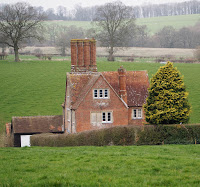
By the time my story, The Phantom Tree is set, some twenty years after King Henry hunted in Savernake Forest, Wolf Hall had become an old, draughty, inconvenient manor that was no longer considered grand enough for the status of the Seymour family. In the book, I write about it as a house in a state of ramshackle neglect, ignored by the Duke of Somerset’s son, who had plans for a magnificent house nearby at Tottenham Park. Stone from Wolf Hall was taken to build the new house; eventually Wolf Hall became derelict and fell down. There is a trace of overgrown earthworks still visible that mark the spot of the original manor and I found another remnant of the original Wolf Hall when I visited the church of St Mary at Great Bedwyn. It is a stained glass window that features a crown, Jane Seymour’s heraldic device of a phoenix rising from a castle between two red and white roses, the Prince of Wales feathers, and a Tudor rose, and it is said to have been taken from the medieval manor. This is also the place where Jane's father Sir John Seymour is buried.

The Phantom Tree, like Savernake Forest itself, has its roots set deep in the history and landscape of
Wiltshire, drawing on this fascinating part of the county for its inspiration. Wolf Hall may be long gone leaving only a name and a legend, but Savernake Forest is a place whose ancient oaks and woodland paths lead us in the footsteps of the past.


Thursday, April 07, 2016

The Girl in the Title

It started with The Girl With the Dragon Tattoo, I think. Then there was Gone, Girl, the Girl on the Train and many, many other girls in various situations, places and circumstances, mostly with a hint of danger about them. Yes, the prevalence of the word “girl” in book titles has been apparent to us all and shows no sign of waning. And it’s not just girls. At the RNA Conference last summer Matt Bates, buyer for WH Smith Travel commented that over 60% of their best selling titles that year had a female noun in them whether it was girl, wife, mother, sister or something similar.

Choosing a title for a book is a difficult business so it’s always interesting to analyse what makes a particular theme popular. I hadn’t thought that “girl titles” were particularly applicable to historical fiction until I looked at the book charts and then I realised I was quite wrong. The Girl with No Name by Diney Costelloe is at the top of Amazon’s historical fiction charts. It has a nice, mysterious ring to it. There are others - and I've used a couple of covers to illustrate.

When will the popularity of girl titles end and what will be next? I wish I knew so I could get in first and start a trend rather than follow one.  In the meantime I'm
setting a challenge. Can we get the "girl craze" to work for Regency romance? I don’t really think the Girl and the Duke has the right nuance and if I re-titled my latest book The Girl in the House of Shadows it sounds like too much of a mouthful. Yet I feel sure we could make the “girl” trend work. So I am offering a copy of House of Shadows (without the girl) to any commenter who comes up with a good historical title featuring the word “girl” or even better re-writes a classic title in that way. When I threw down the gauntlet to my husband on this he came up with “The Girl on the Moor” which I thought was inspired. Over to you!

Saturday, November 07, 2015

Lady Elizabeth Berkeley and private theatricals

Minor characters are always fun to write and in my new book, House of Shadows, I have an “offstage” character, Lady Evershot, who is modelled on a famous Georgian aristocrat, Elizabeth Berkeley. Lady Elizabeth, the daughter of the Earl of Berkeley, married the 6th Baron Craven and they lived at Ashdown House for a couple of years, their two eldest children being born there. Alas the Craven marriage was not a happy one; from the earliest times Lady Elizabeth was complaining that her husband was uncultured and uncouth whereas she was more creative, an artist and a writer. After not many years they drifted apart and she had an affair with the French ambassador whilst he set up a mistress who styled herself Lady Craven, much to the real Lady Craven’s fury. Eventually she left her errant husband and travelled abroad.
The author Sybil Rosenfeld, in her book Temples of Thespis, describes Lady Craven’s subsequent life:
“She travelled about Europe for some years until she finally settled at the court of the Margrave of Anspach in 1787 as his “adopted sister”. In 1791 only a month after she heard of the death of her husband she married the Margrave in Lisbon and persuaded him to give up the ruling of his principality and retire with her and his fortune to England. Her precipitancy was considered indecent and, on her return, she found herself cold-shouldered by the court and high society. The Margrave, a stolid German who seems only to have wished for a peaceful life, purchased Brandenburgh House a country villa on the bank of the Thames at Hammersmith and spent the rest of his days there. His wife built a theatre in the grounds where she could entertain him and at the same time indulge in her favourite past time of taking the centre stage….
Despite the fact that the Margrave was related to King George III his wife was not received at court
as she was considered too scandalous. Nothing daunted, she spent her time at the races and organising private theatricals, which were often performances of plays she had written herself.
The theatre at Brandenburg House (interior pictured right) was built as a faux castle in the manner of Walpole’s Strawberry Hill and the productions were lavish and extravagant with the Margravine frequently centre stage. As a larger than life figure of the era, she was lampooned by the caricaturists of the time and described my Walpole as entertaining but “infinitely indiscreet.”
Perhaps private theatricals suited the former Lady Craven’s need to be the focus of attention and gave her the opportunity to assume a number of different roles and act out her fantasies. In that she was not alone since it was a popular entertainment in upper class Georgian society. Nevertheless she snubbed her eldest son’s wife who was a “real” actress, Louisa Brunton. The two were said to cordially detest one another. Perhaps it was envy on the Margravine’s part rather than snobbery!

Wednesday, July 22, 2015

Writing Tips #5 - Nicola Cornick's Trade Secrets for Writing Regency Romance

Recently I came across an article I wrote a few years ago on my trade secrets for authors of Regency historical romance. I jotted down the ideas one day when I was critiquing a manuscript and thought it would be useful to have a list of the elements I considered important in a Regency romance. I have updated and added to it for this piece. Obviously the list isn’t totally comprehensive and it is only my opinion but I hope it gives aspiring authors some useful ideas! 
  
Start with a strong hook/story idea – think about the possibility of giving a historical twist to a contemporary situation such as speed dating. This need not be as anachronistic as it sounds. Think about a Regency ball and the amount of time that the partners can actually spend together, exchanging information and getting to know one another. It is time pressured. There are a great many contemporary situations that have strong parallels with historical ones.

If you are keen to use a “standard” Regency idea, such as the hero winning the heroine in a card
game (which Georgette Heyer used in a short story in Pistols for Two), try giving it a new twist. For example the heroine could win the hero instead.

Start the book straight into the action. On her website, award winning romance author Liz Fielding has the following advice: “A great opening to a romance sets up questions in the readers mind… Start with something happening. Get the hero and heroine on the page. Grab the reader’s attention.”

Create strong characters. You need to create a hero your readers will fall in love with and a heroine your readers will identify with. This is a whole area in itself!

Make sure that your plot is sustained throughout the story.  It is important to have a strong plot in a longer-length historical. You need to be working with an idea that can change and develop. You also need a big, convincing conflict to keep the characters apart and not something that could be resolved during one heart-to-heart conversation.

Show the way that a strong relationship develops between your characters. They need to communicate with each other during the story so that their relationship can grow. One of the mistakes that a lot of new authors can make is that they don’t allow their characters really to talk and interact at depth and this can give the impression of a relationship that is stalled for a great deal of the book, only to be resolved rather easily with the HEA ending.

It’s also important to show the characters’ motivation for their actions very clearly. And these motivations must be consistent. Even when a character is behaving “out of character” it has to be believable.  Sometimes it helps to think about motivation in the context of the “GMC” – Goal, Motivation, Conflict. What is that your characters want? What is the logical and consistent reason that your character wants this goal? What is the huge obstacle that is standing in their way?

Hooks at the end of each scene and each chapter are essential. Finish each scene on an “up” or “down” note, focussing on the hero or heroine. (Soap operas in particular use this method to keep the viewer engaged).

Background and setting can be a very powerful tool in creating the atmosphere of a historical novel. You do need to do your research but you don’t want to dump it all on the reader in the first few pages! The language of the dialogue is also subtly different from modern conversation. Love is eternal and the emotions that people feel may be universal, but the society and culture within which the relationships take place change over time. So does the way that people express their feelings. The manners and mores of a particular period have a profound effect on the key players in a story.  The Regency period is a good example of this as the rules by which society operated were codified so clearly. You can take the rules of your particular historical period and use them to your advantage. You don’t need to see them as restrictions. They are opportunities. And even if your heroines are the sort of spirited women who will break society’s rules, setting them within the confines of society and showing them kick over the traces will demonstrate the sort of strong characters that they are.

So in summary the book must have:

An atmospheric setting
 Emotional intensity
 Communication between the protagonists
 Sensual tension
 Humour (preferably)
 Witty dialogue
 A whopping big emotional wallop at the end!

Friday, March 07, 2014

Vanished Mansions

I love stately homes, visiting them, taking in all the art and artefacts, the details of who has lived there down the ages. I love ruins too. They can be poignant and romantic and you can let your imagination run wild about the history and the people who inhabited them. But there’s a third category of historic house that I enjoy; the ones that have disappeared. They are like ghosts, mysterious, lost. Two of the houses that inspired my current manuscript are “lost” houses.

The first, Hamstead Marshall in Berkshire, pictured above, was known as Hamstead Marshall Palace, a house of the size and grandeur to rival Blenheim. Hamstead was intended for a queen, Elizabeth of Bohemia, the sister of King Charles I, and it was reputedly modelled on the castle in Heidelberg where she had spent the early years of her married life. It was grand and fabulously luxurious. A contemporary described it as having not only bathrooms but rooms with the specific purpose of “reposing after bathing.” The servants’ quarters included a distillery, a spicery, and a confectionery.

Hamstead Marshall burned down in 1718 when workmen were making renovations and accidentally left a
brazier unattended on the roof. All that is left of the house now are some magnificent gateposts that stand in the parkland, marking out where the drive and gardens once were. The site of the former house and its wonderful parterre is now a field and plenty of floor tiles and window glass from the building can be found just lying around on the ground. On the day I visited it felt like a lonely and windswept place.


The other house I’ve drawn on for background research suffered the same fate, but much more recently. Coleshill House in Oxfordshire was built around the same time as Hamstead Marshall and inspired by fashionable European houses of the period. It
had a grand entrance hall and beautiful ornate plasterwork ceilings. Builders were finishing renovations to the house in 1952 when a fire broke out and despite the efforts of fire brigades from three counties, the house was so badly damaged that it had to be demolished. I draw on the newspaper reports of the fire in my new book as they vividly recreate the sheer monumental destruction of such a beautiful house. Today there is a garden planted on the site of the house that marks out its walls and windows in a design that keeps the memory of Coleshill alive. I hope that in my manuscript I too will be able to bring Hamstead Marshall and Coleshill House back to life and people their ballrooms and corridors once again with characters from a lost age.

Wednesday, August 07, 2013

The Lady and the Laird - Scotland in the Regency Era

The first book in my new series, Scottish Brides, has just been published and I've found researching Regency Scotland so interesting. I thought I would share a few of my favourite pieces of research.

Scotland in the Regency period is a fascinating era in which to set a historical romance. Long gone are the days of medieval warfare against the English. By the early 19th century even the Jacobite uprisings, culminating in the Battle of Culloden of 1745, were sliding into the mists of time.

In the mid 18th century the Highland soldier had been feared and mistrusted, seen as a bloodthirsty rebel who should not be allowed to carry arms. Within 60 years this view had completely changed. During the Napoleonic Wars the Highland regiments of the British Army undertook some of the most courageous and fierce fighting of the campaigns, drawing on that legendary Scottish bravery, loyalty and unquenchable valour that had driven them forward through their tempestuous history. By 1815 there were 48 000 Highlanders in the British Army and 20 Highland regiments. They were the pride of the army.

The old bonds that had tied the Highland chieftains to their clans were under pressure long before the’45. From as early as the 17th century many of the estates were falling into debt. A search for profit started to take precedence over traditional responsibilities. When government improvement schemes and a growing demand for Highland produce led to a booming economy, some chiefs were determined to keep all the profits for themselves and increased their rents, in some cases by 500%. As a result many families left the Highlands to seek out a better life elsewhere.

In the first book of my new Scottish Brides series, the Lady and the Laird, the hero Robert Methven is determined to reverse this process of neglect, exploitation and emigration. Although the links of clan and chief might have been weakened by economic hardship, the loyal ties that bound family and kin could still be strong. Robert is a new breed of highland laird, a self-made man. Like many of his countrymen, Robert left Scotland to travel and trade in Canada, carving out a career as an explorer and making a fortune in the timber industry. Life for the Scots adventurers in Canada was incredibly dangerous but explorers such as Alexander Mackenzie and Simon Fraser became both rich and famous for their daring exploits. It was men such as these, whose portraits I saw in the Scottish Portrait Gallery in Edinburgh, who inspired my hero.

The ties of responsibility and kinship call Robert home when he inherits his ancestral estates. On Golden Isle,
the land he holds in the far North of Scotland, he finds a community at war. I drew heavily on the history of the Shetland Islands for the book. French privateers were frequently seen in the waters to the west of the Shetlands and warning beacons would be lit in a chain across the islands when an enemy ship was sighted. Sometimes the pirates would raid the estates or threaten the lairds with the destruction of their lands if they did not give them supplies. In addition the British Navy was not above taking any man it could lay hands on into service via the violent press gangs. Sometimes the press gangs took boys as young as 14 into the Navy and left their families defenceless and destitute. It took a strong laird to keep his people together and protect them against the combined threat of enemies from overseas and the clearing of the land at home.

The lairds of the Northern and Western Isles had as much Viking blood as Highland blood, which is a pretty stirring combination. It embodies all the rugged individualism and determination that we look for in our heroes of Scottish romance. And although this is a time when claymores had gone out of fashion, your laird (and indeed his lady) would still be accessorised with a very handsome basket-hilted sword. Sword blades were often imported from Spain and Germany. Scottish sword smiths then added the hilts. The dirk was another essential for the well-armed highlander.

Speaking of accessories, highland dress, tartan, the plaid or kilt, had been one of the things that separated the Highlander from the “civilised” Lowlander. It was outlawed after Culloden and was not made legal again until 1782. Fortunately, by the end of the 18th century the Highlands were starting to be seen as wild and romantic rather than merely dangerous. In 1815 the Highland Society of London decided to collect tartans and identify them with the particular clans and tartan became an extremely fashionable fabric.

The visit of King George IV to Edinburgh in 1822 did much to increase Scotland’s popularity. It was the first visit by a reigning British monarch since 1650 and was orchestrated by Sir Walter Scott. Scott was determined that it would be a celebration of all things Scottish. He invited the clan chiefs to Edinburgh and specified that they should have an escort of Highlanders. The spectacle delighted the King and so the clan system with its tartan overtones was regenerated, at least in the popular imagination.

Finally a word about marriage… If you lived in Scotland, there was no need to run away to Gretna Green to wed, of course. Two major differences in the law between Scotland and England were that in Scotland the age of consent for marriage without the approval of a parent or guardian was 16 not 21 and there was no requirement for the reading of banns. It was thus a lot quicker and easier to marry in Scotland, which Robert and Lucy take full advantage of in the wedding of the Lady and the Laird. The US edition is on sale now and the UK one is out next month!

Sunday, April 07, 2013

Forbidden


I am very excited that Forbidden, the sixth and final book in my Scandalous Women of the Ton series, is now available in the UK from MIRA. Forbidden is a rags-to-riches Cinderella story of Margery Mallon, a maid turned heiress. In a twist on the Cinderella theme, Margery disinherits her very own Prince Charming when she comes into her inheritance because the man she loves is the one who would have gained everything – title, money and estates, if only she had not been found.

One of the things I liked about writing Forbidden is that Margery will inherit her title in her own right. Whilst it is unusual in the English peerage for women to inherit, there are plenty of precedents and I liked that Margery was a girl who could inherit a title!

Here is the blurb for the book:

After 20 years the Earl of Templemore has found his lost heir and the Ton is in uproar!

Margery Mallon is a lady’s maid with ambitions to be a confectioner. The one thing she does not want is to be Lady Marguerite of Templemore, the richest heiress in England.

Henry, Lord Wardeaux is the man who would have inherited Templemore if Margery had not been found. Now it is his duty to teach her all she needs to know about the estate.

Henry has too much pride and too much of a dark past to marry Margery simply to regain the inheritance he thought was his but although she is forbidden to him it seems she may be the one woman he cannot resist.

I think the cover for Forbidden is gorgeous and the way in which it was designed is going to be featured on the Channel 4 TV programme Interns later this month as part of a programme filmed at Harlequin Mills & Boon.

There’s more information about the book, background research and contests on my website www.nicolacornick.co.uk

Friday, September 07, 2012

Desired - Radical Politics and Political Satire!


Today I am celebrating the UK publication of Desired, the fifth in my Scandalous Women of the Ton series. Here it is with its beautiful UK cover!

I loved writing Desired for many reasons but one of the most important was that I adored the character of the heroine, Tess Darent. Tess has a big secret – she is a female cartoonist drawing caricatures of the government in support of the radical party. She wants political reform and she uses her pen to try to achieve it, working under the pseudonym of Jupiter.

Political satire was rife in Georgian and Regency England. William Hogarth’s drawings had a moral tone to them. Artist and cartoonist Thomas Rowlandson’s work was witty but he was also making strong and influential comment on the politics of the time. He would highlight the flaws of political leaders and he could influence the popularity and reputations of those in power through offering clever criticisms of social and political trends. George Cruickshank, another cartoonist of the period achieved notoriety with political prints satirising the royal family and those in power - until he was paid off with a bribe of £100 in 1820!

As far as I know there were no female satirists of the period but there is no real reason why there should not have been. Drawing and painting was seen as an accomplishment for ladies of the gentry and the upper classes in the period who had plenty of leisure time. Itinerant drawing masters would travel the country, teaching the daughters of the wealthy how to draw. It is against this background that Tess has developed her skill in cartoons and caricatures.
  
Radical politics in the 18th and early 19th century did much to keep the revolutionary traditions of the medieval Peasants Revolt alive. The Radicals called for the redistribution of land and wealth amongst the population and during the years that followed the French Revolution the British Government cracked down on them hard because of fears that they would inflame the population to overthrow the established order.

I feature the Spa Fields riots of 1816 as a backdrop to Desired. The popular and law-abiding Radical Henry “Orator” Hunt had been asked to address two meetings of “Distressed Manufacturers, Mariners, Artisans and others” and he took a petition to the Prince Regent asking for reform. When the Regent failed to respond in any way (no surprise there!) several radical leaders encouraged the crowds to riot. About two hundred men, inflamed by patriotic rhetoric and also by alcohol, marched through the city towards the Tower of London, arming themselves from gun shops on the way. By the time they reached the Tower their numbers had dwindled, they failed to persuade the guards to open the gates and were dispersed by a detachment of cavalry. The rising, such as it was, was a complete failure but at a time when war made the ruling classes more paranoid about rebellion and revolution it only served to set back the cause of peaceful reform.

I found the research for Desired fascinating and enjoyed weaving it together with what I hope is a very sweet and romantic love story!

Wednesday, December 07, 2011

Georgian and Regency Greenwich


This month I have a new book out in the US, Desired, book 5 in my Scandalous Women of the Ton series. Desired will be out in the UK next year. One of the geographical locations I used for the book was Greenwich. I love modern day Greenwich with its park, riverfront and Maritime Museum and as a place with a long and fascinating history it proved to be a very interesting setting for a book.

Here are a few of the things I learned about Greenwich in the course of my research:

At the beginning of the 18th century Greenwich was an impoverished fishing village on the Thames with no more than a collection of timber cottages on some dirty lanes and some very dodgy inns such as Fubb’s Yacht, a notorious “beer house” for the sailors. By the end of the century, however, planners were imposing order and geometry on the growing town, designing houses in the style of Bath or Cheltenham but on a miniature scale. Gloucester Circus was the epitome of this, two crescents of houses enclosing a central circle. Only one of these crescents was built and the twenty-one houses, completed in 1809, are still standing.


Greenwich was the place where the body of Lord Nelson was brought ashore after his death at the Battle of Trafalgar. It was Christmas Eve 1805 and crowds had gathered but the weather was so poor that by the time the ship carrying Nelson finally arrived in Greenwich at 8pm, everyone had gone home assuming that he would not arrive that day. The sailors carrying Nelson’s coffin had to leave it at the top of the riverfront steps whilst they went off to find someone to let them in to the Seaman’s Hospital.

Princess Caroline, wife of the Prince Regent, rented Montague House in nearby Blackheath from 1798 and was a fixture on the Greenwich party scene. One guest commented of her: “The Princess is grown very coarse and she dresses very ill, shewing too much of her naked person.”


The Blackheath caverns were a considerable tourist attraction during the Regency period. They consisted of four underground caves cut from the chalk. They appealed to the romantically inclined as dating from an age long past and there were wild theories about their origins and purpose. Visitors complained of the cold and the spooky atmosphere and suggested that they had been created in Anglo Saxon times as a hiding place from the Vikings. In fact they originated as a 16th century quarry but this explanation was not suitably gothic to satisfy people. During the 19th century candles were installed in the caves and masked balls held there. These were considered extremely indecorous.


I drew much of my research from “The Story of Greenwich” by Clive Aslet and “Greenwich” by Charles Jennings which are both great reads as well as being packed full of useful facts.

Thursday, July 07, 2011

Life in the Country Town

One Wicked Sin, book 2 in my Scandalous Women of the Ton Series, is out in the UK this month and I am very excited about it! I have been doing a series of radio and newspaper interviews to promote the series and one of the things that has fascinated readers is the idea that One Wicked Sin is set in Wantage when it was a parole town.


The idea of a small county town having to accommodate an influx of foreign prisoners fascinates me. At the end of the eighteenth century Wantage had the reputation of being very rough; as well as the prisoners of war, it's permanent population was swollen by the navvies working on the nearby Wiltshire and Berkshire Canal. There were reports of fights in the local inns between the townsfolk and the "incomers," and visitors to the area were warned not to visit Wantage as it was the sort of place where you might be robbed, beaten or worse.


I've always enjoyed reading reports from local newspapers of the era and from these one can gather all sorts of information on local life which often was a great deal stranger than fiction. I've included a few examples here just to give a taste of news from the English country towns.


From the Bury and Norwich Post, January 1801: "The following extraordinary incident took place at St Ives on Monday. A bullock walked into the passage of the Royal Oak public-house in the town and the staircase door being open, it went upstairs into the dining-room and ran with such violence against the front window (which was a sash) as to drive the whole window-frame into the street... It received no material injury."


From The County Chronicle, August 1801: "The young gentlemen of Eton, on leaving school for the Midsummer vacation, took their annual aquatic excursion to Surley-Hall... The young gentlement exhibited great skill in rowing, and were all attired in fancy dresses. In the evening some beautiful fireworks were let off and the day concluded with festive mirth and innocent entertainment."


From The Suffolk Chronicle 1815: "It is with the deepest regret we learn that a riotous disposition has shewn itself in the parish of Gosbeck... On Tuesday last, twenty deluded persons assembled and in a wanton and most disorderly manner they destroyed two threshing machines and threatened to destroy others."


From the Norfolk Chronicle, March 1806: "Tuesday morning last, we understand, an affair of honour was conducted between Captain RN and GT of the militia in garrison. A brace of pistols was discharged without effect. Upon the seconds interfering, the affair was honourably terminated. The cause of the misunderstanding we are not acquainted with."

Tuesday, June 07, 2011

Whisper of Scandal

This month sees the UK publication of Whisper of Scandal, the first in my Scandalous Women of the Ton series. This will be followed by One Wicked Sin next month and Mistress by Midnight in August. I am thrilled that the Scandalous Women are coming to the UK and I love the gorgeous covers that the books have! I hope you like them too.


Whisper of Scandal is set in London and the Arctic and was huge fun to write and research. I'll be talking about the book and my research at two forthcoming book festivals: The Burford Festival on 17th June and the Witney Book Festival on 19th June. At Witney I'll also be discussing "How to write the Regency Historical." All the details are on my website and if you are in the area I would be delighted if you would like to come along to say hello and join in the debate.

Thursday, April 07, 2011

Prisoners of the Parole Towns


I am very pleased and excited to report that my book One Wicked Sin is a finalist not only for the Romance Writers of America RITA Award for Best Historical Romance but also for the Colorado Award of Excellence as well!


The research I did for this book was fascinating, drawing on the experience of Napoleonic prisoners of war in Britain. A little while ago Louise blogged about the prisoner of war camp built at Norman Cross in 1797 and excavated recently by Channel 4’s Time Team. Thousands of prisoners of war were also housed in prison hulks and in medieval castles turned gaols such as Portchester and Edinburgh. But the background to One Wicked Sin looked at a different side of the prisoner experience, that of the officers who were accommodated in parole towns across the country.


There were 50 parole towns across Britain, ranging from Kelso in the Scottish Borders to Abergavenny in Wales to Wincanton in Somerset. Each town could house between 200 – 300 officers. One thing that struck me immediately about the parole town experience was that these were small country or market towns as opposed to big cities. What must it have been like suddenly to have hundreds of prisoners of war living amid the small local populace? And not just French prisoners but other nationalities as well - Danish, Irish, Spanish, American and many more.


Before any officer was permitted to reside in a parole town he had to sign up to certain terms and conditions including that he could not go further than a mile out of the town and that he had to observe a curfew. Perhaps the terms should also have included that he should not attempt to elope with a local girl – several officers did! The British authorities gave each French officer a half a guinea a week for living expenses and the more resourceful supplemented their income by teaching French or dancing or setting up in business. However half a guinea evidently was not sufficient for some of the officers. In Wantage, where One Wicked Sin is set, one French colonel wrote to his bankers, Coutts in London, asking them to transfer funds to the local bank because he simply could not manage on such a pittance!


The history of the parole towns is a fascinating one and the French prisoners of war have left surprisingly little trace in the written records of the towns where they lived amongst the population for a number of years. Their legacy lives on however in the businesses they started and thefamilies they married into. In contrast to the officers the non-commissioned prisoners have left their mark on the landscape. They laboured on many engineering projects of the early nineteenth century from canal building to docks. Putting together their stories and learning about their experiences has been a very interesting process. One of the few memorials that I discovered to the parole prisoners is this one at Leek in Staffordshire.


One Wicked Sin was published in the US last year and will be coming out in the UK in July from MIRA.

Thursday, October 07, 2010

A Lady of the Fancy!

My October US release, Whisper of Scandal, is in the shops now. In the book I have a scene at a prize fight, a setting I’ve never used in a Regency before. In part this is because, like my heroine, I don’t really like boxing but the scene was right for the story so I went with it and I did find the research fascinating.

Joanna, the heroine of Whisper of Scandal, is a Lady of the Fancy, one of the patrons of Regency boxing. In the Regency fans of the sport came from all strata of society. It was an age when sport was rowdy, riotous and sometimes cruel. Sport was also one area where the rigid ranks of society mingled; a duke would play cricket in the same team as his gardener and the Prince of Wales entertained a pugilist to dinner.

In 1750 an act of parliament reaffirmed that boxing was illegal largely because of the 18th century nervousness about big gatherings and unruly crowds. In legal terms boxing was considered to be an affray or assault, but from 1780 it was patronised by the Prince of Wales and the Dukes of York and Clarence and thus became both popular and fashionable. Wealthy patrons were vital to the sport, providing the prize money, which could range from £50 to £1000. As boxing was illegal the fights frequently took place on private land or landed estates outside London. Word would go out only a few days before a fight was to take place in order to avoid alerting the magistrates though often the magistrates themselves would come along because they enjoyed a mill. Word was spread via the boxing pubs – the Castle Tavern in Holborn, the Union Arms in the Haymarket and the Horse and Dolphin in St Martin’s Lane. Followers would set off early in the morning, travelling out of London armed with fishing rods to act as a decoy. Crowds of 20 – 30 000 were common and the roads became cluttered with riders, pedestrians, coaches etc. Sometimes bouts were held at racecourses where the spectators could use the grandstands. This occurred at Newbury in Berkshire.

The fighters, in contrast to their patrons, were usually from the working classes. Jem Belcher, a champion prize fighter, combined boxing with butchery, as did Tom Spring. John Gully was a coal merchant, Tom Cribb a sailor from Bristol. The most famous pugilist, Gentleman John Jackson, was the son of a builder. He set up a boxing academy at 13 Bond Street. “Jackson’s Rooms” were grander than other boxing academies and attracted a noble clientele. Jackson was known as the Professor of Pugilism and the Commander in Chief. He organised gloved exhibition bouts at the Fives Court in St Martin’s Lane. The Court could seat 1000 people and was packed for bouts. The general public paid three shillings whilst the elite paid a guinea and sat on their own balcony. Gambling on boxing was prodigious with stake money far outstripping the prize for the fight. £40 000 was gambled on one match and over £100 000 on another.

There was a special exhibition match in 1814 for the Allied Heads of State. The Pugilistic Club was also formed in that year. Members subscribed an annual amount to go towards bouts but this did not replace the funding provided by private patrons. The Pugilistic Club met at Jackson’s Rooms. It was committed to fair play and exposing corruption in the sport. It was also flamboyant for its members wore a uniform of blue and buff with yellow kerseymere waistcoats with PC embroidered on the buttons.

In Whisper of Scandal Joanna attends a prize fight at one of the boxing pubs in Holborn and afterwards experiences the raucous high spirits of the boxing fans. It must have been quite an experience for a gently bred female!

There is an extract from Whisper of Scandal on my website plus a contest and my history blog!

Monday, June 07, 2010

The ancient laws that inspired the Brides of Fortune Trilogy

I’m thrilled that my Brides of Fortune trilogy is being published in the UK starting with Confessions of a Duchess this month. The covers for the US and UK versions of the series are very different but I love both styles.

When I was sorting out some files recently I came across the notes I made before I started writing the series back in 2007. The spark for the whole trilogy idea came from an article I read in a national newspaper. A businessman had bought the title of Lord of the Manor of a village in Kent. Once installed, he discovered that there were various ancient rights and privileges associated with the title. He decided to revive these and put forward the idea, amongst other things, that people should pay to walk their dogs on the village green and to park in front of the village shop. Not surprisingly there was an outcry from the villagers, who objected to this high-handed behaviour on the part of their new “lord”!

This gave me the idea for the “Dames’ Tax” whereby all unmarried women in the village of Fortune’s Folly are obliged to give half of their wealth to the lord of the manor if they do not marry within six months of him coming into the title. Whilst I freely admit that the Dames’ Tax was pure invention on my part, I did research various other real taxes existing at the time. These included the tax on dogs, which was in force until 1882, the tax on male servants, abolished 1852, and the tax on racehorses, which only ceased in 1874. These were all taxes paid on a national basis.

Most local taxes, known as “scots” were abolished in England after the Restoration of the Monarchy in 1660, so in order for Sir Montague Fortune’s revival of local taxes to have any historical authenticity I had to find a way in which his village might be exempt. One way that presented itself was for Fortune’s Folly to have been a church enclave where the abolition did not apply. Thus the series starts with Sir Montague discovering to his glee that the abbey church in Fortune’s Folly had exemption from the 1660 abolition.

Many of the medieval taxes were paid to the church and naturally many others were weighted heavily in favour of the lord. However the Fortune’s Folly villagers, to get their own back for Sir Montague’s greed, in turn revive those taxes that give them the advantage: Pontage, by which they charge a fee to cross the bridge in the village, pannage, the right to let their pigs roam in the lord’s woods, and foldage, sending their sheep to manure Sir Montague’s beautiful rose gardens!

Probably the most well known of the early taxes was the droit de seigneur. In England this was known as the amober, the sum paid to the Lord of the Manor to waive his right to sleep with the bride the night before her wedding. William the Conqueror was famously supposed to have been conceived after the droit de seigneur was invoked.

Book 3 of the series, The Undoing of a Lady, is inspired by this idea, but with a twist. It is the Lady of the Manor who exercises her ancient rights, kidnapping the hero to stop the wedding!
It fascinated me that some of the ancient laws and taxes are still legal in the UK today. Mostly these are laws such as wood penny, which is still applicable where I live: for the payment of a nominal penny a year to the local landowner we have the right to take his wood for our fire. Other laws and taxes serve as great inspiration for story ideas but I would not want to see them revived…

Saturday, November 07, 2009

In the steps of the Romantics!

On my recent trip to Scotland I did some historical sightseeing with a difference! On a beautiful sunny and calm day we embarked on a small fishing boat for a trip to the island of Staffa.

It took about an hour to reach Staffa from Mull, where we were staying. The island is uninhabited and is now in the care of the National Trust for Scotland. It was originally formed 60 million years ago as a result of violent volcanic activity. Staffa’s magnificent basalt cliffs, which resemble enormous organ pipes, were created when liquid rock cooled and hardened into columns. The sea caves for which Staffa is also famous were formed when the sea wore away the soft volcanic ash at the base of the columns. The name “Staffa” comes for an Old Norse word meaning wooden building staves which suggests that like modern tourists, the Vikings also marvelled at Staffa’s basalt columns.

Staffa was farmed during the late 18th century and the ruins of several stone structures on the island suggest that people either lived there permanently or seasonally. The island was first brought to the attention of the wider world in 1772 by the famous botanist Joseph Banks, who wrote: “Compared to this what are the cathedrals and palaces built by men! Mere models or playthings, imitations as his works will always be when compared to those of nature.” It was Banks who coined the name “Fingal’s Cave.” This was a reference to the then fashionable Macpherson’s Ossian, the tale of the great deeds of the Gaelic hero Fingal, a bestselling epic poem, which was later proved to be a forgery. The poem was discredited but the name of Fingal’s Cave stuck!

Banks’s “discovery” of the island coincided with the spread of the Romantic Movement across Europe with its emphasis on wilderness, emotion and natural splendour. Staffa soon became one of the “must-see” sights of Scotland. Samuel Johnson and James Boswell attempted to land on Staffa during their tour of the Hebrides in 1773 but were beaten back by heavy seas. Fingal’s Cave went on to become a place of pilgrimage for the Romantics: William Wordsworth, John Keats, Sir Walter Scott, JMW Turner and Felix Mendelssohn all visited and were moved to write, paint or in Mendelssohn’s case create a piece of music inspired by the island. The island proved so popular with visitors that in the 19th century a romantic-style folly was built to provide some shelter and a place to rest and eat. This is in ruins now but it’s possible to imagine Regency and Victorian visitors huddled within its walls when the weather turned stormy and I did think what a wonderful setting it would make for a book!

We followed the walkway along the cliffs and entered the cave, which is a hugely impressive 250 feet long and 70 feet high. The sound of the sea crashing on the rocks does indeed mimic music and it was an awe-inspiring place. This photo shows Monty, our intrepid sea-dog, admiring the view outside the cave! Unfortunately, by the time we got back to the boat, the wind had changed and the tide was creating big waves that were driving onshore. We had to choose our moment to leap back into the boat, arguably the most exciting part of the trip! All in all though it was worth it to see the majestic splendour of Staffa’s cliffs, to stand in the spot that had inspired the poets, writers and musicians of the Romantic Movement and to hear the sound of the sea that had suggested to Felix Mendelssohn the music of the Hebrides Overture.

Saturday, February 07, 2009

Kidnapped!

What is the enduring appeal of Scotland as a setting for the historical romance? Is it that it seems a mysterious land of legend and folklore, with a history that is dramatic, fascinating and frequently violent? Is it the beautiful, rugged landscape? And is that ruggedness reflected in the strong, passionate nature of the hero?

For me the appeal of setting a book in Scotland was to draw on the places I know and love. I set my book Kidnapped: His Innocent Mistress in Wester Ross in the Highlands at the beginning of the nineteenth century. My “version” of Kidnapped is a homage to the classic novel by Robert Louis Stevenson. A few years ago my mother-in-law gave me an ancient copy of the book as a birthday present. I had read and enjoyed Kidnapped many years before and now I picked it up again and was plunged into a world of romance and intrigue and adventure. I'm dating myself here but I also love the 1979 TV version with David McCallum as Alan Breck Stewart!

Kidnapped: His Innocent Mistress will be published by Harlequin
Historicals in the US in March and by Mills & Boon Single Titles in the UK in October. Those readers who know the original story and read my re-imagining will realise that my version only draws on half the original tale. I'd love to write a sequel! Here is an extract:


I knocked on the study door and went in, Mrs Campbell following me. The minister was seated at his desk with Mr Sinclair in a chair beside the fire. Mr Sinclair looked up when I came in. He had a thin watchful face tanned a dark brown from sea and sun, a face with character and resolution in the line of his jaw. I gave him a cool nod, which seemed to amuse him, and addressed myself to Mr Campbell.
“You wished to see me, sir?”
I spoke very politely but I saw the flash in Mr Sinclair’s eyes that suggested he thought this obedience out of character. A faint smile curled the corner of his firm mouth. I turned a shoulder to him.
“Catriona… Yes…” Mr Campbell seemed flustered, which was unusual to see. He gestured me to the long sofa. This piece of furniture was the most uncomfortable in the house and necessitated me to sit upright as though I were a bird perched on a twig. This did nothing to improve my temper, especially as Mr Sinclair seemed deliberately to lounge back indolently in his chair with a sigh of contentment as he sipped his brandy and watched me over the brim of the glass.
Mrs Campbell had followed me in and now hastened to see to her visitor’s comfort. “You have had sufficient to eat and drink, Mr Sinclair? May I fetch you anything else?”
I watched the gentleman smile his thanks and put Mrs Campbell at her ease. He had a very easy charm. I could not deny it. When Mrs Campbell went out again her face was flushed peony pink like a young girl’s.
“Well now,” Mr Campbell said, shuffling the papers on his desk, “there are matters to be settled, Catriona. Matters to do with your future. We have been thinking that now your parents have passed on, the natural place for you is with your remaining relatives.”
I thought that he meant my mother’s family, who lived far, far away on the south coast of England. My mother had made a scandalous match twenty years before when, as a young debutante, she had visited Edinburgh, fallen in love with my father, a poor schoolmaster, and eloped with him.
“Can I not stay here?” I asked. “Here in Applecross, I mean,” I added, in case poor Mr Campbell had thought I was suggesting I should live on his charity indefinitely.
“I could help the new schoolmaster, or act as companion to old Miss Blois...”
Mr Sinclair smothered what sounded suspiciously like a snort. I looked at him.
“I beg your pardon, sir?” I said frigidly.
There was laughter in his eyes. “Forgive me, Miss Balfour,” he said, “but I cannot see you as companion to an elderly lady. Nor as a schoolmistress, for that matter.”
I set me lips in a thin line. I did not see what business it was of his. “You do not know me very well, Mr Sinclair,” I said. “My father taught me himself, having no prejudice against the education of females. I can teach reading and write a very fair hand.”
“I do not quarrel with your father’s abilities as a tutor,” Mr Sinclair said lazily. “I simply have seen no evidence that you have the temperament required to do the job yourself.”
I was so cross at his presumption that I almost burst there and then. “Well, I do not see it is any concern of yours,” I began, but Mr Campbell made a slight movement and I subsided, holding fast to the fraying shreds of my temper.
“It would not serve, Catriona,” he said. “Applecross is a small place and it is time for you to go out into the world, the sooner the better. I have already had three requests from gentleman for your hand in marriage and have no desire to be turning more away from my door.”
I was astonished. Not one single gentleman had approached me with a view to marriage and I could not imagine who could have asked Mr Campbell for permission to pay their addresses to me. I stared at him in puzzlement.
“Who on earth…”
Mr Campbell ticked them off on his fingers. “McGough, who farms up beyond Loch Ailen, young Angus the shepherd and Mr Lefroy of Callanish.”
This time there was no doubt that Neil Sinclair was laughing. His shoulders were positively shaking. I tried to ignore him whilst inside me the anger seethed at his presumption.
“McGough has buried three wives already,” I said, “young Angus is kind but a mere lad, and Mr Lefroy wants a housekeeper he does not have to pay for.”
“A wife is more expensive than a housekeeper in the long run,” Mr Sinclair observed laconically.
I swung around and glared at him. “Do you know that for a fact, sir?”
His dark eyebrows went up. “Not from personal experience, madam,” he drawled, “but I do know on the strength of a few hours acquaintance that you would no more make a biddable wife than you would a suitable lady’s companion.”
Nicola Cornick

Tuesday, October 07, 2008

It Isn't Christmas Yet, But...


Although we are only at the beginning of October, last Thursday was the day that UK publishers launched their titles for the Christmas market. Eight hundred books were published on what was called "Super Thursday"!

My own contribution to this pile of Christmas offerings is a novella in the book Regency Christmas Weddings, an anthology of three short stories. My story The Pirate's Kiss was first published in the US last year. Here is the blurb:

"Daniel De Lancey is a privateer - beyond the law and beyond love. He risks his life secretly in the service of his country but when he meets his childhood sweetheart again, he cannot risk his heart. Lucinda Melville bitterly regrets the youthful passion she shared with Daniel and has sworn never to fall into his arms again. But when she meets the dashing privateer again it seems that the love they shared has never died."

The Cataromance review site called the anthology "Pure Regency gold" and The Romance Readers Connection commented that it "brims with adventure, sensuality and romance."

It seems a bit early to say Happy Christmas so I'll just say happy reading instead!

Nicola

Sunday, August 31, 2008

A rising star


We are all so proud of Nicola here on the blog. Publisher's Weekly said, "Ms Cornick is a rising star of the Regency genre..." and we couldn't agree more. Not only does she write fabulous historicals but her wonderful new book, Unmasked, has been chosen to launch Harlequin's NEW, interactive Enriched Edition e-book series!

The e-book is available with pictures and buttons to click for hyperlinks to websites giving more details of the historical background. So if you want to look up obscure period details, customs, terms or references it's easy. Just press a button and hey presto! the information is at your fingertips. It looks fantastic and it's a brilliant new way for readers to enjoy their favourite historicals.

As if this wasn't exciting enough, Unmasked was up in lights in Times Square! We're all blown away by it here on the blog. What do you think, isn't this the coolest thing you've ever seen? If you need any more reasons to check out Unmasked, here they are:

"Sensual, dangerous and charming, Nicola Cornick’s Regency romances are darkly compelling." Rendezvous the romance Bookstore.

"A book… with a unique premise and whose heroine and her journey are the star of the show." Cheryl Sneed, All About Romance.

"A haunting story... The characters are well drawn and the plot is intricately detailed and surprising. Ms Cornick... improves with each new book but her writing has moved to a new depth with Unmasked." Leanne Davis, Rakehell.


"A spellbinding historical romance spiced with plenty of intrigue, adventure, chivalry and passion, Unmasked will grab your attention from the very first page and leave you breathlessly turning the pages late into the night until you reach the final satisfying denouement." Julie Bonello, SingleTitles.com

"A wickedly seductive Regency Romance!" MurderOne Bookshops.

So where can you get hold of it? You can find it on the Harlequin site, for the same price as their regular ebooks, by clicking here You will also find more details including an exerpt.

Hooray for Nicola, history writer, history maker!

And don't worry, if you're not into ebooks, Unmasked is also available as a regular paperback.

Tuesday, July 22, 2008

The strange byways of research!

We've all said it before and no doubt we will say it again - research can take you in some strange directions sometimes!

Last week I was researching "the beautiful Lady Craven", the flamboyant and some would say rather wayward wife of the 6th Baron Craven. In 1780 the couple built a house called Craven Cottage, a villa on the Thames at Fulham, with the proceeds of lottery winnings. The site of the villa was later to become Fulham Football Club and it was said that the original house was on what is now the centre circle. Lord and Lady Craven lived at Craven Cottage for two years before separating in a scandalous case that riveted London society. Lady Craven discovered that her husband was openly keeping a mistress. He in turn accused her of having an affair with the French ambassador.

Amongst all the salacious details in the book I was reading was something that caught my eye. Apparently the Cravens and their guests used to go hunting, play bowls and also play a game called "tlachtli" which was based on a ritual game invented by the Aztecs! Even more startling were the details of the game - players had to score a ball through a hoop using only their hips! This set me wondering how on earth tlachtli came to be played by the aristocracy in England and whether it was considered rather daring to play such a physical and even rather suggestive game!

After the death of Lord Craven, his widow went on to marry the Margrave of Anspach and to entertain on a vast scale at Brandenburgh House. Snubbed by some of the ladies of Regency society and by King George III himself because of her rather racy reputation, she ended her colourful life in Naples in 1828.