Sunday, June 19, 2011

The Waltz - From Outrageous to Acceptable in Six Years?

I recently acquired a print and text from the fashion journal la Belle Assemblee for February 1817 with a charming print of "A group of waltzers" and it was so different in tone from the other prints of waltzing in my collection that I did a little digging to see what I could find out about attitudes to the waltz.

The dance originated in Germany in the 16thc as a country dance and by the 1780s there are references to how shocking it is that members of the German aristocracy have taken it up. Even in its country of origin the holds and something about the rythym of the dance caused severe doubts about its morality. The image on the left is from the French publication Le Bon Genre and is undated, but it must be at least 1810 as the version below, an English print acknowledging the French original, is dated to that year.

Both versions are caricatures that make the dance seem dangerous and sexual. The couple on the left in both versions, seem to be anticipating quite another form of exercise!

Some authors say that the dance was introduced to England in 1816 by Princess Lieven, one of the patronesses of Almack's, but Raikes dates its arrival to 1813 and Gronow to 1815. In fact it must have been known here earlier as the prints show.

The Mirror of the Graces, a handbook on costume and female etiquette written by "A Lady of Distinction" and published in the UK in 1811 has this to say on the subject-
But with regard to the lately introduced German waltz, I cannot speak so favourably. I must agree with Goette,[sic] when writing of the national dance of his country, "that none but husbands and wives can with any propriety be partners in the waltz."
There is something in the close approximation of persons, in the attitudes, and in the motion, which ill agrees with the delicacy of woman, should she be placed in such a situation with any other man than the most intimate connection she can have in life. Indeed, I have often heard men, of no very over-strained feeling, say, "that there are very few women in the world with whom they could bear to dance the Grman waltz."

But by the time of the Belle Assemblee (1817) print and article, the attitude seems rather different. This was an expensive journal, bought by the upper classes and read by matrons with daughters to launch onto the Marriage Mart - not a group likely to take kindly to the promotion of a dubious dance, although the whole article appears to be a puff for the book mentioned in the text.

The scene is rather odd - the ballroom has only three groups of dancers and the three young ladies appear rather out of place. However, from the accompanying text, this would appear to be a dancing class or demonstration. I found the text facinating with its description of a veariety of waltz styles, so I have copied it in full.

It is so well known that dancing, from the earliest ages, with persons of all denominations and in all countries, has been esteemed not only a species of polite amusement and recreative pleasure, but also a healthy exercise, so as to require scarcely any further comment to recommend it. Waltzing is a species of this amusement; and notwithstanding that it is capable, from the beautiful simplicity of its graceful movements, of affording to its votaries much pleasing and delightful practice, many prejudices have long existed agaisnt it, arising from the extravagant manner of performing it peculiar to those countries in which it was till lately so generally practised. By the more immediate and recent extensive communications with the Continent, waltzing has become a prevalent species of amusement in this country; and that it is equally chaste with quadrilles, English country dances etc becomes clearly obvious on the perusal of a late publication by Mr. Wilson, Dancing-Master, entitled "A Description of the correct Method of German and French Waltzing." The Embellishment to which this subject refers, represents a lady and gentleman performing the French slow waltz;  the lady having (what is technically termed) turned a Pirouette, and the gentleman performed a Pas de Bourie.


The three ladies in the centre are performing an Allemande waltz; the composition of which, in point of beautiful figure, attitude, and varied effect, affords ample opportunity to the dancers of displaying all the grace, ease, and elegance of which the human figure is capable.
The couple on the right are represented as performing the Jette, or quick Sauteuse waltz; in the perfomance of which the agility of the dancers may be fully displayed, as it can only be properly performed by "tripping it on the light fantastic toe;" it also afford pleasing, and occasionally desirable, recreation after enjoying the performance of the more easy and graceful movements of which the slow waltz is composed."
I can imagine the scenes in many a Mayfair drawing room as the young ladies of the house attempted to leap about on their toes and reluctant brothers were drafted in to assist as partners while Mama stood by, torn between worries over how respectable it all was and a desire that her daughter be in the forefront of fashion!

Louise Allen

Friday, June 17, 2011

Graveyards


Old cemeteries fascinate me. Apart from being havens for wildlife, they are a wonderful resource. The parish church for our village was founded in 411 AD and has been a site of worship for sixteen hundred years. St Melior was supposed to have arrived on a millstone. Other saints in Ireland and Brittany are also associated with this mode of travel. Perhaps it’s the nature of being a saint that you have to do things the hard way. But would people have believed any less in their preaching had they arrived in – say - a coracle? To have safely crossed the Irish sea, Bay of Biscay or English Channel in a tiny circular one-man craft made of animal skins stretched over a wicker frame would surely have been a miracle in itself, and far more believable.
In the older parts of the churchyard large marble or granite tombs are the final resting place for several generations of the same family. The surnames on these tombs reveal who was important in the area over different centuries. Sons were often given the same first name as their father and grandfather. These range from Alfred to Zephaniah.
The ages inscribed on the headstones tell their own stories. Many children died in infancy. Women died during or shortly after childbirth. Ours is a fishing village and many men were lost at sea.
Then there is a memorial commemorating men from the village who died in two world wars. A short distance away is another.

Erected in 1872, this lists the names of 53 boys aged between 15 and 17 who were training for a naval career aboard the wooden ship HMS Ganges moored for 33 years off Mylor Naval Dockyard (now Mylor Yacht Harbour) The majority of the boys died from illnesses like measles, scarlatina and ‘flu; preventable now but too often fatal then. But 8 died from falls (from the spars or rigging) or from drowning. As a mother with two sons and three grandsons I can never pass this memorial without a lump in my throat.

But though this graveyard holds stories of great tragedy, there is also unintentional humour. Near one of the main paths is the headstone of a man who drowned while fishing off rocks. The inscription reads:

His end was all most sudden
As if the mandate came direct from Heaven.
His foot did slip, and he did fall.
Help, help, he cried. And that was all.

Monday, June 13, 2011

How fashions change! The panier


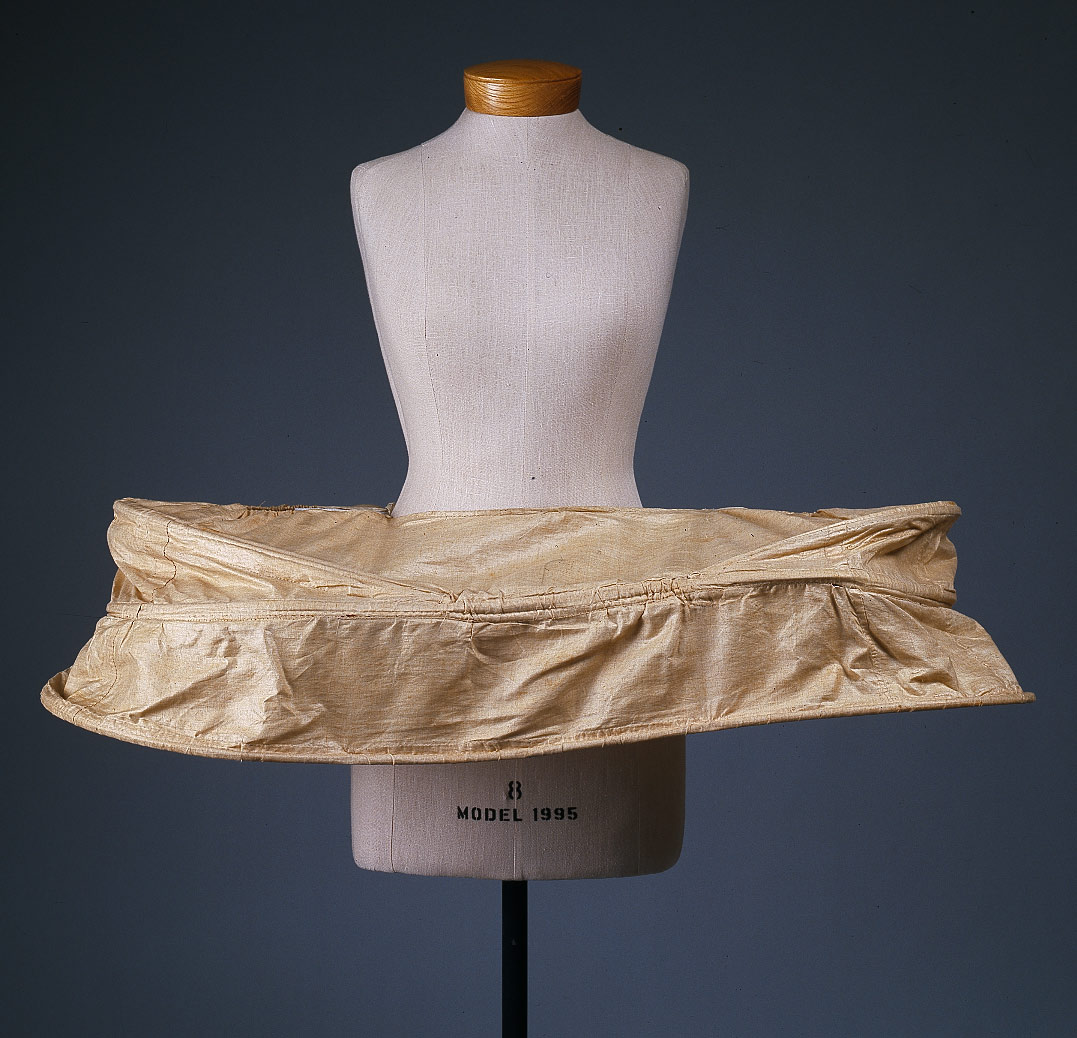
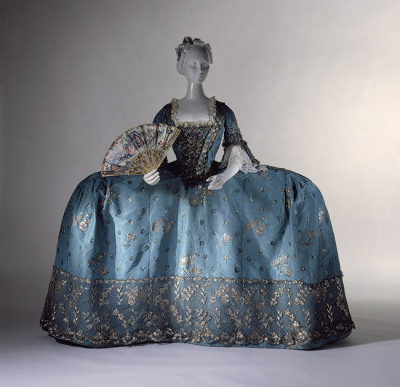
I write books set in the Regency era, but my real love is the mid Georgian era, the 1750’s in particular. And of course one  of the big differences is dress. I can’t possibly cover all the differences in one blog post, but one of the most—prominent—differences was the panier. Or paniers, strictly.

The shape of the skirt changed drastically throughout the century. At the beginning, the bottom was padded to give an elegant shape to the folds flowing over the back. Then the skirts got fuller and fuller, until the sheer bulk of petticoats must have been too much, and the hooped petticoat was worn. Those of us who have been bridesmaids and forced into a meringue dress knows what that’s like. quite handy, because you can wear big pockets under it. it must have signalled freedom to the hampering, tangling, hot skirts.

In the 1740’s, the hoops became enormous. Women had to go through doorways sideways, and coming towards you they looked like ships in full sail, or walking sofas. As fashion developed the mantua went out of fashion, replaced by the sacque, the robe anglaise, and the robe a la francaise, but the mantua continued to be worn at court. and the huge size of the hoops continued, too, right through until the 1820’s.

But the hooped petticoat is cumbersome. Getting in and out of coaches, walking in high winds and just getting through doors can be a hazard. So eventually some bright spark developed the panier. It was a cage, usually made of cane or whalebone, that rested on the hips. It gave the necessary padding for passion, but were much more practical. They were collapsible, that is, they worked a bit like an umbrella and could be lifted to temporarily collapse them for doors and coaches.

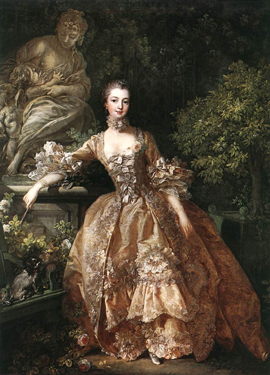
By the 1750’s, everyday hoops and panniers were much smaller. Sometimes, especially on informal occasions, the lady might replace the panier with a quilted petticoat for some light padding. There was a brief fashion in the mid 1750’s among the younger set for leaving off the paniers in public. With gowns designed to be worn with paniers underneath, it made the wearer look a bit—deflated. But the panier continued to decline in size, until they disappeared altogether in the 1780’s and the bum roll made a reappearance. I love the look. Before the hair became stupidbig in the fashion of the 1770’s, the line was elegant and beautiful, as seen in the gorgeous portraits by Gainsborough and Reynolds.

It’s always the case that the younger generation despises the clothes that its parents wore, although that has sped up in recent times. The heavy brocades and sumptuous silks of the high Georgian era gave way to the impractical pale and thin muslins of the early nineteenth century, and they themselves gradually grew fuller until, inevitably, the hoop made a return. Only this time it was called the crinoline.


Lynne Connolly
http://lynneconnolly.com

Thursday, June 09, 2011

The Jane Austen Handbook

It seems a long time since I posted here- my last post coincided with the blogger black out last month. I was going to talk about my new book but it is not being published until August now.
Therefore I'm going to tell you about a delightful little book I discovered called 'The Jane Austen Handbook' by Margaret C Sullivan -who is the editor of Austenblog.com. She lives in Philadelphia.
This book tells you what Jane would do. For instance:
How to behave at your first ball
How to ride sidesaddle
How to decline an unwanted marriage proposal
How to improve your estate
How to throw a dinner party.
It also includes thoughts on all Jane's books, film adaptions and Jane Austen related retellings.
There are sections on all sorts of regency related subjects.
For instance -acceptable men's professions were -the church/the military/the law and medicine.
How a lady might earn a living- governess/schoolteacher/companion/lady's maid/authoress
This is written with a light witty style and I will find it a useful addition to have on my reference shelf.
Next time I am due to post will be at the RNA conference- I shall have to borrow someone's lap top to do it as I'm sure you will want to know what's going on in Wales.
Fenella Miller

Tuesday, June 07, 2011

Whisper of Scandal

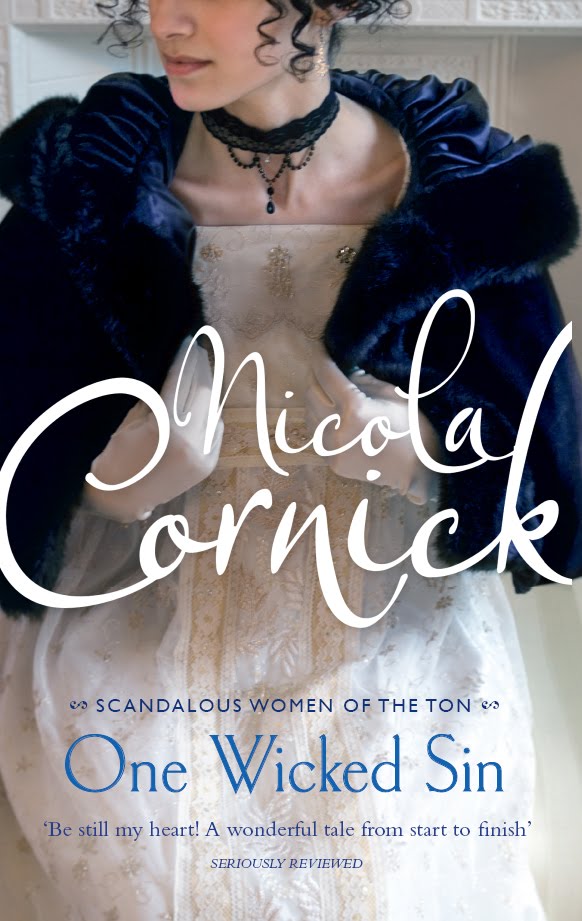
This month sees the UK publication of Whisper of Scandal, the first in my Scandalous Women of the Ton series. This will be followed by One Wicked Sin next month and Mistress by Midnight in August. I am thrilled that the Scandalous Women are coming to the UK and I love the gorgeous covers that the books have! I hope you like them too.


Whisper of Scandal is set in London and the Arctic and was huge fun to write and research. I'll be talking about the book and my research at two forthcoming book festivals: The Burford Festival on 17th June and the Witney Book Festival on 19th June. At Witney I'll also be discussing "How to write the Regency Historical." All the details are on my website and if you are in the area I would be delighted if you would like to come along to say hello and join in the debate.

Friday, May 27, 2011

Regency Letters


The Bartered Bride is out now in USA. Coming soon there the Hanover Square trilogy and cming here soon, paperback in august is Bought For the Harem.


Dearest Mama


I write to you from Italy, where I have spent a pleasant month with my sister Horatia and her friends. I must tell you that the climate suits my health and I have decided to settle here. There is a very pleasant villa not far from my sister's home and it is there I shall live. The estate will be sold and while I realise this may leave you without a home I am offering you the chance of living here with me and the lady I intend to marry, as soon as her family will allow it - or a house in Bath.


I am quite prepared to purchase a house in Bath for you, dear Mama. My lawyers will make certain that you have all you need - but should you wish to visit either Horatia or myself we shall be delighted to see you. I know you feel my sister has disgraced the family but I assure you that here no one regards it. She is welcomed by most of the local notables, though some visiting English do not wish to be known to her. However, her divorce is soon to be complete and then she will marry. I must tell you that she is expecting her husband-t-be's baby and very happy. We should all like to see both you and Antonia.


Your loving son, Robert


Hope you enjoyed this little series. I expect it will be back to excerpts next time.


Best wishes Anne Herries

Sunday, May 22, 2011

The bi-centenary of the battle of Albuera

May 16th, 2011, is the two hundredth anniversary of the battle of Albuera, one of the bloodiest of the Peninsular War. The small town of Albuera is immensely proud of its part on the battle and, each May, hosts a day of celebration, together with the Friends of the British Cemetery in nearby Elvas, to honour those who fought and died there.


The Friends of the British Cemetery was set up to restore both the abandoned cemetery and also the tiny chapel of S. Joao, which had been the military hospital in Wellington's time but which had fallen into serious disrepair. After long negotiations with the Archdiocese of Evora, the Friends were allowed right of usage and took on the responsibility for the chapel's restoration and maintenance. This was marked by a formal ceremony in which the bishop of Evora re-dedicated the chapel.

The picture below shows the Corps of Drums - Princess of Wales's Royal Regiment, looking splendid in their scarlet uniforms, who were there to mark the occasion.


The seond picture (below) shows the Portuguese Infantry Regiment No 8. There are wearing original 1811 uniforms which were doscovered in an old cupboard in the now-disused barracks. Unfortunately, all the uniforms were too small for 21st century Portuguese soldiers, so the 'soldiers' on parade are, in fact, women!


Elizabeth Hawksley

Top photograph of the chapel of S. Joao was taken by the author, the other two are courtesy of http://www.british-cemetery-elvas.org/

Friday, May 20, 2011

Moving House

The problem with moving house - well, two of them actually - is the realisation that you can't find anything and that everything is taking far longer to get straight than you ever imagined.

Having moved a month ago we're still chasing both things and time, so instead of the quite long and detailed post I was planning for today I am just going to share a couple of Regency prints which amused me and which focus on housing problems of some kind.

The couple on the pavement surrounded by their possessions are part of a series published by Ackermann featuring "boring" social situations. This one is all about what a bore it is when your landlady discovers that the young woman sharing your rooms is not married to you - "you have not pass'd thro the inconvenience of the matrimonial ceremony" - and evicts you without ceremony - along with lapdog, parrot and potplant. The young gentleman in his highly fashionable pantaloons and wasp-waisted coat looks as though he is about to take off and leave his weeping ladyfriend to deal with the situation!

The lodgings shown above look very respectable and the street is clean. Even the family begging seem unthreatening, if pathetic.


The other print shows lodgings that are far less respectable. It is from the famous "Tom and Jerry" series and shows Jerry returning to London and calling on his old friend Bob at his lodgings. His post chaise is standing in the road behind and the postillion is knocking on the door but there is no sign of Bob, only the annoyed landlady hanging out of the window and the nightwatchman snoring down below. The ricketty house is propped up on the pawnbroker's shop opposite, a pair of cats are squaring up for a fight on the roof and the dome of St Paul's Cathedral looms over the scene.

I doubt whether this landlady would turn a hair if her gentlemen lodgers brought home a woman who who was not their wife!


Louise Allen

Tuesday, May 17, 2011

Plot Wars


Last December my husband Mike was given indefinite loan of a field in which to grow fruit and vegetables. Though thigh-high in weeds, for him it was a clean page. First he bought a brush-cutter and strimmed the entire field including the hedges – working in 15-minute bursts as this machine is heavy, requires a supporting harness, and is swung from hip height. It took weeks. Next he dug over the first 3 metre by 9 metre plot and poured on thirty bags of home-made compost - a mix of straw-free horse poo and seaweed gathered from our local beach during the freezing winter (I held the sacks open) when it was so cold our faces were numb and even with gloves on we couldn’t feel our hands. Never has no pain no gain rung more true. But to get good stuff out you have to put good stuff in. And with gardening, as with writing, preparation is the key. Meanwhile the field’s previous occupants, rabbits, pheasants and pigeons, were watching, biding their time. With the soil warm from four weeks of hot dry weather in April, new and second-early potatoes were planted before Easter. Additional plots were prepared and planted. That’s when the trouble started.

The day after planting leeks and onions he had grown from seed, Mike returned to the field. The onions had gone and there were random diggings among the potatoes. Clearly something was trying to reach the fresh shoots. We ordered some plastic mesh – the kind builders use – and surrounded the plots with that. The rabbits chewed through it and the pheasants simply jumped over. Each morning he’d arrive and catch the pheasants among the crops. Once over the mesh in a flurry of wings and squawks they stretched their necks forward, head and body totally level as they hurtled towards the hedge, looking as if they were on wheels. Mike dismantled the frames and used the wire netting as an additional barrier all the way round the outside of the mesh. That stopped the rabbits but not the pheasants. This was war and demanded radical measures. My suggestion of an air rifle with telescopic sights and a silencer was declined. Instead he ordered some black electrical conduit and a roll of fine-mesh green netting and built a cage to cover each plot. He made a door for each cage from spare panels of corrugated Perspex on a wooden frame. So far it’s working. The netting allows sun and rain through, keeps the pheasants out, and has created a micro-climate. And we’ve just dug our first new potatoes.

While this was going on I sent off a 14-page outline and character biogs for my new book to my editor who had asked for "a darker edge". She received them on the Tuesday after Bank Holiday. On Thursday of the same week I received an email from her to say she had read them, liked them, and looked forward to receiving an exciting book. So no pressure!


Saturday, May 14, 2011

Henry Tilney - what a bargain!


It isn't my day, but I'm just dropping in to let you know that Amazon UK are offering the hardback of Henry Tilney's Diary at the absolute bargain price of £7.83 instead of RRP £18.99

Hale hardbacks are beautiful books, with removable glossy covers, and at £7.83 the hardback is cheaper than many paperbacks. I've no idea how long this offer will last, so seize the day!!!

Amanda Grange

Thursday, May 12, 2011


No one seems to be blogging so I thought I would put another post on. Just received a huge parcel of copies of the USA A Country Miss in in Hanover Square. HH are bringing the trilogy out one after the other in consecutive months. I was thrilled with the cover which unfortunately I can't scan to show you. However, because it is going mainstream as well as direct they sent me loads of copies and that means anyone who would like one should email me at
linda@lindasole.co.uk
and I'll send a free copy anywhere in the world free of charge to your snailmail.
Just got back from holiday in Spain, which was lovely but it is nice to be home. Haven't started work yet but I have lots of ideas for future books. In the Uk M&B are bringing out Bought For The Harem in August. Captive of the Harem is now on sale in China as a comic book and I bought a copy for my kindle from uk site. The pictures are wonderful. You can see what is happening without understanding the balloons. It is a lot of fun and I feel delighted it has been done that way in Chinese. It was done a while ago in Japense. COTH has sold in so many countries. I wonder if Bought For The Harem will do as well?
:ove to you all, Linda/Anne

Wednesday, April 27, 2011

Regency Letters


Nearly at the end of this story. Never mind I'll think of something else to post then.


I received a four star review in the Romantic Times for Bartered Bride, which came out in USA recently. Several new books in the pipeline. Love to all.


Now read the story:


May 1816
Dearest Mama.
I know you may never forgive me. I have shamed you and my family and if Melton carries out his threat Robert will be ruined. He says that Melton will find it harder than he thinks and is determined not to be bullied. You know now that Frederick has given up his career for my sake. His family were disturbed but he says they support him and he should not care if they did not, because he loves me more than his life.
Please Mama, do try to understand and to forgive me. In the end I had no choice but to leave England. My dearest Freddie says that you will always be welcome here and perhaps one day you will visit us.
I send you my love and hope you will not turn your face from me for ever.
I love you, Mama. Horatia


May 1816
My own dearest Robert.
How can we ever thank you enough for what you did for us that day? I think that if you had not stood between them Freddie and Melton would have killed each other. I know you have risked much for us and I wish it might have been otherwise. Forgive me for bringing trouble to your door.
You said you might sell the estate and come to us in Italy. How I should love that and I think the sun would be good for your health, but you might lose too much. Mama will be furious I know and my sister may not be allowed to receive letters from me, though I shall send them.
I shall not write to Melton. He may blacken my name as he pleases. I shall not defend myself. Freddie says he may pursue us but I think he will not trouble himself. Once he calms down he must see it is for the best.
Should you decide to visit us it would be a joy – and there is a villa for sale just down the hill from us. What happiness could be ours if you bought it – but the decision must be yours, dearest.
I shall tell you that I am as happy as it is possible for a woman to be and I owe much of my happiness to you, for without you I might not have had the courage.
Know that you have my love, dearest one, and write to me soon.
Horatia

Tuesday, April 26, 2011

200 Year Anniversary of Sense and Sensibility


Two hundred years ago this week, Jane Austen was staying with her brother Henry in London whilst she was editing proofs of her book, Sense and Sensibility. She wrote letters to her sister Cassandra from Sloane Street where Henry lived. Her brother and his wife were also busy entertaining friends, and I always think it must have been a most exciting time for Jane.

She'd been shopping: I am sorry to tell you that I am getting very extravagant, and spending all my money, and, what is worse for you, I have been spending yours too; for in a linendraper's shop to which I went for checked muslin, and for which I was obliged to give seven shillings a yard, I was tempted by a pretty-coloured muslin, and bought ten yards of it on the chance of your liking it; but, at the same time, if it should not suit you, you must not think yourself at all obliged to take it; it is only 3s. 6d. per yard, and I should not in the least mind keeping the whole. In texture it is just what we prefer, but its resemblance to green crewels, I must own, is not great, for the pattern is a small red spot. And now I believe I have done all my commissions except Wedgwood.
But, her book was never far from her thoughts: No, indeed, I am never too busy to think of S and S. I can no more forget it than a mother can forget her sucking child; and I am much obliged to you for your inquiries. I have had two sheets to correct, but the last only brings us to Willoughby's first appearance. Mrs. K. regrets in the most flattering manner that she must wait till May, but I have scarcely a hope of its being out in June. Henry does not neglect it; he has hurried the printer, and says he will see him again to-day. It will not stand still during his absence, it will be sent to Eliza.
She gives details of the party that Eliza and Henry gave: Our party went off extremely well. There were many solicitudes, alarms, and vexations, beforehand, of course, but at last everything was quite right. The rooms were dressed up with flowers, &c., and looked very pretty. A glass for the mantlepiece was lent by the man who is making their own. Mr. Egerton and Mr. Walter came at half-past five, and the festivities began with a pair of very fine soals.
Yes, Mr. Walter - for he postponed his leaving London on purpose - which did not give much pleasure at the time, any more than the circumstance from which it rose - his calling on Sunday and being asked by Henry to take the family dinner on that day, which he did; but it is all smoothed over now, and she likes him very well.
At half-past seven arrived the musicians in two hackney coaches, and by eight the lordly company began to appear. Among the earliest were George and Mary Cooke, and I spent the greater part of the evening very pleasantly with them. The drawing-room being soon hotter than we liked, we placed ourselves in the connecting passage, which was comparatively cool, and gave us all the advantage of the music at a pleasant distance, as well as that of the first view of every new comer.
I was quite surrounded by acquaintances, especially gentlemen; and what with Mr. Hampson, Mr. Seymour, Mr. W. Knatchbull, Mr. Guillemarde, Mr. Cure, a Captain Simpson, brother to the Captain Simpson, besides Mr. Walter and Mr. Egerton, in addition to the Cookes, and Miss Beckford, and Miss Middleton, I had quite as much upon my hands as I could do.
Poor Miss B. has been suffering again from her old complaint, and looks thinner than ever. She certainly goes to Cheltenham the beginning of June. We were all delight and cordiality of course. Miss M. seems very happy, but has not beauty enough to figure in London.
Including everybody we were sixty-six - which was considerably more than Eliza had expected, and quite enough to fill the back drawing-room and leave a few to be scattered about in the other and in the passage.
The music was extremely good. It opened (tell Fanny) with "Poike de Parp pirs praise pof Prapela"; and of the other glees I remember, "In peace love tunes," "Rosabelle," "The Red Cross Knight," and "Poor Insect." Between the songs were lessons on the harp, or harp and pianoforte together; and the harp-player was Wiepart, whose name seems famous, though new to me. There was one female singer, a short Miss Davis, all in blue, bringing up for the public line, whose voice was said to be very fine indeed; and all the performers gave great satisfaction by doing what they were paid for, and giving themselves no airs. No amateur could be persuaded to do anything.
The house was not clear till after twelve. If you wish to hear more of it, you must put your questions, but I seem rather to have exhausted than spared the subject.

In celebration, I have a copy of Willoughby's Return to give away. Just leave a comment below, or on my blog telling me who is your favourite character from Sense and Sensibility and why, by May 1st.

Jane Odiwe

Thursday, April 21, 2011

Happy Birthday Charlotte Bronte, and thank you for Jane Eyre :)

Today is Charlotte Bronte's birthday. She was born in 1816 at Thornton, near Bradford in Yorkshire, a place close to my heart as I was born and bred nearby. When I pulled back the bedroom curtains every morning, I saw the same moors that the Brontes saw all around them during their lives.


If Charlotte had lived, she would be 195 today. A lot has changed in those years. Photography was only developed towards the end of her life, but how glad I am that it was possible before Charlotte died, because we now know what she looked like.


Contemporary sources describe her as plain, and portraits of her are not very attractive, but her photograph shows her to be a woman I consider pretty. Gone is the severe expression of the portrait, and in its place a softer face and expression. Charlotte's appearance, as well as her writing, it seems, was ahead of its time.

But although a lot has changed, a lot remains the same, and this is why we still love Jane Eyre, and the woman who wrote it, almost two hundred years after Charlotte's birth. We recognise our own inner lives and inner struggles in Charlotte's most famous heroine, our struggle to be ourselves no matter what the circumstances, and to find our own happy ending.

So what is about Jane Eyre that you love? Is it the romance, is it the mystery, is it the Gothic horror, is it Mr Rochester with his strong character, or is it Jane herself, with her indomitable will, or is it something else entirely?

Amanda Grange

Tuesday, April 19, 2011

A Turn for the Dramatic

I spent a week in Yorkshire recently and took the opportunity to visit Richmond because I had heard that they possessed the most complete Georgian theatre still operating in the UK. I had seen the lovely Regency theatre in Bury St Edmund's while I was researching for The Notorious Mr Hurst, but this one is older, and opened in September 1788. Samuel Butler had been managing a troupe of travelling players who were struggling, like other actors were, with the results of the Licensing Act of 1737 which forbade the production of plays for reward. The only way round it was to put on a concert and insert a "free" play in the interval. Only the big London theatres and a handful in major cities, had special patents to permit them to put on "proper" plays. But there was a breakthrough in 1788 with the Theatre Licensing Act which enabled companies to put on plays for up to sixty days at any one time. Butler seized the oportunity and took over a large barn-like stone building in Richmond, converting it into a theatre in four months. The theatre was in a "courtyard" form - rectangular with a pit, boxes and rows of galleries on three sides. The stage was raked and two dressing rooms - with fireplaces - were installed underneath. There was even an open fire at the back of the stage. Those three fires were the only heating for the shivering players. The theatre museum posseses a wonderful hoard of playbills that were found in a local home. I don't have any in my collection for Richmond, but the two illustrated, for Hull and Norwich, look identical and give a real flavour of the kind of entertainment these provincial theatres were providing. In 1848 the theatre closed and was used for a variety of purposes - an auction house, a wine store, a chandlers store - but by some miracle the galleries, boxes, stage and ticket office all survived with their original paint. Even the names of great actors painted benath the fronts of the gallery could be read. Beneath the best box - the one the Price Regent had used - was Shakespeare's name and this has been left unrestored. In 1939 the theatre was rediscovered and in 1963 it re-opened after restoration and is now a fully working theatre. Unfortunately photography is not allowed inside and the images in the guidebook are copyright, so I can only show you the original main entrance, tucked discreetly round a corner. You can see a little more at the theatre website http://www.georgiantheatreroyal.co.uk/ Louise Allen

Sunday, April 17, 2011

Straw Ropes

During my recent research I came across a plan of Perran Foundry dating from 1860. Though that is 30 years later than the period of my new book, the plan was invaluable regarding the layout. At that time the foundry covered six acres and employed 400 men. Though the names on many of the buildings and sheds were self-explanatory: smith’s shop, engineer’s shop, milling shop etc. when I came across the straw rope shed it stopped me short. What on earth were straw ropes, and what would they be used for? I asked an engineer friend, and he had no idea. Then he spoke to his 90-year-old uncle who had been in marine engineering all his life and knew the answer.

Straw ropes were exactly what the name suggests, ropes made from plaited straw. Because each straw is hollow it holds air. Air has excellent insulating properties. So these straw ropes were closely wrapped around the boilers in early steam ships to form an insulating jacket, much like those we use today around our immersion heater cylinders. (It’s so obvious when someone explains.)

But straw is highly inflammable and there was always a risk from stray sparks when more coal was shovelled into the boiler’s fire box. To minimise this risk, sacking strips - similar to the old-fashioned lagging used around water pipes to stop them freezing in winter - were wrapped over the top of the straw. This sacking was first soaked in a solution of borax then dried, as borax was commonly used as a fire-retardant in the early part of the C19th. Unfortunately, as a safety measure this was all too often ineffective.

Saturday, April 09, 2011

Lady Eleanor's Secret and The Sweetest Love


My third book for Aurora Regency/Aspen Mountain Press , Lady Eleanor's Secret, will be released on 18th April. This is the cover - I think the house style is exactly right for the line. The fact that the author is involved all the way is another thing I
like about Aurora.
This is my first full length book for Aurora and it has a more complicated plot and a lot more romance.
Here is the cover blurb.

Lady Eleanor believes she will never escape from the misery of her life as an unpaid governess to her beloved nieces and nephews. On the advice of his mistress, Alexander, Lord Bentley, is seeking a suitable wife to take care of his children and remain in the country, leaving him to live as he pleases.

Mistakenly believing he has compromised Eleanor, he makes her an offer and she, puzzled but delighted, accepts. When she discovers the real reason for his offer, Eleanor is horrified. If she tells him she wasn't compromised, he will surely send her away. Her brother, Edward, is determined to separate them—he cannot live without his sister's inheritance.

Can Alex foil Edward's evil plans and save the woman he has come to love? Or will her secret ruin their relationship when it is revealed?

What a contrast the People's Friend cover is. The original title was Miss Bannerman & The Duke - which I must admit I prefer. However it's a lovely cover and although the costume is more Victorian than Regency it does fit the story which is about twin girls and their respective suitors.
This novella is still available so I hope some of you find time to read it. This book, with the original title, will be my next book for Aurora and will be released in June this year.
I've updated my web site (www.fenellajmiller.co.uk) and now have my own blog - do go an have a look.
best wishes
Fenella Miller


Thursday, April 07, 2011

Prisoners of the Parole Towns


I am very pleased and excited to report that my book One Wicked Sin is a finalist not only for the Romance Writers of America RITA Award for Best Historical Romance but also for the Colorado Award of Excellence as well!


The research I did for this book was fascinating, drawing on the experience of Napoleonic prisoners of war in Britain. A little while ago Louise blogged about the prisoner of war camp built at Norman Cross in 1797 and excavated recently by Channel 4’s Time Team. Thousands of prisoners of war were also housed in prison hulks and in medieval castles turned gaols such as Portchester and Edinburgh. But the background to One Wicked Sin looked at a different side of the prisoner experience, that of the officers who were accommodated in parole towns across the country.


There were 50 parole towns across Britain, ranging from Kelso in the Scottish Borders to Abergavenny in Wales to Wincanton in Somerset. Each town could house between 200 – 300 officers. One thing that struck me immediately about the parole town experience was that these were small country or market towns as opposed to big cities. What must it have been like suddenly to have hundreds of prisoners of war living amid the small local populace? And not just French prisoners but other nationalities as well - Danish, Irish, Spanish, American and many more.


Before any officer was permitted to reside in a parole town he had to sign up to certain terms and conditions including that he could not go further than a mile out of the town and that he had to observe a curfew. Perhaps the terms should also have included that he should not attempt to elope with a local girl – several officers did! The British authorities gave each French officer a half a guinea a week for living expenses and the more resourceful supplemented their income by teaching French or dancing or setting up in business. However half a guinea evidently was not sufficient for some of the officers. In Wantage, where One Wicked Sin is set, one French colonel wrote to his bankers, Coutts in London, asking them to transfer funds to the local bank because he simply could not manage on such a pittance!


The history of the parole towns is a fascinating one and the French prisoners of war have left surprisingly little trace in the written records of the towns where they lived amongst the population for a number of years. Their legacy lives on however in the businesses they started and thefamilies they married into. In contrast to the officers the non-commissioned prisoners have left their mark on the landscape. They laboured on many engineering projects of the early nineteenth century from canal building to docks. Putting together their stories and learning about their experiences has been a very interesting process. One of the few memorials that I discovered to the parole prisoners is this one at Leek in Staffordshire.


One Wicked Sin was published in the US last year and will be coming out in the UK in July from MIRA.

Friday, April 01, 2011

Austenesque extravaganza quiz

(Please ignore the date on this post. I was hoping to post the answers on my website but it's being updated and so I've had to improvise, removing an old blog post and using the space for the answers to the August 2011 quiz)

Here are the answers from the Austenesque quiz:

1) Darcy's Diary

2) Darcy's Diary (hardback) was renamed Mr Darcy's Diary for the paperback.

3) She gets married.

4) 1806

5) Henry Tilney's Diary

6) George Wickham

7) She is forced to marry his brother

8) Edmund Bertram

9) After

10) A Darcy Christmas

Thanks for taking the quiz. I hope you enjoyed it and that you have fun with the rest of Austenesque August!