Showing posts with label Waterloo. Show all posts

Monday, April 10, 2017

ROMANCE & THE DARK SHADOW OF WAR


 I have been writing Georgian and Regency romantic adventures for decades now, and one cannot research the period without coming up against the dark shadow of war. England and France had been at war, off and on, for centuries, it affected everyone's lives, from trivial problems such as where to buy French brandy, to families fearing for their loved ones who were in the army or navy.
I make no apology for my first illustration of this post - Cornwell may not write "romantic novels", but there can be no doubt that this guy sets many hearts a-flutter!)


As a romantic novelist I am writing an entertainment, but although the main theme of my books may be love, and the reader is guaranteed a happy ending, I also like to acknowledge at least some of the realities of life in the Georgian and Regency period, and very often that means alluding to war in some way. My latest Sarah Mallory novel, The Duke's Secret Heir, is partly set in Harrogate, and even in this genteel watering place the consequences of war make themselves felt: the duke is there to visit his closest friend, an ex-soldier who is surviving with a bullet lodged in his lung.

There were breaks in the hostilities between England and France. One of them was the short-lived Treaty of Amiens, which lasted for just over a year from March 1802. I used this period as the setting for another story, where I sent my newlyweds careering across France. War was declared again before they could complete their journey back to England and they had to use a great deal of ingenuity to escape, so it proved a very adventurous honeymoon! At one point, as their coach hurtled through a hostile village, it was pelted with sabots by the locals (and it is said that the word sabotage derives from the disgruntled French workers from  about this time, throwing their wooden clogs into the machinery to damage it). I had great fun with this book, and it remains a firm favourite, a lively tale despite the fearful danger surrounding my couple. It is currently e-published as To Marry a Marquis in the Ladies in Love box-set, available on Amazon.
One of the turning points for the Regency was the Battle of Waterloo – "a damn close-run thing," as Wellington described it. Perhaps it was growing up in a street full of boys and playing war games most evenings and holidays that gave me a liking for action, and I find military history fascinating. However, I write romance, and mainly from the female point of view, so most of my books show the aftermath of war rather than the battles themselves. Most ladies were kept well away from scenes of conflict, even soldiers' wives and the camp followers did not venture onto the battlefield itself until after the event. However, in A Lady for Lord Randall ,my Sarah Mallory book for the Brides of Waterloo series, the hero is a colonel, and I did put in a large battle scene, which I thoroughly enjoyed writing!

 
Hand to hand fighting at Hougoumont

Fascinating as it might be, war is a dark and desperate business. When I was refreshing one of my early Melinda Hammond novels ready to re-publish it as an e-book , I had quite a surprise. I had forgotten just how much description I had included about Waterloo. In Maid of Honour, my heroine, Lucy, travels to Brussels in June 1815. She attends Lady Richmond's Ball, probably the most famous party of all time, and unlike most of her non-military compatriots, she remains in Brussels during the battle. Maid of Honour is written mainly from the heroine's point of view, and since it was not the hero, but Lucy's childhood sweetheart Tom who is the soldier, I wrote this part of the story as Lucy would have experienced it.


On the day of the battle itself she mistook the rumble of guns for thunder over Brussels, until a crippled old veteran explained. Then, fleeing cavalry careered through the town proclaiming that all was lost, the Allies were defeated and Bonaparte would be in Brussels by nightfall.

Lucy is advised to leave the city but she is determined to remain, and when at last she learns that Napoleon has been defeated, she waits anxiously for Tom's return. When she learns his regiment was caught up in some of the bloodiest fighting near Hougoumont she sets out to look for him on the battlefield itself. Here's a brief excerpt: (NB if you are of a nervous disposition, you may want to skip this bit!)

***

It seemed to Lucy that the full horror of the battle was spread below her. The ground was covered with the dead, men and horses entangled in a nightmare pattern, the garish colours of the uniforms dulled by mud and grime and dried blood. Scores of French cavalry had died attacking the British squares, yet the men who had shot them down now lay dead in the very formations they had fought so hard to maintain. That anyone could come out of the battle alive seemed to Lucy to be nothing less than a miracle. A movement caught her eye and she saw grey-cloaked women moving amongst the dead, taking rings and watches, even pulling teeth from the corpses to sell in the markets of Brussels and London.

***

She finally finds Tom in one of the field hospitals. These are little more than a huddle of tents with overworked medical officers and surgeons doing their best to save lives. There was very little they could do – there were no painkillers or antibiotics, and surgeons would remove an injured limb in an attempt to save a man. It was crude, brutal, and those who did not die of their wounds often succumbed to infection. This section of the book is dark, perhaps, but I wanted to show the horror Lucy was experiencing. She was a young woman from a privileged background, accustomed to a safe, comfortable home. Suddenly she finds herself in a nightmare world where she has to draw on all her strength of character to get through it.

A romance needs a backdrop, and there is no doubt that wartime provides one of the most dramatic. Whether the characters are in physical danger themselves, or living with the uncertainty of what may happen to their loved ones, war adds an extra dimension to a story.

What is your favourite wartime romance? Is it perhaps a literary classic like War & Peace or an epic like Gone With the Wind? Or maybe it's a romance by Carla Kelly, or Louise Allen? There are so many to choose from, so wartime romance clearly strikes a chord with many readers.


Melinda Hammond / Sarah Mallory

Thursday, March 03, 2016

Surgeons, Doctors and a new Sarah Mallory novel!


My very latest Sarah Mallory novel, Return of the Runaway, is published next month, so I thought I would give you a sneak preview of the cover.


When I sent Lady Cassandra off to France after her scandalous elopement in The Chaperon's Seduction (Book 1 of The Infamous Arrandales series) I had no idea what would happen to her, only that she would have to come home eventually, having met the love of her life (I am writing romance, after all!)

In 1802 the Treaty of Amiens brought a brief lull in hostilities between Britain and France, but neither side expected it to last. War was declared again in May 1803 and Bonaparte ordered the arrest of all British males between the ages of 18 and 60 in France and Italy. Cassie and her husband were among those detained, but when Cassandra is widowed and wants to return to England, her journey is not straightforward and she needs help. Enter Raoul Doulevant, a surgeon from Belgium who has his own reasons for wanting to leave France.

The story was partly inspired by a book I picked up by chance one day on a market stall. It is called Escape from the French and is the story of Midshipman Maurice Hewson. In 1803 he was captured near Brest and marched to the Fortress of Verdun. Eventually he managed to escape and after a dangerous journey overcoming illness, police, customs officers and inquisitive strangers he reached safety in Austria. The narrative of the rigours of his journey were extremely useful to me in imagining Cassie and Raoul's flight.

Although Return of the Runaway is set more than a decade before Waterloo, it was my research for the famous battle of 1815 that inspired Raoul's character. It was then that I learned about Baron Dominique-Jean Larrey, Chief Surgeon to the French Army. Larrey was described by Bonaparte as "The most virtuous man I have known" and even Wellington noticed his courage under fire.  (This is a portrait of Larry on the left, and I think he looks quite heroic, don't you?)
Larry was instrumental in improving the medical support for the army and he also developed the flying ambulance, a light carriage that could be used to transport the wounded away from the battlefield.


Bringing together the granddaughter of a marquess and a Belgian surgeon gave the story an added twist, for at that time surgery was not considered a gentlemanly profession, so Raoul is even less acceptable to Cassie's family than her first husband. Doctors were gentlemen and would be invited to dine with the wealthiest families. They might study Latin and Greek at university and attend lectures on medical procedures, but they rarely had any practical experience - their profession was not supposed to include any manual labour (a gentleman did not do any actual work!).

As a surgeon, Raoul was considered a tradesman because he worked with his hands and actually carried out operations and was paid for his work (doctors too were paid, of course, but discreetly). The role of surgeons had changed in France since the revolution, and it was one of the reasons Raoul went to study at the Hôtel Dieu, a major hospital in Paris. Surgery was also becoming more respectable in England too, and after the founding of the Royal College of Surgeons of London in 1800, it was customary for surgeons to take the examination for Membership of the Royal College of Surgeons and put MRCS after their name. 

So, I had the background for my book and I put Cassie and Raoul through a great deal before they reached their happy ending…. But if you want to know how they achieved it, well, you will just have to read the book!


Melinda Hammond / Sarah Mallory
Return of the Runaway – Sarah Mallory. Published by Harlequin April 2016


Winter Inheritance – Melinda Hammond. Out now on Kindle


Thursday, December 17, 2015

Three Days at Windsor Castle

Windsor Castle - The Quadrangle
I have been to Windsor many times before, but somehow visiting the castle was something that was always left for another day. Not enough time, too late in the day or the children were too small and they would have had no patience for a lengthy visit. So it was something jotted on my ever-growing ‘bucket list’. But earlier in November I had the great pleasure of not only visiting, but also spending the day there in excellent company. Thanks to Catherine Curzon from ‘A Covent Garden Gilflurt’s Guide to Life’ and to Mr Arturo Ramirez, who is one of the fortunate people who have Windsor Castle entrusted to their care, the tour was very much like a ride on the magic carpet, as we were guided by Mr Ramirez and had the privilege of hearing countless precious snippets from the castle’s long history.

I was so taken with the wonderful experience that a few days later I visited again. I must admit that I would happily loiter for hours in a historic place examining artefacts or waiting for that elusive people-free photo. This time I did not have to wait too long. It was a weekday and at times it felt like I had the place all to myself. 

Sensibly, indoor photography is not permitted, but countless images are available for research and personal use on the Royal Collection Trust websiteSo thankfully I will not have to rely just on my memory to catalogue all the gems I have seen. Such as the burnous currently displayed in the Grand Vestibule. It was taken from Napoleon’s fleeing coach, after the battle of Waterloo – a flamboyant garment, bright-red with golden trimmings, that amongst other things served to dispel the myth of Napoleon’s stature and prove that the cartoons of the time were largely propaganda, and he was in fact around 5’6” in height.

A great many artefacts were displayed elsewhere, in the Drawings Gallery, as part of the ‘Waterloo at Windsor’ exhibition. Watercolours showing the personages of the day; the site of battles; the crowds gathered in 1816 at the Bullocks Museum in London, where Napoleon’s captured carriage was exhibited for a while. More fascinating still, the original letter of surrender that he had sent the Prince Regent from Rochefort on the 13th of July 1815. In that brief note, Napoleon declared that he had terminated his political career and had determined to throw himself on the hospitality of the British people and claim the protection of their laws, from ‘the most powerful, most constant and the most generous’ of his enemies.

As we know, the flattery did not serve him well. By the time the letter was delivered, Napoleon was already on his way to St. Helena. Perhaps the Prince might have responded differently had the letter reached him sooner. Or perhaps not. In the decade of ‘Peterloo’ there was more than enough tension in Britain without the added powder keg of having the former emperor settled in some English country-house.

We are never to know if the letter of surrender conveyed mere flattery or genuine thought, but I still chuckle at the anecdote showing that it was not Napoleon whom the Prince Regent regarded as his very worst enemy. The story has it that, when the then King George IV was told that his worst enemy was dead at last, he had exclaimed ‘Is she, by God!’ – he was referring to his estranged wife.

I am one of those people who would find more familiar faces in the large canvas depicting Queen Caroline’s trial than in any images of modern-day parliamentary proceedings, so it was no surprise that of all the treasures displayed at Windsor Castle it was those with links to the Georgian period that had my full attention. Such as the small but deeply moving exhibit in one of the display cabinets in the Grand Vestibule: a small silver locket containing the very bullet that killed Admiral Lord Nelson and which, Mr Ramirez told us, still has remnants of golden braiding from Lord Nelson’s epaulette embedded in its surface.

Then there was the story of the Waterloo elm, a towering tree that Lord Wellington’s command post was set beneath. After the battle, the spot had become one of pilgrimage, and the tree a target for souvenir hunters, so much so that the owner of the field, heartily sick of having his crops trampled over, had decided to cut it down. As serendipity would have it, at the time the site was visited by Mr John Children, an antiquarian from the British Library, who was travelling with his daughter Anna. He persuaded the farmer to allow Anna to sketch the tree in situ, then bought the timber and brought it to Britain to entrust it to the skill of Mr Thomas Chippendale the Younger, who fashioned the Waterloo Chair. It is currently on display in the King’s Drawing Room – an exquisite piece ornamented with allegoric carvings and an inscription devised by the Earl of Mornington, the Duke of Wellington’s elder brother, whereby the Waterloo Chair was dedicated to King George IV, ‘liberator of Europe’.

So much to see, so many treasures! The Sèvres ‘Table of the Great Commanders’ (La Table des Grands Capitains) commissioned by Napoleon. His writing desk. The exquisite Rockingham Service, ‘probably the most ambitious porcelain service ever made by a British factory’ (Windsor Castle Guide p.36) commissioned by King William IV but only finished in time for Queen Victoria’s coronation. King George IV’s statue, its design largely chosen by the sitter due to a flattering well-turned calf. And in the semi-state apartments the bright and colourful Crimson Drawing Room, fully restored to its Georgian splendour. We see it now, we are told, just as King George IV would have seen it, not faded with the passage of time but in all its new and glittering brilliance – the colours vibrant and fresh, the gold leaf decorations glowing – its restoration to its original glory one of the fortunate outcomes of the devastating fire of 1992.

Windsor at Christmas
I could not resist the temptation of going back to Windsor for the third time in as many weeks, to see the Castle decorated for the festive season. There is a gorgeous Christmas tree in the Crimson Drawing Room now, a towering giant in St George’s Hall – very nearly as tall as the hall itself – and in the Octagon Dining Room there is a delightful homage to Queen Charlotte, King George III’s queen, who had introduced the Christmas traditions of her native country at the royal court of England. It is sometimes mistakenly believed that we owe the Christmas tree to Prince Albert, Queen Victoria’s consort. The novel custom did indeed take root throughout the land during Queen Victoria’s reign, as everyone was keen to follow in the footsteps of a dearly loved royal couple, but it was Queen Charlotte who first introduced it, by having a yew tree placed in a tub in her drawing room, which she decorated with sweetmeats flavoured with cinnamon, cloves and nutmeg. Two hundred years later, there is a large branch set in a tub in the Octagon Drawing Room, its decorations reminiscent of Queen Charlotte’s: beautiful little ornaments cleverly crafted from cinnamon sticks and dried oranges and limes.

In the nearby State Dining Room, originally intended as George IV’s private one, we are treated to an exquisite display of Regency dining splendour, of glittering epergnes and elaborate pyramids of glazed fruits and berries, looking delightfully real to the unsuspecting eye, and from a display board we learn of the plum broth served to the Royal Household for Christmas 1815, made of 90 lbs of beef, 38 lbs of veal, 78 lbs currants and as many lbs of raisins, to which spices, “cochinile”, prunes, Lisbon sugar, butter and no less than 50 eggs were added.

I am very tempted to scale down the recipe and try it out, but since the maths might be a challenge I should have a fallback option for Christmas dinner :)

Have a wonderful Christmas, however adventurous your cooking, and do visit Windsor Castle decked in its seasonal splendour if you get the chance!


Friday, August 07, 2015

GETTING TO KNOW YOU – Melinda Hammond


Hi, I am Melinda Hammond, but if you are a regular reader of this blog you will know that I also write as Sarah Mallory, so first of all let me answer a question I have been asked many times… why do I use two names?

I started writing my romances many years ago as Melinda Hammond but when I began to write for Harlequin Mills & Boon I needed another name, a separate brand, if you like, for the fast-paced passionate historical romances I write for Harlequin. As Melinda Hammond I have published a much more varied selection, from the sweet traditional Regencies such as the award-winning DANCE FOR A DIAMOND to my WWII time-slip AND THE STARS SHINE DOWN and dual time novels like MOONSHADOWS and CASTING SAMSON (an e-book that is best described as Ivanhoe meets the Vicar of Dibley!)


As a child I used to make up stories and by the time I went to secondary school I was telling stories to my friends in the playground and beginning to write down the odd tale. My very first "commercial" success was when I was about ten. We had a visit from the Cadbury's educational team telling us how chocolate was made and there was a competition to write an essay about it. I won and the prize was several bars of chocolate. Unfortunately I have never been paid in chocolate since!

Georgette Heyer
I scribbled away, writing short stories, adventures, anything and everything, but inthose early days I never considered that I might get published, but it must have been there, deep down, because one of the reasons I went into secretarial work was for the typing skills, I knew they would be very useful for my writing!  I continued to write, and gradually found my direction - I had discovered Georgette Heyer's novels when I was a teenager and I don't think there has ever been anyone to match her for the mixture of story-telling, historical detail and witty light comedy.  She virtually invented the Regency novel and when she died in 1974 I was bereft – what was I going to read now?  It seemed logical to try and write my own. So that was when I began to write Regency romance.


However, although I had always read a lot I knew nothing of the publishing world and it was not until I gave up a full time job to have my first child that I even considered sending something to a publisher. In blissful ignorance I bought a Teach Yourself to Write book, typed up my manuscript and posted it off. I was incredibly lucky – the third publisher I approached actually made me an offer. I wrote two more books in quick succession but then the birth of my twin boys put an end to any spare time. This was coupled with a downturn in the publishing world, my publisher was not taking so many historical novels and although I kept on scribbling, my growing family were taking up most of my time and I decided that the writing would have to take a back seat. I didn't have anything else published for several years.

Then in 2000 I had a stroke of luck (!) – I stepped off a kerb, broke one ankle, badly sprained the other and was confined to a sofa for 12 weeks.  I was soon very, very bored. I decided to use the time to dig out an unfinished manuscript and have another go at it. By the time I was back on my feet the book was revised, I sent it off to the publisher and was thrilled when it was accepted. That was MAID OF HONOUR and since then I have never looked back.  I have now published over a dozen books as Melinda Hammond and June this year saw the publication of my 20th book for Harlequin Mills & Boon.

The Chaperon's Seduction, my 20th book for Harlequin Historical

I love writing historical novels, but I also like my books to have an element of adventure. I grew up in a street full of boys, with three older brothers and no sisters, so I was a bit of a tomboy.  My dad was a reader, and I read the books that were in his bookcase, The Three Musketeers, The Scarlet Pimpernel plus all the Jeffrey Farnol novels, which were historical romances. Oh, and I fell in love with Biggles, so much so that for my birthday a couple of years ago my family bought me a flight in a  1940'sTiger Moth – complete with WWII flying jacket, helmet and goggles!

As a writer of historical fiction, and especially writing about the Regency era, I couldn't miss out on the bicenennary events to mark the Battle of Waterloo so in June I joined a small party of enthusiasts to visit Waterloo.  We have the most fantastic time, so many re-enactors living under canvas for the duration, it was living history!  There isn't room here to tell you all about it, but you can read it on my own blog here  One Belle's Strategy


So that's it, a brief introduction, which I hope you have enjoyed. Now, with the family grown up, I am back to writing full time and I love it. There are so many stories I still want to write and as soon as one if finished I can't wait to get on to the next!
Happy reading!

Melinda Hammond / Sarah Mallory

www.melindahammond.com


Saturday, June 13, 2015

Two for Waterloo!


Waterloo is a big deal in British history. European history, really. It marks an end and a beginning, and changed the way Europe looked for a hundred years. So when I was asked to write two novellas to commemorate the event, how could I resist? I read so many stories of bravery and heartbreak in my research for these books, I wanted to do the conflict and the people who took part in it, as much justice as I could.
Samhain asked me to write a novella, so I came up with “It Started At Waterloo.” Waterloo wasn’t all about the soldiers. Heroism off the field was provided in plenty by the surgeons, who learned some revolutionary techniques in treating seriously injured patients. 

It Started At Waterloo
Does she love him enough to let him go?
After three straight days working beside surgeon Will Kennaway to treat the wounded of Waterloo, Amelia Hartwell collapses on the nearest bed to sleep. Surely she can be forgiven for not caring that the warm body sleeping next to hers is Will’s.
Amelia’s status-hungry mother, however, couldn’t be more pleased to have an excuse to get the painfully shy, socially awkward Amelia married off, albeit to a less-than-ultra-rich husband.
Will doesn’t keep his title a deep, dark secret. His little-known earldom simply affords him the financial freedom to focus solely on healing the sick. But now that he has a wife to think about—and to admire, thanks to her unstinting bravery at Waterloo—he reluctantly takes up the mantle of earl to do his duty.
Missing her meaningful work as a nurse, Amelia finds herself floundering in society’s glaring spotlight, wondering if Will regrets being forced to marry. Perhaps it might even be better to give him his freedom, even if doing so will break her heart…
Warning: Steamy, battlefield kisses under a tent canvas lead to steamy scenes in the bedroom.
Coming June 16th from bestselling and award winning historical romance author Lynne Connolly
Preorder and Read an Extract From:
Samhain

Kindle

Nook

iBooks

Kobo

And then there is Dreaming of Waterloo...
Fenella has introduced the concept of the boxed set. I didn’t take the plunge until last year, but a contemporary collection, “The Naughty List,” brought me up to date. The books sell like whoa and damn, so when I was approached to write a story with a Waterloo theme, I was more than ready. Even more so that the authors I’m working with are enthusiastic, knowledgeable and friends. Mind you, working on a box set has proved the downfall of not a few friendships, but this one cemented ours.
We all had our separate jobs, and we’ve all done them. As well as presenting a fully written and edited novella, we introduced a new London club to the scene. That was my job. A club for officers who served at Waterloo, called The Incomparables, set up in St. James’s, on the site of a club that had gone bankrupt.
Our heroes are all members, but they have very different backgrounds. I wrote about a soldier nicknamed “Lucky.”
Paul “Lucky” Sherstone was a younger son who inherited his title from his brother, but remained a soldier. After an injury early in his soldiering career, he never sustained another scratch. Men vied to be in his regiment, and Wellington threw him into every difficult encounter, turning him into a lucky mascot for the army.
Not surprisingly, Paul arrives home a complete wreck. Dashingly handsome, a popular commander, but inside he’s feeling the strain. And he arrives home to a wife he barely knows. They married before he left for the army. Now Hetty is used to running her own life, and so she doesn’t exactly wait for Paul with open arms.
I loved writing about this couple, and now I’ve started, I want to do some more! The box set isn’t out yet, but we’ve hit the Amazon.com bestseller lists already, so I’m a bit (a lot!) excited about this one.
Here’s the details. Oh yes, and the set is 99 cents or the local equivalent!
The Incomparables: 6 Heroes of Waterloo and the 6 Ladies They Adore
This limited edition box set includes 6 scorching romances that commemorate the 200th anniversary of the June 18, 1815 Battle of Waterloo.

From the Duchess of Richmond’s ball in Brussels to the Battle of Waterloo and beyond, join these six unforgettable heroes as they journey back from the physical and emotional trials of war and discover the passion that thrills the body can also heal the heart. 

Coming June 18th from bestselling and award winning historical romance authors Cerise DeLand, Sabrina York, Suzi Love, Lynne Connolly, Suzanna Medeiros and Dominique Eastwick.

Preorder and read extracts from:
Amazon
Kobo

All Romance Ebooks
Our Facebook Page: https://www.facebook.com/groups/736061146513329/

Read more about this steamy collection!

Interlude with a Baron by Cerise DeLand
Emma wants only an interlude with the man she’s adored for years. But Drayton Worth has spent five years riddled with guilt for hurting her—and he’s determined to have more than a few nights in her bed.

Tarnished Honor by Sabrina York
Daniel Sinclair is a broken man with war wounds that are physical and spiritual. He’s weighed down by grief and guilt and tormented by his tarnished honor. When he meets Fia Lennox, a beautiful and brave Highland lass in dire need of his protection, he sees in her his chance for redemption…or utter damnation. Because despite his valiant attempts to resist her, he cannot.

Love After Waterloo by Suzi Love
When Lady Melton and her son join Captain Belling and the last wounded soldiers evacuating from Waterloo to London, she expects clashes with army deserters but doesn’t anticipate how falling in love with the antagonistic captain will change her life.

Dreaming of Waterloo by Lynne Connolly
They called him “Lucky,” but not all injuries are physical ones. Plagued by headaches and living nightmares, Paul, Lord Sherstone returns to London to a wife he doesn’t know and an estate he has to manage. He daren’t let her close, even though he is falling in love with her all over again.
Married and abandoned in a month, Hetty learned to manage a large estate and fend off would-be lovers, but a threat emerges much closer to home and from an unexpected place. In need of help she turns to Paul but since his return he has only shut her out. Refusing to give up on the man she fell in love with five years ago, Hetty has to persuade her husband to let her into his bed—and his heart.
The Captain’s Heart by Suzanna Medeiros
A man who is determined to fulfill his duty at the expense of his own happiness, a woman who wants only one taste of true passion, and a case of mistaken identity. Can Captain Edward Hathaway and Grace Kent overcome the guilt that continues to haunt them both and find true love?

For Love or Revenge by Dominique Eastwick
Captain Roarke Wooldridge is about to find out that sometimes love does heal all wounds.But when his need for revenge collides with desires he never believed he would feel again, will he be able to put aside the scars of Waterloo to embrace his future?

Monday, April 13, 2015

Waterloo in a nutshell


I’ve been taken up with two anniversaries that fall this year. The first one is the bicentenary of the Battle of Waterloo.
Although I tell people I write books set in the Georgian period, my real speciality is the earlier period, the 1750’s. So when I was asked to write a couple of novellas to help commemorate the event, I had a lot of research to do. And what fun it was! Of course I do have quite a lot of information on the Regency, since I’ve written books set in that time before, but the details of Waterloo, the nitty-gritty, are fascinating. The letters, records and accounts are legion, especially in this bicentenary year.
At university I had to read Thompson’s “Europe Since Napoleon,” which is still as interesting as it ever was, but my real interests lay in the lives of the people, how it affected them and what they did afterwards.
So I plunged into letters and newspapers. Utterly riveting. I could have read for a long time, but I had books to write!
I decided on a medical theme. The first book has more of a medical background, concerned with a surgeon and his nurse who are forced by circumstances into marriage. But with similar ideals it was only a matter of time before they found their way into each other’s hearts. The second is about a war hero who has what we would call PTSD, a little understood condition at the time. Just because they couldn’t put a name to it, didn’t mean they didn'tt experience it. From the Berserkers of the Dark Ages to the present day, traumatic events have triggered unfortunate responses in some people. So how did they cope with it back then, after Waterloo? Mostly by telling people to pull themselves together, which was no help at all.
I thought it might help to have a quick overview of the battle, and why it was so important. With the plethora of books to commemorate the battle, most either concentrate on a small part of it or go into huge detail, which might be fascinating for me, but isn’t necessarily what the regular reader, somebody who wants a general background, might be looking for. I just ask for some indulgence from my fellow historians, who will doubtless wince at my ruthless elimination of events in my attempt at a broad overview.
Waterloo was a terrible battle. There were thousands of men on each side, with their women, children, camp followers and support staff like medics all waiting anxiously for the outcome. The figures often given are 68,000 British and Allied troops against 74,000 French, and the official date is 18th June 1815.
But like most messy events involving real people, this doesn’t tell anywhere near the whole story. There were skirmishes before and after, for instance. Nobody shouted “Start!” and “Stop!” at the beginning and end. In charge of the armies were the Duke of Wellington, a brilliant strategist who had turned the fortunes of the Peninsula War around, and Napoleon, a self-aggrandising man, but also brilliant. There are no reliable recorded instances of Wellington meeting Napoleon. That leaves the field nicely free for the novelist because there were many chances for them to do so. The other intriguing thing is that Waterloo was the first time Wellington and Napoleon faced each other on the field of battle.
Wellington was cold in his interpersonal relationships. He hated war, and tried to minimize losses to his men. Napoleon threw men at the enemy, treating them as disposable cannon-fodder.
The battle was further complicated by a torrential downpour the day before, that turned the battlefield into a churning mass of mud and made the quick charges that the Hussars specialised in even more difficult than they were already.
On the 15th June, Napoleon took position by ejecting the Allies at Charleroi, but although Wellington knew of it, he wasn’t yet sure that this was the main thrust of Napoleon’s army, so he kept a watching brief on it. He didn’t want to commit his army before knowing that another flank wasn’t going to attack from somewhere else. He was also waiting for Marshall Blucher and his troops to arrive for the main engagement. The Prince of Orange’s army was involved in the skirmishes before and during, but not the main battle itself.
He heard about the attack on the 16th June, at the Duchess of Richmond’s ball. The speed of Napoleon’s advance shocked him into taking action. Wellington’s army could be overrun.
The start of the battle was signalled by a fight at the crossroads of Quatre Bras. In a way this indicated how the rest of the battle would go. A narrow victory for the Allies at a terrible cost. First the French won, then when Wellington sent reinforcements, the Allies won.
By the end of the 17th, the British army was in position, with Blucher around 7 miles away.
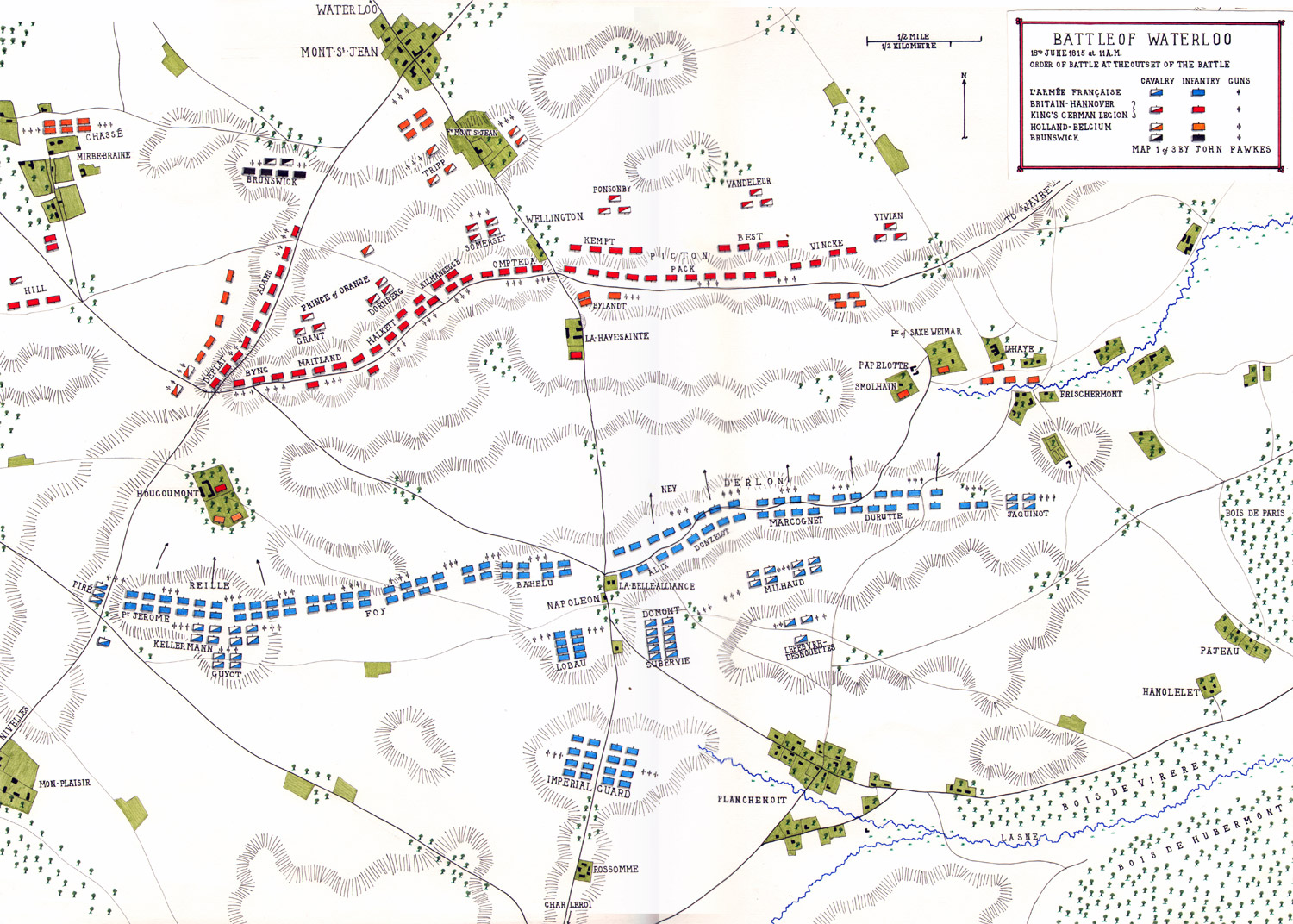
On the late morning of the 18th, the French attacked the house at Hougoumont, where Wellington had stationed some of his vanguard. The other fortified position, at the farmhouse at La Haye Sainte, was attacked a few hours later. The French managed to cut it off from the rest of the army. By around two pm, it looked like the French were winning.
Then the British cavalry moved in. Although Napoleon’s army had the superior reputation, the mud helped to make things a bit more equal. No horse, however skilled, can move fast when its hooves are deeply embedded in thick mud.
After that, came the infantry’s turn. When Napoleon attacked, Wellington formed the infantry into squares, with the cavalry in the center.
Then Wellington regained the farmouse at La Haye Sainte and the tide started to turn. The Prussians arrived and helped to reinforce an exhausted British army.
Napoleon finally committed his precious Imperial Guard. This was his last throw. By the time dusk had fallen the French army was in disarray and the day was won.
But as I said earlier, they didn’t just stop. It was a bit like putting out a big fire. They had to set a watch and cover the skirmishes and final flickerings of the great French army.
Like Wellington said, it was a damned near-run thing.
On the 24th June, Napoleon abdicated, and a few weeks after, was once again in custody, this time until the day he died.
After Waterloo? Britain went into economic depression, a lull that was only redressed when the middle class began its inexorable rise to wealth and influence. Lines and frontiers were redrawn. After Waterloo, nothing was ever the same again.

Lynne's books, "It Started at Waterloo" and "Dreaming of Waterloo" will be out in June, in time for the commemoration of the battle. 
https://www.samhainpublishing.com/book/5465/it-started-at-waterloo
"Dreaming of Waterloo" is part of a box set, and will be out soon.