Tuesday, March 17, 2015

Serendipity


Apologies for my absence, I took a break from historical fiction to write the second novella in my contemporary series set in Polvellan, a Cornish village not a million miles from the one where I live.  Writing something completely different in length and genre was exhilarating.  Fortunately it pleased the Boss and I’ve signed a contract to write more. 

Now I’m back in the C19th writing a sequel to ‘The Consul’s Daughter’ which is due out in July, called ‘The Master’s Wife.’ 

Because the first book ended after drama and upheaval with the couple finally recognising their love for each other, the challenge with this new one was to decide when it would begin and what precipitating event would turn their lives upside down.

Once I had chosen both, I still needed something more, something that would broaden and deepen the story.  It came via  one of those wonderful ‘serendipity’ moments.

Thirty-five years ago I attended a seminar by Screenwriting & Story guru, Robert McKee.  It was fascinating, exhausting and packed with useful information.  I made masses of notes and typed them all up when I got home.  But I had three young children and was writing for Mills & Boon where trying to apply what I had learned conflicted with the specific requirements of the genre.  So my notes got put aside. They went missing during a house move.

Then three days ago I received an email notifying me of the latest series of Story Seminars by Robert McKee. One is taking place in London from May 8th -10th.  I’ve shortened the email slightly. It began with:

‘Less than 1% of writers sell their scripts.’   (Shouldn’t that be ‘Fewer’?)
75% of your effort should go into designing the story. Only 1% of writers realise this.
Invest the time. Do the Work. Write the Truth. The Results Will Follow.
Story Seminar Content springs from these premises:
Story is about principles not rules
about archetypes not stereotypes
about eternal, universal forms, not formulas
about thoroughness not shortcuts
about the realities not the mysteries of writing
about mastering the art, not second-guessing the marketplace
about respect, not disdain for the audience
about originality, not chasing trends.
It goes well beyond the essential mechanics of screenwriting, and will elevate your writing from an intellectual exercise to an emotional one; transforming the craft into an art.’

I was seriously tempted.   The cost of the seminar plus rail fare plus at least two nights in London would be eye-wateringly expensive, even so...

Then I remembered that many years ago I bought a book called  ‘45 Master Characters.’  It describes in depth mythic models and shows how you can use and adapt them to create original characters. I read it when I bought it and it has been sitting on my ‘Books on Writing’ shelf ever since. 

I got it down and began reading. It covered much of the ground promised by the Story Seminar. Even better, I didn’t have to travel anywhere.

As I read I had a ‘light-bulb’ moment. Things that had felt stuck suddenly shifted and ideas started flowing. While I scribbled notes, I could feel that lovely bubbling excitement that comes when your gut tells you you’re on the right track.  All because of a marketing email. 
The crocuses?  Simply to celebrate spring. 

Jane Jackson.    www.janejackson.net

Sunday, March 15, 2015

Pockets and Ridicules

This month we welcome guest blogger Althea Mackenzie. Althea is Curator of Costume at Hereford Museum and Curator of the Wade Costume Collection, National Trust. She has a wealth of knowledge about all those sneaky questions that authors and readers have always wanted to ask about what Georgian and Regency people wore and how they wore it. Today, she's blogging about pockets and reticules or -- to use that lovely word of the period -- ridicules.


Over to Althea:

**************************

Our relationship with our bags and the 'essentials' housed within is not dissimilar to the relationship between the 18th century lady and her pocket. The nature of the essentials have changed slightly to include the mobile phone, but Henry Leigh Hunt's description in 1812 has some resonance:

'In one is her handkerchief, and any heavier matter that is not likely to come out with it, such as the change of sixpence. In the other is a miscellaneous assortment, consisting of a pocket-book, a bunch of keys, a needle-case, a spectacle-case, crumbs of biscuit, a nutmeg and grater, a smelling-bottle, and, according to the season, an orange or apple, which after many days she draws out, warm and glossy, to give to some little child that has well behaved itself.'

Frying Sprats with a large pocket
In a period when opportunity for privacy and security of personal property was limited, the pocket was an ideal solution, sitting as it did close to the body under the petticoat and the gown and only accessible through the pocket slits.  However, pockets were not totally secure as was shown by the number of convictions for crime associated with pockets - pockets being targeted by pickpockets or used for transporting stolen goods.


The radical change in fashion that took place at the end of the 18th century/early 19th century has often been associated with the emergence of the reticule. 

Boilly Checkers 1803
Such a revealing silhouette based on classical simplicity with high waistlines and skirts that fell close to the body and legs didn’t lend itself to a bulging pocket and yet so many of the dresses still have pocket slits. In 1809 in ‘Celia in Search of a Husband’ the young girl is asked ‘What is Fashion?  To which the reply is ‘fashion is not to wear pockets’.

A splendid reticule in a 1790s print

The speed to which women could have access to changes in fashion had been revolutionized with the growth of the printed word.  Access to materials was equally revolutionized, as was the emergence of a wage-based population who could shop. Gradually in museum collections we see the representation of a wider slice of society, not just the very high end of fashion but a combination of radical followers of fashion and the more conservative, such as those advised by Theresa Tidy in ‘Eighteen Maxims of Neatness and Order’ who wrote in 1819:

'Never sally forth from your own room in the morning without that old-fashioned article of dress - a pocket. Discard forever that modern invention called a ridicule.'


It looks as if dresses were made with pocket slits regardless of whether the individual continued to wear pockets or carried the new-fangled reticule, or indispensable, for those essential items.

A beautifully embroidered pocket


************************
Thank you, Althea. Fascinating stuff. I expect you'll get lots of comments and questions from our blog visitors.

Joanna 

Friday, March 13, 2015

Plus ca change...


I watched the commemoration service for the Afghanistan conflict today. A moving expression of a nation’s thanks to the soldiers who fought there. Some lost their lives, others came back damaged in mind and spirit.
Added to the recent death of a friend’s son fighting the forces of IS, and my thoughts are for the military men and women who work so hard.
My husband is from a military and navy family, with a tradition of enlisting. For them, it was a matter of “shut up and get on with it.” They have fought in all of the wars of the twentieth century.
I’m currently working on a book about the heroes of Waterloo, and these events have helped me to understand. I’m writing two novellas. One is about a civilian surgeon working after the battle, and the other is about a soldier who comes back from the battle damaged in spirit.
While PTSD is a fairly recent concern, it affected soldiers for centuries. It just wasn’t acknowledged. Until so many soldiers were affected by “shell shock” in World War One, and studies by Freud, Jung and others concentrated on the illnesses of the mind, it was considered of no importance. Men were sent back into war mentally unable to cope with it. On others it had a cumulative effect. Tracing back into history, the effects of this terrible, insidious illness are easy to track in some people, especially when a researcher knows what she’s looking for.
Recent events have indeed concentrated the mind wonderfully. A writer is a sponge, absorbing what happens around her and then pouring it out in a different form. In my research into the results and consequences of the Napoleonic Campaign, the evidence is there. Private journals and accounts of suicides point to people who found the strain of war too much to cope with. And yet they were told they would get over it, or even to “pull yourself together, man!”
This more enlightened age is currently seeing brutalities and horrors first hand. It’s reported on the news and it haunts us for a long time afterwards. Seeing it like that, there have been reports of people so badly affected that it has given them nightmares. A form of PTSD? Perhaps.
At the time of Waterloo, news travelled much slower. One of the last great conflicts before photography delivered the news to people’s doorsteps with visceral reality, it nevertheless affected the population deeply. The influx of unemployed soldiers and the agricultural depression led to another crisis. The ordinary person could retain a romantic image of war until they had personal experience of it, and then it was forced upon them.
But the difference in the effects of war, then and now? Not so much.

Saturday, March 07, 2015

Literature's Top Dog!

In a year that features some important anniversaries, a very special one was marked last weekend. It was the 200th anniversary of the publication of Guy Mannering, the 1815 novel by Walter Scott, which tells the story of Harry Bertram, the son of a laird, who is kidnapped by smugglers. The book, a rip-roaring historical novel set in the late 18th century was a huge success and sold out on the day of publication. Amongst a host of characters is a farmer called Dandie Dinmont who owns a number of terriers either called Mustard or Pepper depending on their colour.

In the two hundred years since the book was published the Dandie Dinmont terrier has become an established and now an endangered breed of dog. It’s antecedents if not its name go back to before the publication of Guy Mannering; Sir Walter Scott was a good friend of the 4th Duke of Buccleuch and there are paintings of both the 3rd Duke and Duchess with dogs that resemble a Dandie Dinmont. In one, by Gainsborough dated 1771, the 3rd Duke is holding a terrier and in another by Reynolds the Duchess is painted with the same dog.

The Gainsborough portrait created some discussion over the breed of the dog. Several people
claimed it was the earliest depiction of an otterhound or an Old English sheepdog but experts dismissed this. One wrote: “I
t is a large, rough Scotch terrier with all the look of a Dandie. The dog is no taller than an Irish terrier, for we put one alongside a tall man in just the pose in the picture, and the top of his clean head was as high as the head of the Duke's dog, shaggy coat and all.”

Sir Walter is recorded as having given presents of dandies to various friends and one of these was Old Pepper, whom he gave to the 4th Duke of Buccleuch. This dog was the founder of the Dandie Dinmont dynasty of today, siring Old Ginger, the ancestor of all modern Dandie Dinmont terriers.

These days the Dandie Dinmont is an endangered breed with only 300 puppies born worldwide last year. Walter Scott commended the breed for its vermin-killing abilities, its loyalty and its intelligence. As a working dog it was popular in the 19th century but when vermin-killing dogs were no longer in demand its popularity waned. From personal experience I can confirm that these lovely dogs make great pets. They have strong personalities, they are loyal, clever and very cuddly! It would be a pity if the breed was to die out and we would lose not only a very special dog but also a part of our literary heritage. 

Thursday, March 05, 2015

The Importance of Sons: a Trip Round my Victorian Screen

I have a nineteenth century screen in my sitting-room. It comprises four hinged panels: one side of the screen has a scarlet background,  and the other has a black one. It was a popular pastime for ladies to buy cut-out and varnished pictures to paste onto the screen, or perhaps into a scrap book, and create their own customized art-work.

Mine – dating it by costume – is roughly 1870s, and the young lady (for I’m sure it was a young lady) who once owned my screen chose to paste pictures which unwittingly demonstrates how rigid gender roles were at the time. Many of her pictures emphasize the importance of sons; daughters are there only in admiring roles. I found myself wondering if this reflected her own life.
 

New suit

The picture above shows a small boy standing on his mother’s dressing-table, holding her hand. One foot is negligently crossed over the other and he is looking, with some complacency it must be said, at his reflection. He wears a sailor suit with long trousers, known as a Man-of-War suit, and his hair is cut short.

According to the Cunningtons’ Handbook of English Costume in the 19th Century, Small boys between 3 and 6 years of age might wear tunics with white frilled drawers showing beneath them.’ And a number of fond mamas refused to cut a baby son’s hair – Elizabeth Barrett Browning among them. Her poor son, Pen, was forced to keep his hair long until his mother’s death, when he was twelve.

The boy in the picture has, fortunately, been spared the indignity of long curls and he obviously feels the importance of his new status: a sailor suit with long trousers (and a suitably manly name) and his baby curls cut off. His older sister stands by the dressing table looking wistfully up at him. No sailor costume for her.


It’s a boy!

This picture depicts a nurse showing the new baby – obviously a boy – to his five sisters. There is no need for a caption; the importance of the occasion is obvious. This is the baby that matters – now Papa will be happy. The girls, all dressed much the same, are merely decorative adjuncts.

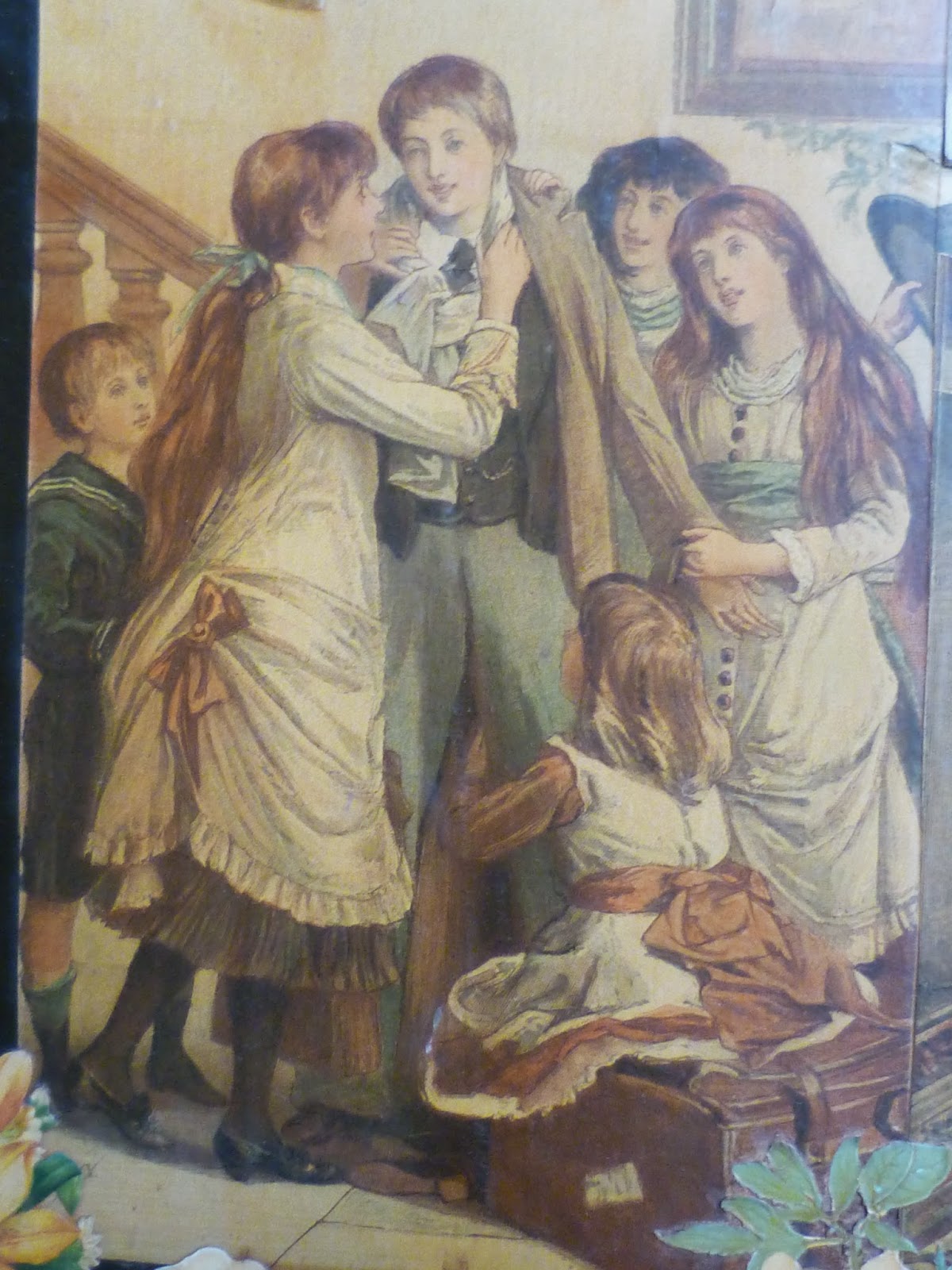
My next picture shows the return of an elder brother from boarding school. He has a fresh open face and he is smiling to see his sisters and younger brother again. His school trunk on the floor plainly shows that he is home for the holidays. The younger brother (in his sailor suit) looks up wistfully. One day, it will be his turn to go to a proper school. Again, adoring sisters crowd round.

 
Back from school

What strikes me is that the boys in the pictures are going somewhere; they are moving on – symbolized by the sailor suit and the school trunk. The girls have no useful role to play, apart from that of marriage and bringing future boys into the world. They don’t go to boarding school; they will have a governess at home.

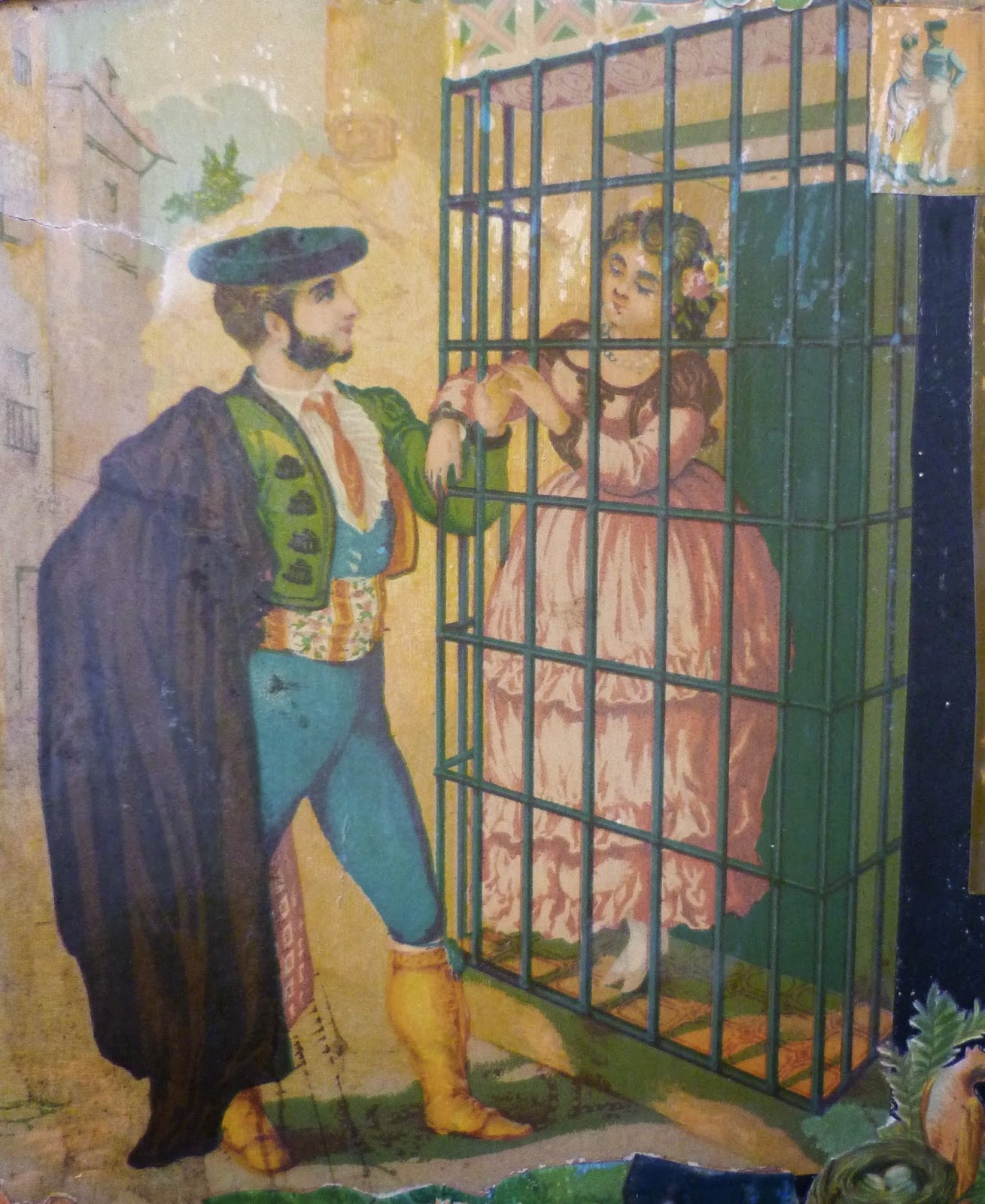
To what could a daughter aspire? Nothing much, according to my screen. There are a number of oval cartouches decorating the borders showing Latin lovers with the man serenading his lady. Tellingly, one lady is behind a grille – and her lover is reaching inside the bars to kiss her hand or, perhaps, to pass her a note.


Behind the grille

Apart from showing the importance of sons, the other major theme of my screen is romantic love. Alas, there are no pictures of girls being proactive, apart from a lovelorn lady posting a letter into a hole in a tree.


Love letter

There are plenty of stories on my screen but none are very positive for girls. The more I looked at the screen, the more I feared that the young lady who owned it had bought into the prevailing view that girls were to be Angels in the House, delicate creatures whose husbands would protect them from the rough outside world.


Sleigh Ride

The picture of the sleigh ride, for example, shows three young Cavaliers in 17th century costume (and they are certainly not Roundheads!) pulling a sleigh carrying a pretty little girl carrying a little dog. On the front of the sleigh, a carved cupid is about to shoot an arrow at one of the boys. The inference is obvious – shades of Lydia Bennet tenderly flirting with six young officers at once. You can see where my young lady’s fantasies are going.

Almost the entire screen is devoted to pictures showing the importance of the male sex; and romance appears to be the young lady's sole interest. I just hope her personal story had a happier ending than Lydia’s with Wickham. 

Elizabeth Hawksley

Tuesday, March 03, 2015

Flying Ambulances and German Sausages


With the imminent publication of Brides of Waterloo trilogy, Louise Allen, Annie Burrows and I will be blogging on aspects of the battle and our books over the next few months.  I am sure there will be lots of posts about the British army, but I thought I would redress the balance a little bit and talk about one aspect of the Napoleonic Wars where the French had the advantage. They invented and developed the ambulance.

When I first saw the term "flying ambulance" I thought it was something that had originated in Africa, or in the Australian outback. In fact it goes back much further than that.  It was Annie Burrows who first brought it to my attention, when we were planning our trilogy of stories. The Brides of Waterloo features a British artillery troop nicknamed Randall's Rogues and when Annie needed to get her wounded hero from the battlefield she calmly announced, "the French have ambulances, so the Rogues will steal one."

An intriguing idea, and I read more about the development of the ambulance in Dr Martin Howard's two wonderfully detailed books, Wellington's Doctors and Napoleon's Doctors.

For his day, Bonaparte was very forward-thinking when it came to the health of his army. He preferred prevention to medication and advocated good food, good hygiene, fresh air and high morale. He also supported the use of quinine and vaccination. He was known to support his surgeons and doctors and yet he was also capable of callously sacrificing huge numbers of men on ill-thought-out military schemes. He aroused mixed feelings in his medical staff, including those in civilian life as the years of the Empire drew to a close and the casualties in the French army rose to alarming proportions.

Weapons of war changed very little during the 18th century.  The effectiveness of the lead musket balls varied widely, a bullet could kill or it might inflict only a superficial wound that could cause little immediate pain and there are reports of soldiers digging out the balls themselves.  Howard tells of a French volunteer in 1792 who was shot in the hip. He dug out the ball and re-used it, shouting "look, this is how republicans fight!"

Soldiers facing cannon had perhaps more to fear. A soldier in the path of round shot was often killed outright, or had major injuries that required amputation because bones and tissues were so badly damaged. Then there were the sword wounds. Straight swords were used for thrusting and caused deep internal injuries, usually to the chest and abdomen, whereas a curved sabre was used for slashing at the head and arms. The heavy cavalry wielded a broad sword capable of breaking bones and severing limbs. And it was not only weapons -  there was the risk of being crushed by falling masonry or trampled by horses, or burned by exploding shells and fires in the undergrowth or buildings.

And if none of the above actually killed you, for survivors there was the risk of disease.

Normal practice in the 18th century was to leave the wounded on the battlefield until the end of the battle then send out litter-bearers to carry anyone still alive to field hospitals situated a mile or so from the site, where the doctors would remain safely away from the battle. Many of the wounded died before they could get to help or were never even moved from the field as many of the litter-bearers preferred to become looters and never carried their injured comrades to the hospitals.

However the Revolution had brought the welfare of the rank and file to prominence and by 1793  the French Revolutionary Authorities were ordering army doctors to remain with their men in battle or risk a charge of desertion. Many medical men were dedicated and courageous doctors and  happy to comply, and two of the most prominent of these were Pierre-Francois Percy and Dominique Jean Larrey. They were both surgeons in chief to Napoleon, and with the support of many of their colleagues they pioneered the idea of taking medical help to the wounded men. 

By 1772 the French were already using heavy wagons drawn by as many as 50 horses to carry medical supplies. These were large "ambulance hospitals" with hundreds of medical personnel to cater for up to 2,000 injured soldiers but they were slow and cumbersome.  In 1793 the National Convention even set up a competition to design a carriage suitable for transporting the sick and wounded. None of the designs proved a success, but it demonstrates that the provision of medical help was a concern. However, the doctors themselves were making more progress.

A "Wurst" c 1807
In 1792 Percy was the surgeon in charge of the Army of the Rhine and he formed a number of old soldiers and disabled men into a corps of stretcher bearers. The men worked in pairs to remove the wounded from the field and take them to the nearest mobile hospitable. Then, when all the wounded had been collected the corps assisted the surgeons in the hospitals.   Percy also designed an elongated vehicle with four wheels that was filled with surgical instruments, dressing, elastic sticking plasters etc. These vehicles were called "wursts", the German for sausage, because that is what they resembled. The top was rounded, covered in leather and provided saddle-like seating for up to ten surgeons and their assistants to sit astride. They had supplies enough to deal with upwards of a 1,000 casualties.  However, the vehicles were large and cumbersome and the lack of logistical support and a shortage of horses and supplies hampered their effectiveness.

These "wursts" were praised by officers but never in widespread use on the battlefield. However, Larrey designed a smaller, lighter but sturdy vehicle that was able to travel quickly over the ground. It could bring medical aid to men during the fighting and could carry away two patients lying down. His idea was to remove the wounded from the battlefield with all speed, so the surgeons accompanying these vehicles carried only the equipment required for first aid, and the more seriously wounded would then be removed to mobile hospitals close by. Larrey was supported by the medical men of the day and in 1797 he received official approval for his idea, which by this time included not just the light vehicles, but a whole medical organisation dedicated to treating the wounded and removing them from the battlefield as quickly as possible. The smaller, light vehicles also had the advantage that if one of them was lost it would not be a major blow as there were others to carry on the work.

These "flying ambulances" were a full complement of 340 men and over 30 wagons split into three divisions with surgeons, assistants, orderlies etc. each man with specific duties and his own role to play. Great attention was given to the medical equipment carried and the uniforms, everything had to be practical and useful. In 1798 Larrey also had the opportunity try out his ambulance system in Egypt– and when there was a shortage of draught animals he used camels to transport the wounded!

This was just the start of the ambulance system. Larrey was chief surgeon to the Imperial Guard, and their ambulance service was well organised by Larrey himself. For the rest of the army the ambulance service woefully inadequate but the idea was born and it had been shown that it could work.  

British doctors could only look on with envy at this advanced system of medical care. Today it seems a very logical idea, but it took another 60 years after Waterloo for the British to set up their trained ambulance corps.

And as a final footnote, Larrey had another innovative idea - he  wanted hospitals to be inviolable during war. This concept was much later taken up by the Red Cross and the Geneva Convention.

Melinda Hammond/Sarah Mallory

Published by Harlequin May 2015 -
A Lady for Lord Randall, 
first in the
Brides of Waterloo Trilogy