Saturday, November 07, 2015

Lady Elizabeth Berkeley and private theatricals

Minor characters are always fun to write and in my new book, House of Shadows, I have an “offstage” character, Lady Evershot, who is modelled on a famous Georgian aristocrat, Elizabeth Berkeley. Lady Elizabeth, the daughter of the Earl of Berkeley, married the 6th Baron Craven and they lived at Ashdown House for a couple of years, their two eldest children being born there. Alas the Craven marriage was not a happy one; from the earliest times Lady Elizabeth was complaining that her husband was uncultured and uncouth whereas she was more creative, an artist and a writer. After not many years they drifted apart and she had an affair with the French ambassador whilst he set up a mistress who styled herself Lady Craven, much to the real Lady Craven’s fury. Eventually she left her errant husband and travelled abroad.
The author Sybil Rosenfeld, in her book Temples of Thespis, describes Lady Craven’s subsequent life:
“She travelled about Europe for some years until she finally settled at the court of the Margrave of Anspach in 1787 as his “adopted sister”. In 1791 only a month after she heard of the death of her husband she married the Margrave in Lisbon and persuaded him to give up the ruling of his principality and retire with her and his fortune to England. Her precipitancy was considered indecent and, on her return, she found herself cold-shouldered by the court and high society. The Margrave, a stolid German who seems only to have wished for a peaceful life, purchased Brandenburgh House a country villa on the bank of the Thames at Hammersmith and spent the rest of his days there. His wife built a theatre in the grounds where she could entertain him and at the same time indulge in her favourite past time of taking the centre stage….
Despite the fact that the Margrave was related to King George III his wife was not received at court
as she was considered too scandalous. Nothing daunted, she spent her time at the races and organising private theatricals, which were often performances of plays she had written herself.
The theatre at Brandenburg House (interior pictured right) was built as a faux castle in the manner of Walpole’s Strawberry Hill and the productions were lavish and extravagant with the Margravine frequently centre stage. As a larger than life figure of the era, she was lampooned by the caricaturists of the time and described my Walpole as entertaining but “infinitely indiscreet.”
Perhaps private theatricals suited the former Lady Craven’s need to be the focus of attention and gave her the opportunity to assume a number of different roles and act out her fantasies. In that she was not alone since it was a popular entertainment in upper class Georgian society. Nevertheless she snubbed her eldest son’s wife who was a “real” actress, Louisa Brunton. The two were said to cordially detest one another. Perhaps it was envy on the Margravine’s part rather than snobbery!

Thursday, November 05, 2015

Byron in Albania

In 1809, Lord Byron arrived in Albania. As I've just visited Albania myself - where I kept coming across him - I thought you might enjoy a post about Byron's time there.


Lord Byron in Albanian costume by Thomas Phillips, 1814.

Albania, at the time of Byron’s visit, was part of an ailing Ottoman Empire. In theory, Albania was ruled by the Sultan; in practice, much of it was ruled by a ferocious and able brigand leader who later became known to history as Ali Pasha (1740-1822). The Sultan, forced to recognise Ali’s diplomatic and administrative abilities, as well as his military prowess, persuaded him to abandon brigandage and serve the Ottoman Empire instead. Ali did so to great effect and was rewarded in 1787 by being appointed Pasha. In theory, he was under the Sultan but, in practice, he extended his Albanian territory considerably to include much of northern Greece and ruled it more or less as an independent territory.    


Ali Pasha reclining in a boat

Ali developed his own independent relations with Europe, initially with Napoleon, but his main interest was the extension of his own power, in particular, establishing a strong Mediterranean sea presence. When he discovered, in 1807, that Napoleon was discussing plans with the Tsar to dismantle the Ottoman Empire, Ali switched sides and made overtures to the British.

In 1809, Byron left England for the continent on what he called a ‘pilgrimage’. In effect, it was a Grand Tour, taking in Portugal, Spain, Sardinia, Sicily, Malta and Greece, and it seems to have involved a lot of drinking, sex and scenery. In September, he arrived in Albania and headed straight for the court of Ali Pasha in Tepelene. He was twenty-one and Ali Pasha was sixty-nine.


View over the River Vjosa

Bryon was impressed by the scenery. In a letter to his mother, he called it: ‘a country of the most picturesque beauty’. His travels inspired Childe Harold’s Pilgrimage, the narrative poem which made his name as a poet, where his hero visits various countries and has adventures.

Here, Childe Harold describes the mountains in Albania:

Here roams the wolf, the eagle whets his beak,
Birds, beasts of prey, and wilder men appear,
And gathering storms convulse the closing year.

Wolves, bears and eagles are still found in the mountains.

Byron was even more impressed by the Pasha’s court. He wrote: ‘The Albanians in their dresses (the most magnificent in the world, consisting of a long white kilt, gold-worked cloak, crimson-velvet gold-laced jacket and waistcoat, silver-mounted pistols and daggers,) the Tartars with their high caps, the Turks in their vast pelisses and turbans, the soldiers and black slaves with the horses,…. The kettle-drums beating, boys calling the hour from the minaret of the mosque… formed a new and delightful spectacle to a stranger.’

He acquired an Albanian costume and wore it for his 1814 portrait by Thomas Phillips (see above), now in the National Portrait Gallery. And one must admit that he looks spectacular in it.


The Castle of Berat

Ali Pasha could not initially see Byron: he was besieging the castle of Berat. Perched on a precipitous crag, Berat is not a place to be besieged lightly, as you can see. 


View looking down from the castle of Berat.

When Ali Pasha returned, he received Byron with great honour in ‘a large room paved with marble; a fountain was playing in the centre; the apartment was surrounded by scarlet ottomans.’  Britain was now Ali’s ally and he may have viewed a visit by a British aristocrat as a compliment.  

Byron appreciated all that Ali Pasha did for him: offering him accommodation, servants, etc. and loading him with ‘almonds and sugared sherbet, fruit and sweetmeats.’  But he did not ignore his host’s other, darker side. As he wrote to his mother:

His highness is sixty years old, very fat and not tall, but with a fine face, light blue eyes and a white beard; his manner is very kind and at the same time he possesses that dignity which is universal among the Turks. He has the appearance of anything but his real character; for he is a remorseless tyrant, guilty of the most horrible cruelties, very brave, and so good a general that they call him the Mohametan Buonaparte.

Gjiokastra castle dominating the town.

At nearby Gjirokastra, another ancient castle substantially re-fortified by Ali Pasha in 1811, I came across Lord Byron again. There is a portrait of him in the castle but, alas, it is so dark with ancient varnish that it was impossible to photograph – but it is clear that Albania has not forgotten his visit.  

Ali Pasha spared no expense to make the castle impregnable as the huge vaulted rooms attest. It is built to withstand a siege with its huge water cistern, bread ovens, and bristling with weaponry.


Vaulted room, Gjirokastra Castle

Gjirokastra is a World Heritage site, not only for the castle but also for the unique series of late Ottoman houses that climb precipitously up the hillside. 


Ottoman house, Gjirokastra, built in 1811

We visited a typical wealthy Ottoman merchants’ house, built in 1811 by the Zekate family (who still live there). The reception room (men only) had a beautifully painted fireplace and elegantly carved wooden ceiling. There were divans skirting the room for guests, though not, alas, in scarlet. Women had their own quarters.


Fireplace in reception room.

Byron, in Childe Harold’s Pilgrimage has his hero come to the Pasha’s court and comments on women’s positon thus:

Here woman’s voice is never heard: apart
And scarce permitted, guarded, veiled, to move,
She yields to one her person and her heart,
Tamed to her cage, nor feels a wish to rove…

A view very convenient for men! Would the ladies of the harem have agreed, I wonder.

View from the castle of Gjirokastra

But Byron’s ‘pilgrimage’ was more than just an adventure and he wasn’t just a dilettante aristocrat traveller. He was honing his skills as a poet and working on Childe Harold’s Pilgrimage. (‘Childe’ is a young man of noble birth.) Harold is a young melancholy but defiant outcast with nameless sins in his past, traveling to distract himself. The first two cantos, which cover his Albanian travels, came out in 1812, and brilliantly depict the places, characters and events Byron saw. It also made his name as a poet. As Byron put it: ‘I awoke one morning and found myself famous.’  The rest is history.

Elizabeth Hawksley

Photo: Lord Byron by Thomas Phillips, courtesy of the National Portrait Gallery

Elizabeth travelled to Albania with Andante Travels: www.andantetravels.co.uk

Tuesday, November 03, 2015

GOVERNESS STORIES


My latest Sarah Mallory novel, Temptation of a Governess, is out this month and in a way it brings me round full circle. In 2009 I wrote my first book for Harlequin Mills & Boon, More Than a Governess. So after more than 20 books I have returned to the theme of education!


In the Regency there were very few ways a woman could earn money and being a governess was one of the more respectable occupations. The governess in my first book, Julianna, applied for the post of governess out of necessity. She had two young siblings to look after, and no money. She was therefore forced to confront the rather intimidating Major Damon Collingham. Here is her first impression of her new employer:-

"...In her cousin's hallway she had only seen the back of his head. Now, staring up into the harsh, unsmiling face, her spirits began to fade. He was very tall, and dressed with military precision – there was nothing of the dandy about him, she noted with approval: the long limbs encased in buff-coloured pantaloons and black books hinted rather at the athlete. His blue coat fitted perfectly about his broad shoulders and the crisp whiteness of his shirt and cravat enhanced his dark complexion, tanned by years in the sun – she knew he had been a soldier, and guessed he had seen action in the Peninsula.  His bearing was upright and looked as solid and unyielding as his countenance.  His voice, when he spoke again, was tinged with impatience."
© Sarah Mallory, More than a Governess. Harlequin 2009


My latest heroine, Diana Grensham, has a different dilemma. She chose to become a governess to her niece and another young relative rather than face the ordeal of a society presentation. She is very happy living in comfortable seclusion with the children until their joint guardian, Alex Arrandale, wants her to vacate his property! This is Diana's view of her adversary:-

"He was a perfect example of the notorious Arrandale family and nothing like his staid and respectable older brother. Now, sitting beside him in the curricle, she was very aware of the size and power of the man. His shoulders were so broad it was impossible not to bump against him as the vehicle swayed on the uneven carriageway, and he was not even wearing a many-caped greatcoat to add to their width, merely a close-fitting coat that was moulded to his athletic body with barely a crease. His hands, encased in soft kid gloves, guided the team with the ease of a master and the buckskins and top boots he wore could not mask the strength in those long legs.

It was not that he was handsome, she mused, considering the matter. His features were too austere and rugged, the nose slightly crooked, possibly from a blow, and there were tiny scars across his left eyebrow and his chin that were doubtless from some duel. His dark-brown hair was untidy, ruffled by the wind rather than by the hand of a master, and beneath his black brows his eyes, when they rested on her, were hard as slate."

© Sarah Mallory, Temptation of a Governess. Harlequin 2015

It wasn't until I began to write this blog that I realised these men are quite similar, both dark, powerful and unyielding. Damon is an ex officer and Alex a man of fashion, but they are both used to getting their own way. However, they meet their match in Julianna and Diana. Damon Collingham needs Juliana because no other governess can cope with his children and she sets out to heal this rather dysfunctional family. Alex Arrandale is a confirmed bachelor who knows nothing about family life, and doesn't want to! Diana engages Alex in a battle of wits that teaches him to care about his wards and in the process she grows in confidence, too.

I am so pleased I have been able to return to this theme. What is it you enjoy about governess romances? Is it the unequal battle between employer and employee, or perhaps you having children in the story. Do tell me!


Sarah Mallory/Melinda Hammond

Tuesday, October 27, 2015

Taxes

Jo Beverley here talking about taxation.

I find that taxes aren't mentioned much in historical romances, but they've been around for a long time, and I'm sure most Regency people felt as taxed to death as we do today.

Can you think of a historical romance that mentions taxes, or even better, uses them as a plot point? All those impoverished families in search of a rich marriage might want to look closely at their taxable assets instead. Get rid of the carriages and block off some windows.

I'm going to mostly describe the small taxes, but a word first about one we all know well.
Income Tax was introduced as a temporary measure (ha!) to help pay for the Napoleonic Wars. It began at a levy of 2 old pence in the pound (1/120) on incomes over £60 and increased up to a maximum of 2 shillings in the pound (10%) on incomes of over £200.  £60 was a modest income, but the tax would only be 120d, or 10 shillings a year. A comfortable income of £1,000 a year would mean paying £100 a year, which would pinch a little more. It was, as we'd say today, a progressive tax as the rich would pay more than the poor.

You can read more about the progress of income tax here. 

It was abolished in 1816 and didn't return until 1841, so the characters in my recent books, all set in 1817, didn't have that burden to bear. But let's look at some others. One interesting thing is that they're all designed to tax wealth, so they were more socialist minded than we might expect.

Window Tax.
This was introduced in the 17th century as a tax on wealth and had the advantage of not obliging people to disclose their income and being cheat-proof. Windows are pretty obvious. It levied 2 shillings per house, and then the amount went up according to the number of windows, up to 8 shillings if the property had over twenty windows. I'm sure the owners of Chatsworth and Blenheim really felt the pinch! Some people bricked up windows to reduce the tax.
The picture shows bricked up windows on one side of a house on St. James's Square in London. I can't be sure they were bricked up to avoid the window tax, but it seems likely.

On to the others.

1. Armorial bearings -- if you have them and keep a coach, £2-8s pa. If you have them and don't keep a coach but are liable to house duty £1-4s. All others, 12s

2. Vehicles. If you keep a four-wheeled carriage for pleasure, £12 pa and it goes up, getting more expensive per carriage so that if you have 9 or more you'll pay £163-7s pa. And people complain about vehicle licencing today! That would be two or three times the annual income of a skilled worker, so we could say the equivalent of £80,000 or more. (c$120,000)

If you're living simply and only have one two-wheeled carriage drawn by one horse -- tax due £6-10s.

There were taxes on carriages let for hire, and on every carriage made, plus taxes on selling them and doing nearly anything to them because owning a vehicle was a sure sign of wealth.

3. Horses. The carriages aren't much use without horses. Again, there's a sliding scale from £2 17s 6d for one horse, reaching  £6-12 for twenty. That seems quite moderate, so perhaps having a horse was not seen as such a sign of wealth as having a carriage.
 
4. Dogs. You can own one dog and be tax-free, but more than one will cost you 14s for each. Greyhounds were taxed at a pound per dog pa, presumably because they had no use except for racing. Though I haven't come across much about greyhound racing in the Regency.

5. Hair powder.  By the Regency that's out of fashion except for court, but if you do wear it you have to pay £1 3s 6d per annum for the privilege. Exempt are the royal family and their servants; clergymen whose income is less than £100; naval personnel below commander; subalterns or lower in the army etc etc. There's a very odd line in the regulations. "No person to pay for more than two unmarried daughters." Perhaps a typesetting error? Or if you're unfortunate enough to have many unmarried daughters they can powder at will?

6. Houses -- 1l 6s up to £2 10s

7. Servants. Male servants are taxed at £2 8s for one up to £7 13s for eleven and up. Note, bachelors pay an additional £2 a year for every manservant. Bachelors were generally disapproved of and dinged in any way possible. Disabled officers on half pay may keep one servant duty free. There's nothing about female servants, so I assume the penalty for male servants is because they were a status symbol, and also the legislators might feel men could be employed in more worthwhile jobs. Anyone giving a servant a false character could be fined £20. That could be a plot point!

And then there are all the taxes on tea, sugar, beer, lace etc etc etc

Are you surprised by any of these? It must have meant quite a bit of book keeping even in a moderate household, and an enormous bureaucracy.

What would you tax today to particularly zap the wealthy over-consumers? Sports cars? Expensive handbags and shoes? Enormous houses? Too many bathrooms?

Cheers,

Jo
Visit my web page for more about my books.

Sunday, October 25, 2015

Jane Austen Lives Again - Jane Odiwe

In my new novel, Jane Austen Lives Again, Jane is brought back to life in 1925 and has to get a job. Her doctor finds her a position as a governess to five girls in Devon, and though Jane is rather dreading the whole thing, she knows that without any money to live on she has little choice. Her only hope is that she'll have time to write in the evenings when the children are in bed …

Here's an excerpt from Chapter One - I hope you enjoy it!
 Jane and her doctor are travelling to her new home in Devon by train.

‘Manberley Castle sounds like a title for one of my books,’ Jane said at last, pushing all memories of the past from her mind. ‘The Miltons of Manberley has a lovely ring to it, perfect for a novel.’
Dr Lyford smiled. ‘I believe it dates back to the twelfth century, though I’m assured there are more modern additions. The last building took place in about 1815 so you should feel quite at home.’
‘And how did the Miltons come by their money?’
‘Well, they’re sugar millionaires, so I’m guessing their family history and wealth was built on the misery of others.’
‘Ill-gotten gains, how perfectly dreadful, and at the expense of so much human suffering, though in my day those who profited from the trade of their fellow men had no qualms in doing so. It is a fine thing to learn that such abhorrent practices are completely stopped. I hope the Milton forbears had a conscience, and helped to put right the wrongs of previous generations.’
‘I couldn’t say, Miss Austen. I am certain Sir Albert Milton is like most men of his class since the war; still trying to hang on to the life he’s always known and enjoyed, that of squire and landowner. But times are changing, and their way of life, though seemingly luxurious to many, is not quite as lavish or extravagant as it was once upon a time. I believe Sir Albert is still very much the gentleman of leisure, though his heir seems to have a lot more about him. He runs the estate, providing much employment for local farmers and workers. By all accounts William Milton is very much a modern man, not afraid to get his hands dirty.’
‘Quite right, too. I’m not certain I could be in the employ of a feckless family content only to laze away their days. You mentioned there is a lady of the house … is she an idle creature or am I to expect hidden depths? Is Lady Milton a useful sort of person or one inclined to lie out on a sofa?’
‘With five girls I expect she has her hands full, but I’m afraid I don’t know anything much about her ladyship or her children.’
‘Though you say she is a second wife, and I’m guessing William is the son of his first.’
‘William is in his late twenties, I believe, and the succession of younger girls most likely from a different mother, I shouldn’t wonder.’
‘But you do have a list of their names? I must try and familiarise myself with them.’
Dr Lyford took out his wallet from his jacket pocket, pulling a piece of paper from inside. ‘Yes, here we are. I’ve written them out and made some brief notes. I was able to talk to the housekeeper on the telephone. Her name is Mrs Naseby; rather an abrupt and evasive woman, but seemed able to distil the essential personalities of the children in one or two words. I thought it might help … give you an idea before you meet them.’
Jane grasped the paper and read. ‘Alice … kind and considerate, Mae … needs a tight rein, Beth … headstrong, Emily … has rather too much her own way, and Cora … reads excessively. Goodness, if I’d read this before, I’m not sure I would have agreed to your plans, though Alice sounds promising and Cora is clearly a little girl I could get along with.’
‘Which is precisely why I haven’t shown you this previously. I did wonder if it was a good idea, but I do think Mrs Naseby has probably not painted the Milton girls in the best light.’
‘I should say not. Heavens, whatever shall I do?’
‘Think of this job as a temporary measure. I couldn’t find you any other employment with your limited experience, and at least if you can stick to it, you’ll gain some valuable skills along with a reference at the end of a year or two.’
‘A whole year … or two.’ Jane found it hard to keep the dismay from her voice. She couldn’t help thinking about her dear friend Anne Sharp who’d been a governess to her niece Fanny. Sweet Anne who’d always been a constant source of pleasure, a clever, witty woman, cheerful and capable, the most uncomplaining person she’d ever known, and always determined to get the best out of life. If Anne had managed it, then so could she.
The train was pulling into the station. Dark, sullen clouds up above were brimming with raindrops like the tears she felt welling inside, and before she’d gathered her belongings, the heavens opened. Water fell in torrents, pattering on the roof of the Victorian waiting room, gurgling down the drainpipes and running in streams along the platform, dribbling down the name painted on the station sign. Jane rubbed at the misty glass with a gloved hand, and peered out anxiously. Stoke Pomeroy looked grey and unwelcoming, cold and dark, despite the fact that it was the beginning of June.
‘This is where we part company, Miss Austen,’ said Dr Lyford. ‘Now, you have my address and telephone number in Dawlish if you need me. I shall be there for six weeks before heading back to London.’ He looked at his companion of whom he’d grown very fond in the last few weeks. ‘Do call or write if you need anything.’
Jane took a deep breath. ‘I shall be perfectly fine, Dr Lyford, do not worry.’
‘Sir Albert said there’d be someone to meet you.’ The doctor opened the door, stepped onto the platform briefly and called the porter to take her suitcase.
‘Thank you, Dr Lyford, thank you for everything.’ Jane knew the words were vacuous, but it was impossible to express just how she felt. If only she’d written him a letter, she thought, the written word always came so much more easily. She watched him step back inside the train, shutting the door with a finality that left her shuddering with fear at the thought of being alone. Jane told herself to stop being so silly and extended her hand through the window, shaking his vigorously.
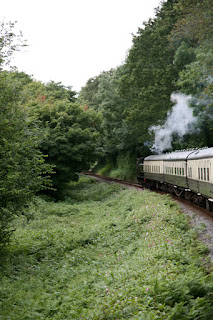
The guard appeared, doors slammed, a flag waved and the great beast ignited once more shunting off in loud roars leaving a trail of dragon’s breath behind it. Jane watched her doctor being taken away, and suddenly felt rather alone. No one else had got on or off the train apart from herself and she wasn’t quite sure what to do, as she waited. Struggling with her umbrella to prevent getting any wetter, she got it up at last and walked up and down the platform. There didn’t seem to be anyone waiting for her and then she wondered if perhaps there’d be a pony and trap with a trusted servant waiting outside beyond the gate. Handing her ticket to the man at the exit she stepped out of the safety of the station to discover there was nobody waiting for her there either, but there was a bench under a shelter so she took a seat and watched the rain gurgling in the gutters and bouncing off the road like large pennies.
Nothing could have surprised her more than the sight of a sleek black motor drawing up a few minutes later, and a liveried chauffeur stepping out to address her. Dressed in navy with a smart peaked hat and leather gauntlets, he took her case and opened the rear door with a flourish. ‘Miss Austen, please take a seat.’
Jane had never been in a car before, though she’d taken a trip into Winchester with Dr Lyford’s housekeeper on the omnibus. She was relieved to be sitting in the back of the vehicle and glad to see a glass partition dividing her from the driver in front. Forced conversation with a stranger was never a very useful activity to her mind, and she didn’t want to chat to the chauffeur. He didn’t look like the talking sort, and for that matter, wasn’t quite what she’d expected at all. He had a very cock-sure way about him, and an arrogant air, which made her feel most unsure of herself. Jane needn’t have worried; he didn’t speak though once or twice she caught him watching her through the rear view mirror which was unnerving, to say the least. She noted his dark hair underneath the cap, and the way he drove with his head on one side, his elbow resting on the window and one hand casually holding the wheel. He was speeding down the narrow lanes, which made Jane shut her eyes and hold onto the strap as she swayed from side to side. It wouldn’t do to be ill, she thought, as she opened one eye to see the world flashing past in a blur of green hedges and cow parsley.
They were ascending out of the valley when she saw her first glimpse of the sea, a slice of lavender ribbon under an oppressive sky, and as they wreathed along the cliff top road she saw the greater expanse below, white horses crashing down on the beach, and a strip of sand stretching along an endless coastline.
The car finally slowed and she saw the chauffeur’s hand reaching for the partition to slide it open.
‘I’m sorry if my driving is a little fast,’ he said.
Jane met his gaze in the mirror. He was staring intently again and she didn’t know where to look. It made her feel very uncomfortable and she had the feeling he was enjoying her discomfort.
‘I must admit I prefer a slower pace,’ she answered, ‘I am not used to being driven about.’
‘I’ll try my best to drive as you wish,’ he said, his eyes still on her face. Jane wished he’d watch the road, and although there hadn’t been another vehicle anywhere since they’d left the station, she was sure they’d meet with an accident sooner or later if he persisted on staring into her eyes.
There was silence for a while for which she was glad, and then the car turned off the road into a drive between tall rusted gates with ornate gateposts topped by crumbling stone urns. A gatehouse looked neglected, ivy climbed over the windows, which were fogged with green moss and mould. There was no keeper to welcome them or wave them through; there’d clearly been no occupants for a while.
‘Have you been a governess long?’ he said at last.
‘Not very long, no.’
Jane thought his questioning impertinent and pursing her mouth stared determinedly through the window at the overgrown tangle of laurels and rhododendrons on every side, bursting into flower and dripping in the rain. Her first impressions of the place were not exactly  reassuring, but she hoped things might improve as they reached the house.
‘The Miltons are an undemanding bunch,’ the driver went on, ‘though what some folk might call slightly odd or eccentric, I suppose.’
Jane regarded the back of the young man's head steadily. ‘I prefer to make up my own mind about people, I thank you, but in any case, I do not think this is a subject for conversation. I dislike gossip and I would appreciate you refraining from further discussion on my new employers.’
‘Just as you please, Miss Austen.’
He appeared to find her amusing, she noted, as he made no attempt to disguise the laughter in
his voice. He kept his eyes on the road after that and as they drove up the long drive the house made an appearance at last in open ground, a gloomy Palladian façade that time seemed to have forgotten with rows of windows on either side of a central pediment. Crouched on a cliff top, the house would enjoy astonishing sea views, Jane thought, and with the stunning scenery of hanging woods on the other side where the village of Stoke Pomeroy could be seen happily nestled in the valley, she decided she’d never seen such a splendid situation. A tower, the only remains of the oldest part of the ‘castle’ formed an extension on the west side with crenellations, and gothic windows clearly added at a later date. But for the peeling stucco and an air of abandonment, the house should have been the jewel in the crown. Lashing rain and skies as green as gunpowder added to the general sense of despondency and Jane felt her spirits sink. The chauffeur swung the car round to the left and to the side of the building.
‘You’ll find the servant’s door at the bottom of the steps,’ he said, and without another word handed her out of the car and deposited her suitcase at her feet before getting back into the vehicle to roar away over the gravel drive.

Jane stared after him hoping she wouldn’t have much occasion to see him again. He thought far too much of himself, she decided, and with his brooding good looks she was sure he must create havoc amongst the maidservants. Overhead she heard the mournful mewing of wheeling gulls, and tasted the brine of the sea on her lips.  Taking a deep breath, she picked up her case, and opening the cast iron gate at the top of the stairwell made her way down the steps until she reached the small door at the bottom.

Jane Austen Lives Again will be available for pre-order on Kindle next week and published in November.

Saturday, October 17, 2015

Getting to Know You – Joana Starnes

Hi, I am Joana, and I would like to start with a big ‘Thank You’ to Jane Odiwe and Amanda Grange for inviting me to contribute to Historical and Regency Romance UK. I am delighted and honoured to be here. 

Since this is my first post, I thought that saying a little about myself would be a good way to start.

I have been fascinated with history and the classics for as long as I can remember, even though for many years I thought this fascination, as well as writing fiction, would be nothing but a sweet indulgence as I went on with the sensible business of day to day life.

For many years, day to day life meant medical school, then lecturing in Physiology followed by a career in medical research – not quite the norm for a history fanatic and an Austen devotee.

Fast-forward a decade and a half and, although nearly everything has changed, my fascination with history and Jane Austen has not. As many before me, I discovered her novels in my teens, but real, full appreciation came much later, when I could begin to understand and delight in the social commentary, the playful narrative, the exquisite sense of humour, rather than merely follow a compelling story line.

Needless to say, the 1995 Pride and Prejudice adaptation was a turning point, though not because of the famous wet shirt. If anything, for a very long time I felt that, for all the exquisite suspense accentuated by the background music rising in skilful crescendo, the wet shirt scene rather distracted the viewer from the original message. Miss Elizabeth Bennet’s encounter with Mr Darcy in the grounds of Pemberley would have been fraught regardless of the aforementioned garment, wet or otherwise. She would have been mortified even if the gentleman had not been discovered in some state of deshabille, merely because she must have been painfully aware that she had no business to be found wandering through his grounds, after rejecting his proposal in so harsh a manner, and for reasons that had been proven at least partially wrong. Likewise, his own discomfort at coming face to face with her without any warning would have been sufficiently severe even without pond water seeping into his riding boots.

Such reflections aside, the scene is delightfully romantic, as is the other famed one, later in the music room. But that was not the only reason why I found this adaptation to be a turning point for me. The greatest attraction lay in learning all the fine details of its production. The painstaking efforts to research the location, the costumes, the hairstyles, the music the characters danced to, the games they played or the food they ate. All of a sudden, I wanted to learn more about the era. Details of daily life, mealtimes, travel, the plays they would have seen in town, what London must have looked like, what books they read, what artists were in fashion. What prominent figures dominated public life? What was the sequence of real-life events that influenced their present and their future?

And so it came to pass that soon afterwards I became a fixture at my local library and all the second-hand bookshops and National Trust properties within driving distance, and some a great deal further than that. Everything was fascinating. Diaries, letters, portraits, antique prints. And of course the Internet, an inexhaustible source of information, and I squirreled away everything that I could find. It was only a matter of time before I discovered that I was not alone in this growing interest – or perhaps I should say obsession – and that an entire industry, as well as countless websites, were devoted to Jane Austen and Austen-related fiction.

So it was also just a matter of time until my fascination with history and Jane Austen was channelled into writing works of fiction of my own.

I have so far published five Austen-inspired novels and, to my great pleasure and no less surprise, they were very well received. They include a Pride and Prejudice sequel, two variations involving characters from Pride and Prejudice, Sense and Sensibility and Persuasion, another that brings the protagonists of Pride and Prejudice into Poldark territory, to the far reaches of Cornwall, ‘into a world of deceit and peril, where few – if any – are what they seem to be’ and lastly my most recent novel released a few weeks ago, a Pride and Prejudice variation exploring a most unsettling love triangle.


More details about The Unthinkable Triangle and my four other novels can be found on my website (www.joanastarnes.co.uk), and also on Facebook (www.facebook.com/joana.a.starnes ) and Twitter (www.twitter.co/Joana_Starnes ). I hope you will visit and will like what you see.


Tuesday, October 13, 2015

The Other Anniversary this year

The Earl of Mar
While everyone is commemorating and celebrating the victory of 1815 at Waterloo, there’s another event that should be remembered this year, equally important to the British people
In October, 1715, the Jacobites were defeated. This was the nearest the Jacobites came to regaining the throne, nearer than the ill-fated campaign of 1745 that led to Culloden.
James II turned publicly Roman Catholic after he married his second wife Mary of Modena. After that, the clock was ticking, and in 1689, he was deposed. His daughter Mary, and her husband William of Orange gained the throne, followed by James’ other daughter, Anne.
Anne gave both to at least 14 children, and none of them reached adulthood. Just think about that for a minute. Anne’s tragedy led to a political crisis on her death in 1714. The Tories lost power, and the Whigs came to prominence. The Tories were not pleased.
It had already been decided by the oligarchy that George of Hanover was the next in line. If Anne had died earlier, Britain would have had an astonishing woman as queen, and what’s more, three Queen Regnants in a row, which is quite something. But Sophia died, and her son George came to the throne.
George couldn’t speak English very well and he’d locked up his wife, Dorothea, for adultery, so he came over alone. Well, except for his two mistresses.
The change in regime all played into the Stuarts’ hands. You think James II gave up? Not a chance, and his son, James Francis, known as the Old Pretender, took on the fight.
What with the change of political party, the French not being friends with the British and the Catholics in Rome decidedly not happy with Britain throwing one of their own out of the country, James Francis had a strong chance.
The Stuarts tended to come in two varieties – the idealistic, not-so-bright ones, (Charles I and James II) and the clever, cynical ones (James I, Charles II). They were also a bit fixated on two male names, which makes matters confusing for us. Guess what James Francis called his son? Yep, Charles.
James Francis was one of the clever ones. Later, when all hope of the Stuarts regaining the throne had gone, he set to politics, gaining leverage as a political influence in Europe. But in 1714, he prepared to attack.
What, you thought it was all about the Scots? They were just the patsys the Stuarts used (twice). Scotland was a easy way into the rest of the country, and the citizens were disgruntled.
In August, the standard of James 8th and 3rd was raised. That officially started the campaign. In return, Parliament said that anyone loyal to the Crown, whose landlord was a Jacobite, could take the land. Pretty sneaky move, that.
In October, the Earl of Mar had gathered 20,000 men and officially received James’s sanction. He marched. Or rather, he rode while the troops marched. They swept through Scotland, taking lands and castles with them.
The first battle was at Sherrifmuir. The Duke of Argyll, for the Crown, didn’t have nearly so many men, but he met Mar anyway. For some reason Mar retreated. Don’t ask me. Actually, don’t ask him either.
It was looking bad for the Crown.
Disaffected Catholics in England also joined the rebellion, although some sat on the fence and awaited events. A rebellion was planned, but Parliament got hold of the ringleaders and locked them up. The Scots lost the initial impetus. Hesitation and lack of experience proved their downfall, plus that other factor, the “Yes, of course I’ll join you,” factor, but when pressed, they changed their minds.
The turning point came in November, at Preston. The Battle of Preston was a really close-run thing, as Wellington was to say a century later. The Jacobites were winning until the government sent reinforcements, but it was still close. And bloody.
James didn’t land in the country until December, and by then it was all over. If he’d arrived sooner, or if the Scots had taken advantage of their superior resources at the beginning, they might have done it. They might have forced a split, and the Stuarts could have reclaimed Scotland, but they did nothing of the kind. They went home, which then was in Italy.
If the Stuarts were to regain the throne, they would have done it in 1715.
By contrast, the more famous 1745 rebellion was a blip.

Buy the Emperors of London series from Lynne Connolly and find out what happened after Culloden! (or did it?)

http://lynneconnolly.com/series/the-emperors-of-london/ 


Sunday, October 11, 2015

In Praise of Jean Plaidy

Jean Plaidy- even now the name conjures up warm, happy memories. Her novels were the first grown-up books I read as a teenager, in common, I suspect, with many other women of my age. It was her historical romances that gave me an abiding interest in Henry VIII’s six wives with what to me is a real, passionate understanding of each woman - I felt I knew each one personally. The first Jean Plaidy I ever read was ‘Murder Most Royal’, about Anne Boleyn and Catherine Howard, and I remember the painful pleasure I felt with each of Anne’s triumphs as she became more powerful, even though I knew she was doomed. Catherine I just felt so sorry for; she didn’t stand a chance against the scheming of her greedy, selfish family; their total abandonment of her when she fell out of favour was heartbreakingly poignant. But it was Anne I gave my heart to; the book coloured my view of her so that to this day she is my favourite queen of England ever. I don’t care that she was selfish, arrogant and sometimes even cruel. She played the meagre hand she was dealt in life as a Tudor woman with subtle skill and nearly won. If only Elizabeth (my second favourite queen) had been a boy, her position in Henry’s court would have been unassailable.   
After that I was hooked and a visit to my local library was never complete without at least one Jean Plaidy book in my hand. There was a time when I could name all the Plantagenet kings and queens, all the Stuart kings and queens, and even knew which Hanoverian George was mad/ fat/ completely German and only saw Britain as a source of money. I remember writing about the Jean Plaidy books in my English language ‘O’ level, and waxing lyrical about how it made me feel as though I were transported back in time to each court. I often wonder what the examiner reading my paper must have thought. Still, I got a ‘B’ grade (and of course in those days, dear readers, as we know, the exams were much harder!) so I didn’t do too badly. I looked JP up on Wikipedia (fantastic resource – the novelist’s friend) and discovered that her real name was Eleanor Hibbert and that she wrote more than 200 books, including murder mysteries and crime thrillers. I now feel totally inadequate and so am signing off to try to complete my sixth novel. Only 194 to go!

Jacqueline Farrell writes historical and paranormal romances with The Wild Rose Press. Her two latest novels 'Sophronia and the Vampire' and 'Maids, Mothers and Crones' can be purchased from Amazon. Follow her on twitter @jacquiefw1 and on her website www.jacquelinefarrell.co.uk


Friday, October 09, 2015

Regency Quintet Christmas Edition

I'm delighted to tell you all that despite the fact that the weather is still mild, that Halloween and Bonfire Night have yet to come, the Regency Quintet Christmas Edition has been published. This is our third edition and we are all just a little excited about it. Not only does it have another beautiful cover, courtesy of Jane Dixon-Smith, but it also has three brand-new books within its covers. As the box set contains three new, never-before published books and two other brilliant stories, it's an absolute bargain at £1.99.

A Most Unusual Christmas, A Merry Christmas Chase and His Lordship's Christmas Bride were all written especially for this Christmas box set. Here are the brief blurbs for each book.

A Most Unusual Christmas by Fenella J Miller
Miss Cressida Hadley is delighted when Lord Bromley and his family are unexpectedly obliged to spend Christmas at The Abbey. However, falling in love with Lord Bromley hadn’t been part of her plan.

Winter Inheritance by Melinda Hammond
Governess Verity Shore longs for a little adventure, then Rafe Bannerman arrives to carry her off to Highclough and Verity discovers that life can be a little too exciting!

A Merry Christmas Chase by Monica Fairview
A penniless lady is caught poaching by a lord, but when she flees to her rich aunt’s manor, she finds the same man is her aunt’s house guest.

His Lordship’s Christmas Bride by Elizabeth Bailey
Isolde Cavanagh seeks refuge with her father’s old friend and finds a reluctant guardian in his son. Richard de Baudresey.

The Six-Month Marriage Amanda Grange
Desperate to escape her brutal uncle, Madeline Delaware enters into a marriage of convenience with Philip, Lord Pemberton. On the night of the Christmas fete they give in to their feelings but it is not until they vanquish a woman from Philip's past that they find the happiness they deserve.

This universal link viewBook.at/Regency5xmas will take you to your own Amazon.

I hope I've whetted your appetite for our Christmas Regency collection,

Still on the subject of Christmas, I also have a new Christmas story out that isn't in the collection.
Christmas at Castle Elrick is a Regency fairy tale, with Miss Verity Sanderson as  the beauty and Sir Ralph Elrick as the beast. He was severely injured in the Napoleonic wars and has been brooding in his castle for years waiting for Verity to reach her majority and come to him. Her father had promised his daughter to Ralph in return for his financial support. Verity decides marriage to a wealthy stranger is preferable to remaining with her step-mother and half-sisters and so she sets off, the week before Christmas, to become his wife. Castle Elrick is a cold, unwelcoming place situated on the bleak Northumbrian coast and Ralph and his small staff are not the only residents. Will Christmas be a celebration or will the ghosts of Castle Elrick force them apart?

You can buy Christmas at Castle Elrick from Amazon: US ($0.99)  UK (£0.99)


Wednesday, October 07, 2015

HMS Victory - Pretty in Pink?

It was reported in the weekend papers that HMS Victory, Admiral Lord Nelson’s flagship, has had a historically accurate repaint and is now pink, which was the colour it was at the time of the Battle of Trafalgar. Previously the ship had been a mustard colour, which I thought was the standard Royal Navy paint colour for 18th century warships, but apparently not. When Victory was first built in 1765 it was plain varnished timber but later in the century, captains were permitted to paint their ships whatever colour they chose.

Whilst richer captains chose more ornate and expensive colours, Thomas Hardy, captain of the Victory, could not afford to customise his ship and so opted for one of the free pigments that the Royal Navy offered.  These would typically have included black, yellow ochre and red ochre. It was only after Trafalgar that Nelson’s famous yellow and black checkerboard design became standard. Earlier ships also had lots of decoration; The Royal George, for example, had a bust of King George II on its stern, and figures of Britannia, Neptune, Ceres, Mercury and Hercules. It also had rich interior decoration with mother of pearl handles on the cabin doors.


It was whilst conservationists were working on restoring Victory that they examined all the layers of paint on the ship – 72 – and discovered it’s original pink hue. Some have called the colour smoked trout, others pale terracotta. Ships like the Hermione, pictured right, were bright blue. Personally I see nothing wrong in pink. It was good enough for Nelson. What do you think?