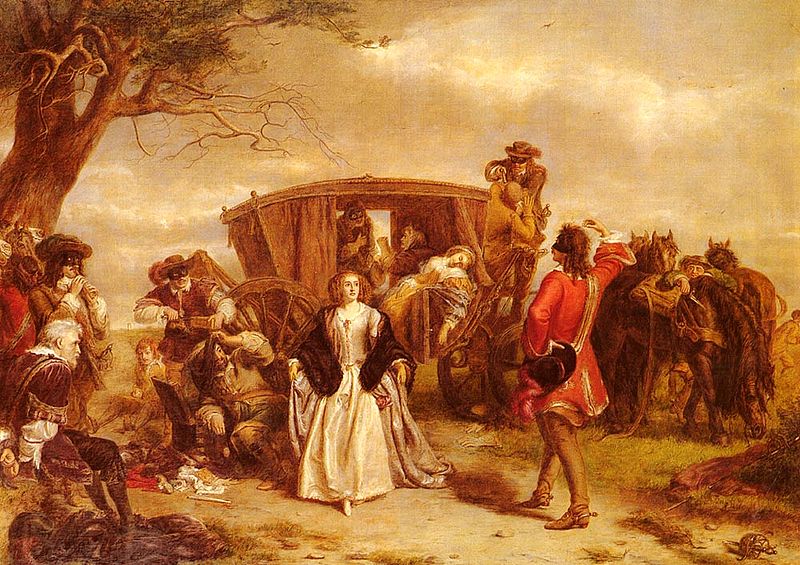
This is my latest romance from M&B
It is a Medieval, out now in paperback and soon in ebook.
I wrote a little poem. I also have a couple of Vampire ebooks out as Anne Ireland. The curse of Beauty and a Modern Vampire
Ode to a Vampire
Midnight in her hair; I turn and she is there.
She walks the darkest hours; I feel her mind, I know her kind.
She will have my soul, yet still I heed her call, my lady of the midnight air.
Upon my face her breath will mean my death, yet in her arms I’ll lie before the night is gone. For her sweet
kiss I’ll give my life and leave my gentle loving wife and all my friends and in their place no peace have won.
No more sunlit hours, no happy days I’ll know; instead I’ll walk the night at her side, my lady of the dark
night air. I’ve fought her song so long but now her call I heed. My soul cries out in need. She lifts her hand
and I must go. As she is now so shall I be, a terrible sweet aching agony possesses me.
Farewell my life, my friends, my sweet children too.
She calls and I will answer for she owns my soul, my mind, my very breath.
Midnight in her hair; I turn and she is there.
Hope you enjoyed the poem.
Sunday, November 27, 2011
Friday, November 25, 2011
Jane Austen Made Me Do It!
When Laurel Ann Nattress of Austenprose contacted me about a new anthology she was putting together I knew straight away I'd like to be a part of it especially as I'd be sharing the wonderful company of fellow authors Amanda Grange, Monica Fairview and Jo Beverley.
Our brief was to write a 5000 word short story for the anthology, Jane Austen Made Me Do It, and as long as it related to Jane Austen in some way we were invited to let our imaginations take flight. The result is a collection of 22 stories-a veritable chocolate box of tales inspired by Jane Austen, some historical and some contemporary.
Amanda Grange's story is Mr. Bennet Meets his Match.
On his daughters’ wedding day, Mr. John Bennet’s mind drifts back to the events of twenty-three years before, and the events leading to his own marriage . . . Encouraged by his parents to marry sooner rather than later and thereby provide a new generation of Bennet heirs for the estate, John laughed at their hurry. However, a meeting with his Cousin Collins, who was next in line for the entail, and an unfortunate accident, made him reconsider his position, and the proximity of the lively, pretty Miss Jane Gardiner sealed his fate.
Monica Fairview's story is Nothing Less than Fairyland.
In this gently humorous story inspired by Jane Austen’s novel Emma, the day has come for Mr. Knightley to move into Hartfield, but Mr. Woodhouse is still not reconciled to the marriage. Trouble looms on the horizon, unless Emma can quickly come up with a way to convince her papa to accept Mr. Knightley’s presence.
Jo Beverley's story is The Mistletoe Kiss.
Elinor Carsholt is living on the charity of a connection of her late husband’s in the village of Chawton, facing a dismal future for her three young daughters, until she begins to hope that her oldest daughter Amy has caught the eye of local baronet Sir Nicholas Danvers. Amy must have been sneaking out for clandestine meetings, which disturbs her, and there is a ten-year age difference, but still, it would be the saving of them all.
When she and the girls go out on Christmas Eve to look for holly, ivy, and mistletoe, Elinor is still undecided and rejects Amy’s urging to go to Sir Nicholas’s estate in search of mistletoe, but then local resident Miss Austen drives by in her donkey cart and pauses to chat.Elinor doesn’t really approve of Miss Jane Austen, for she’s been told she writes novels, which Elinor thinks a bad influence on young female minds, but she has to be polite. Miss Jane turns talk to love and marriage, expressing far too romantic a view, but she also assures them all that Sir Nicholas would be delighted if they searched his orchard for mistletoe, changing the course of their lives.
My story is Waiting.
Captain Wentworth and his beloved Anne Elliot have waited almost nine years to be together. At last all misunderstandings are swept aside. They have declared their love for one another, and all that remains is for their union to be blessed by Anne’s father, the irascible Sir Walter Elliot, and for the family members to be told. As Anne and Frederick ponder their futures each is reminded of the past, and all that has happened.
Persuasion is my favourite Jane Austen novel, and so I knew straight away this was the story I wanted to write. I'd always wondered how Anne Elliot's family would react to the news that she and Captain Wentworth were going to be married, and I also couldn't resist having them look back to the time when they first met. It was such fun writing the characters of Sir Walter Elliot, Anne's sisters Elizabeth and Mary, and of course Anne and Frederick Wentworth too!
Here's a short excerpt:
Captain Wentworth was awake early to witness the greyness of the day, mists rising in a smoking pall above the city along with the icy rain which lashed at the windows of his lodgings in a manner fit for any storm at sea. His spirits were high, though to tell the truth, he was more than a little nervous at the prospect of the interview he was about to face. As he adjusted the cuffs at his wrists, he glanced out of the window to observe the dash of carriages rolling round the square depositing new arrivals in Bath.
Had it only been yesterday when the unimaginable had happened at last? Frederick recalled every second of the encounter, revived every feeling. They’d met in Union Street. He’d been almost afraid to witness her reaction to the heartfelt letter he’d sent. But he needn’t have worried. Her eyes had spoken the sentiments she could not immediately express. Anne Elliot had taken his arm, and he’d sheltered her from the rain with his umbrella.
From his viewpoint past the railings on the other side of Queen Square, Gay Street effortlessly progressed up its steep incline, elegant façades on either side ascending to the Circus much as he and Anne had advanced before turning off to find the relative quiet of the Gravel Walk. Heedless of the sauntering politicians, bustling housekeepers, and flirting girls around them, they had confessed all their hidden, secret feelings, buried for so long.
“She loves me, as I love her,” he said out loud to confirm the truth to himself. He wanted to open the window and shout it out to the muffin man below. “Anne Elliot never stopped loving me from the day we parted. Oh, that my stubborn pride had not prevented me from seeking her out sooner. I’ve wasted almost nine precious years when we could have been together! I admit; I felt very differently all those years ago when she rejected me. I held her in contempt then, although sweet Anne, I now believe, was perfectly justified in withdrawing from our engagement. I was proud, made to feel that I was not good enough for a baronet’s daughter, and the truth of it stung me to my very soul. But there is little point in grieving over the past; I must look to the future with the girl I love most in the world by my side. My only fear, nay dread, concerns the interview I am to have with her father this morning. Not that his consent really matters. Anne will not be persuaded against her wishes this time, not like the first time. We are older, and, I hope, much wiser, both secure in the knowledge that our love is ever true and constant. But, this will not do, I have an appointment with Sir Walter, and I must not be late!”
I had a lot of fun writing this story-if you know a Janeite, why not pop it in their stocking this Christmas?!
Jane Odiwe
Saturday, November 19, 2011
Books Under the Christmas Tree?
The rapid approach of Christmas made me think about books for presents and titles I have particularly enjoyed adding to my collection this year. I thought I'd share five of them that might make useful additions to your own list for Santa, or provide inspiration for gifts for history-buff friends.
My first is from Shire Publications, but is a much larger volume than the familiar Shire guides. Peter Matthew's London's Bridges covers them all from Hampton Court Bridge to Tower Bridge with excellent photographs and historic images. I've found it invaluable for working out what was in existence at a particular date and what it looked like then. But beside that practical use, it is full of fascinating stories and facts.
Staying with the watery theme, the next title is James Stevens Curl Spas, Wells & Pleasure Gardens of London. This contains exactly what it says on the cover - a comprehensive survey of every one of these attractions from the 17th to the 19th centuries. There are the famous, such as Sadler's Wells and Vauxhall Gardens and the obscure - Finch's Grotto Gardens, Acton Wells, the Bayswater Tea Gardens and the Devil's House. As well as the facts about each site there is a fascinating exploration of the social background.
My absolute favourite exhibition this year was the National Portrait Gallery's Thomas Lawrence: Regency Power & Brilliance. The effect for me was of eating very expensive chocolates while wrapped in warm velvet - luxurious, sensual and completely addictive! The catalogue, which is loaded with illustrations, is the next best thing to being able to smuggle a Lawrence home with me. (And for sheer swash-buckling gorgeousness, any author in search of a hero couldn't go far wrong with the portrait of Charles William Vane-Stewart, later 3rd Marquess of Londonderry. Phew!).
A rather less flamboyant man is depicted in The Journal of a Georgian Gentleman: the Life & Times of Richard Hall, 1729-1801, edited by his 4-times grandson, Mike Rendell.
This is packed full of everything from household accounts to observations on ballooning, the wild beasts at the Talbot Inn, the weather, the games the family played, recipes - an absolutely fascinating lucky dip into the life of a Georgian gentleman of the middling sort. My only criticism is the lack of an index.
Fully indexed and with a useful bibliograhy is Coachmaker: the Life & Times of Philip Godsal 1747-1826 by John Ford. Godsall was one of the top coachmakers of his time and left a detailed record of his business and his social and domestic life. He was incredibly well connected - a son in the household of George III, one daughter married to an MP, another to Nelson's attorney. He even supplied a carriage to Napeoleon's mother! He travelled all over the country and this beautifully illustrated book includes information on Cheltenham, the theatre, food and drink, gardening and a host of other topics as well as fascinating insights into carriage-making.
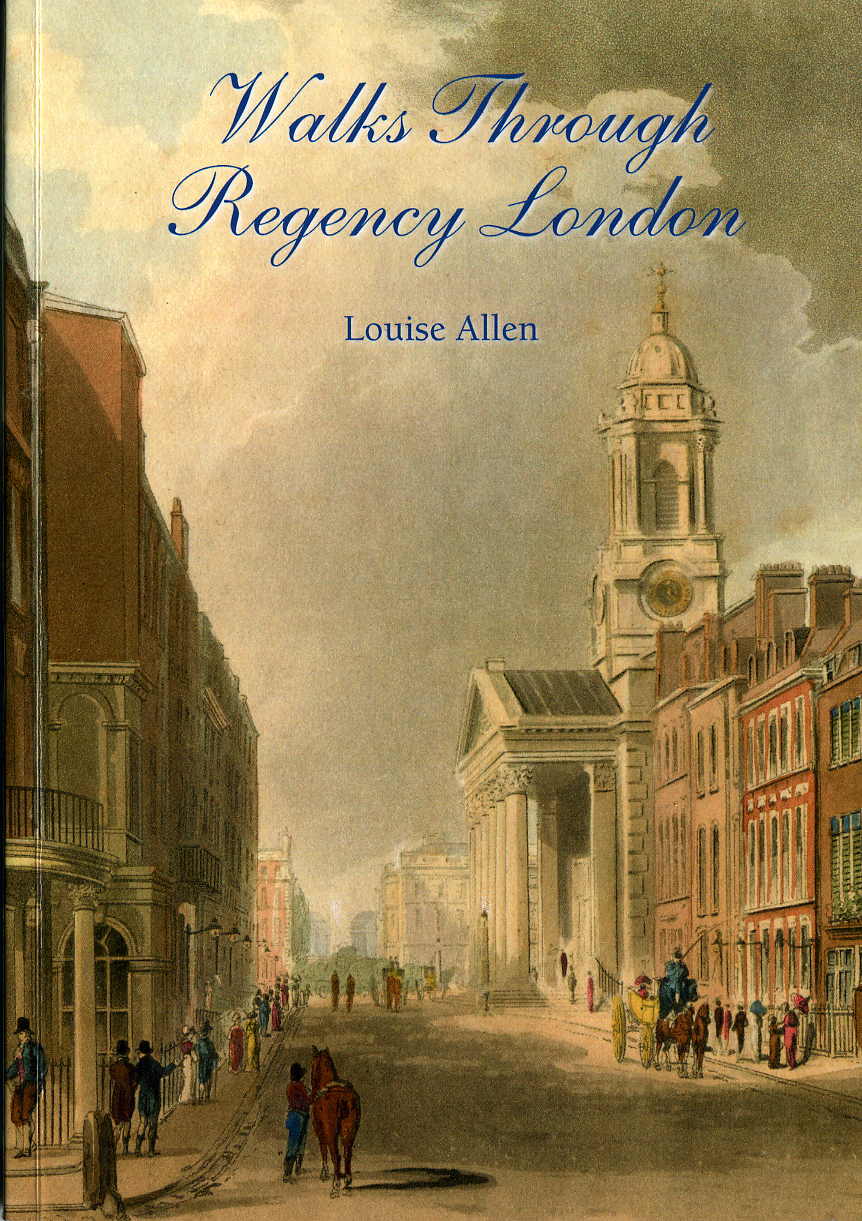
And finally, if you need a stocking-filler, there is my Walks Through Regency London - ten walks through modern London taking you into the world of the "long Regency" and illustrated throughout with original Regency prints. It is available from my website www.louiseallenregency.co.uk at £7.50 plus postage.
My first is from Shire Publications, but is a much larger volume than the familiar Shire guides. Peter Matthew's London's Bridges covers them all from Hampton Court Bridge to Tower Bridge with excellent photographs and historic images. I've found it invaluable for working out what was in existence at a particular date and what it looked like then. But beside that practical use, it is full of fascinating stories and facts.
Staying with the watery theme, the next title is James Stevens Curl Spas, Wells & Pleasure Gardens of London. This contains exactly what it says on the cover - a comprehensive survey of every one of these attractions from the 17th to the 19th centuries. There are the famous, such as Sadler's Wells and Vauxhall Gardens and the obscure - Finch's Grotto Gardens, Acton Wells, the Bayswater Tea Gardens and the Devil's House. As well as the facts about each site there is a fascinating exploration of the social background.
My absolute favourite exhibition this year was the National Portrait Gallery's Thomas Lawrence: Regency Power & Brilliance. The effect for me was of eating very expensive chocolates while wrapped in warm velvet - luxurious, sensual and completely addictive! The catalogue, which is loaded with illustrations, is the next best thing to being able to smuggle a Lawrence home with me. (And for sheer swash-buckling gorgeousness, any author in search of a hero couldn't go far wrong with the portrait of Charles William Vane-Stewart, later 3rd Marquess of Londonderry. Phew!).
A rather less flamboyant man is depicted in The Journal of a Georgian Gentleman: the Life & Times of Richard Hall, 1729-1801, edited by his 4-times grandson, Mike Rendell.This is packed full of everything from household accounts to observations on ballooning, the wild beasts at the Talbot Inn, the weather, the games the family played, recipes - an absolutely fascinating lucky dip into the life of a Georgian gentleman of the middling sort. My only criticism is the lack of an index.
Fully indexed and with a useful bibliograhy is Coachmaker: the Life & Times of Philip Godsal 1747-1826 by John Ford. Godsall was one of the top coachmakers of his time and left a detailed record of his business and his social and domestic life. He was incredibly well connected - a son in the household of George III, one daughter married to an MP, another to Nelson's attorney. He even supplied a carriage to Napeoleon's mother! He travelled all over the country and this beautifully illustrated book includes information on Cheltenham, the theatre, food and drink, gardening and a host of other topics as well as fascinating insights into carriage-making.
And finally, if you need a stocking-filler, there is my Walks Through Regency London - ten walks through modern London taking you into the world of the "long Regency" and illustrated throughout with original Regency prints. It is available from my website www.louiseallenregency.co.uk at £7.50 plus postage.Have you any books you'd recommend for Christmas? I'd love to hear about it if you have - there is just room on my bookshelves for a few more.
Happy Christmas shopping!
Louise
Tuesday, November 15, 2011
Do-It-Yourself Regency Romance
This is a post that I, and several other authors, at least two of whom are on this blog, compiled a few years ago. Interesting how it holds the test of time!
The only thing I'd ask is that you don't take this completely seriously! (as if you would!)
I won't name the other authors for fear of leaving someone out, and in case they prefer to preserve their anonymity.
So what are you waiting for? Get writing!
The only thing I'd ask is that you don't take this completely seriously! (as if you would!)
I won't name the other authors for fear of leaving someone out, and in case they prefer to preserve their anonymity.
Writing a Regency Romance (excluding Scottish romances)
Choose one of the following in each section.
Writing a Regency Romance (excluding Scottish romances)
Choose one of the following in each section.
The hero is:
1. A rake about town
2. An army officer (captain or above, please, no lieutenants)
3. A widower with small children
4. A pirate duke (marquis or earl will do at a pinch)
5. A spy who is also a peer of the realm
The hero is never:
1. Geeky, spotty or bald.
2. overweight
3. Reasonably cautious and sensible.
4. Shorter than the heroine.
5. If he wears spectacles, he isn’t dependant on them and can lose them at convenient times without any ill effects.
The heroine is:
1. A clever, beautiful ingénue
2. A bookworm not interested in society or husband hunting
3. An older spinster looking for a husband for her beautiful younger sister
4. A governess or housekeeper, usually the daughter of a peer fallen on hard times
5. A young girl forced to wear a male disguise and work as a secretary/groom or something similar.
6. A young American heiress, despising English society.
7. A highwayman/urchin/thief by night, a respectable member of society by day.
8. A young woman fighting to save her family from financial ruin, caused by the gambling habit of her brother or father, or even both.
The heroine is never:
1. A respectable young woman with a good fortune looking for a future husband.
2. A war widow, who has lost her husband in the Napoleonic wars and has now returned to society.
3. The daughter of a City gentleman, looking to increase her social standing. This is Bad because it makes her look mercenary.
4. Less than stunningly beautiful, clever and accomplished, even if she tries to hide these facts at the start of the story.
They meet:
1. In a country inn, where they get snowed in.
2. In a ballroom, where she hates him on sight.
3. At the gates of a country house, where she mistakes him for the gardener or he mistakes her for a maid.
4. On the road, he in his phaeton, she in her travelling carriage.
5. At the altar.
6. In a gaming hell where she is the stake.
7. At a secluded lake where the heroine or hero is taking an impromptu bath.
They never meet:
1. By being introduced by their parents, who want to see if they would like to make a match of it.
2. By promenading in the park at the fashionable hour.
3. They have always known each other, because society is small, and they are, in fact, distantly related.
They:
1. Hate each other on sight, but are filled with lustful thoughts
2. He loves her, she hates him.
3. She loves him, he hates her.
They never;
1. Take a liking to each other without it being accompanied by lustful thoughts.
Note: 2 and 3 must be accompanied by a Big Misunderstanding. They must always fancy each other’s pants off on sight, or It Isn’t A Romance.
The first time they make love is:
1. In the marriage bed (boring unless they met for the first time at the altar)
2. In a small antechamber set conveniently close to a ballroom
3. In a summerhouse
4. In a small cottage where they’ve taken refuge from the storm
5. In his library where she has gone in the middle of the night, barefoot, in search of a book to read. He is already there in his shirtsleeves, drinking.
The villain:
Choose one or two of the following:
1. The hero’s brother who wants the title. He is usually handsome, etc, but not as handsome etc as the hero.
2. The hero’s ex mistress (see below)
3. The heroine’s father. He is usually a gambler who has lost the family fortune and now wants to sell the heroine in a card game.
4. A man who wants the heroine, but isn’t prepared to marry her. He may abduct her, take her to Gretna, etc. to achieve his wicked end. He will not rape her, though it is usually a near thing. He often seems to be a pleasant character.
Secondary characters:
1. The hero’s best friend. Usually another peer, with a set of problems of his own. He will get his own story later. Repeat as necessary to create a series.
2. The heroine’s sister. She provides plot problems, adds comments, and is there because she’ll get her book later.
3. The heroine’s closest friends. See heroine’s sister.
4. The hero’s ex mistress. Jealous, experienced, may be the villain. When she is not, she is always jealous of the heroine, and she plots against her.
You may pick as many of the following as you wish, to give color to your story:
1. An urchin, cheeky but very poor, a boon companion of the hero or heroine. This may be actually the heroine in disguise.
2. An old retainer, a maid who used to be the heroine’s nurse. She is referred to by her Christian name and magically has all the skills required of a good lady’s maid.
3. A valet. He may be either scoundrelly and talk with Dick Van Dyke Mockney, or superior, and talk like Jeeves.
4. A butler. Superior, tall, talks like Jeeves, or short and fat and an old retainer who knows all the family by their first names, prefaced by “Miss” or “Master.”
5. A Bow Street Runner, usually less intelligent than the hero or heroine. Always on the side of good, he is upright and honest (unlike the usual run of BSR’s in RL)
6. An old man, who the heroine is required to marry to restore the family fortunes.
So what are you waiting for? Get writing!
Wednesday, November 09, 2011
Wheat Clover and Coleseed
I was thinking what to post this morning on this grey November day and remembered I had a wonderful little book called "Seedtime & Harvest", the diary of an Essex farmer, William Barnard of Harlowbury.There are two entries on either side of today's date.
Nov 7 (1812)
The land is now more firm than it has been for some time. I have drilled 9 acres Upper stoney & finished sowing Wheat yesterday in Grassy piece, nearly the whole of which I have drilled & and have done 4 or 5 acres of my pea land over again; I fear Sweetendiness will be a very deficient plant. I had lodged 43 wether sheep in Hillyfield & last night 3 were slaughtered, the Offal left & carcasses taken away. I sowed 10 stetches of white wheat hither side of Nine acres & on the thirteenth stetch from this side began to sow 1 Quarter of Buncle Wheat I bought of Fresland. Grassy piece is now sowed with Day's Wheat except about three roods next to Woody piece.
Nov 10 (1821)
This has been a fine week since the 5 but on the 4 we had great storms of wind & rain. I have plowed at the other farm & carted haulm. My house was broken into & robbed of a gun,a coat, knives & forks, spoons, a desk and &c & without anyone being disturbed by them on the night of the 7th.
The spelling and punctuation are his.
I find it quite extraordinary that in both entries he reports he has been robbed as if it is commonplace and no more important than planting his wheat. In the first entry rustlers killed and took three sheep and and in the second his house was broken into and a substantial amount removed.
I love the way his farm is named so sensibly- Grassy piece, Woody piece etc.
I have no idea how much a a 'stetch' is or what 'haulm' might be. Any suggestions?
I think it's a pity Sweetendiness was a deficient plant or we might still have something with that wonderful name.
Fenella Miller
I now have four books with Musa Aurora Regency and 'Christmas at Hartford Hall' coming out in December and another one next year.
Saturday, November 05, 2011
A Regency Moment
Last month, at the Regency Readers’ Day in London, I had the opportunity to try on Regency costume, courtesy of Jane Walton of Hands on History who specializes in both original and reproduction historical costumes. It was a taste only because Jane’s rack of clothes was in a public room and there was a limit to how far I was prepared to undress. Fortunately, my underwear was respectable so I stripped off my outer layer and Jane handed me a shift.
The shift was the basic item of female underwear; made of hard-wearing linen and easily washable. We know that, in 1789, Jane Austen bought enough Irish linen to make six shifts and four pairs of stockings. It was also surprisingly warm, which was just as well because it was a chilly autumn day.
Then I was handed what looked like an outside pillow-case with sleeves. This was my muslin gown and, at first, I just couldn’t see how one wore it. Jane explained that the drawstrings around the neck, wrists and under the bust allowed it to be gathered in and assured me that ‘one size fits all’. Sceptically, I put it on. Jane adjusted the drawstrings, arranged the gathers and, instantly, it was transformed into a charming gown. I looked at myself in the mirror and began to feel Regency. Together with the shift, it felt both light and warm. Suddenly, all those Regency heroines wearing the flimsiest of muslins in cold weather began to be credible.
I realized that turning a length of muslin into a wearable garment would be quick work for experienced needlewomen like Jane and her sister, Cassandra. Jane Austen’s letters to Cassandra are full of shopping for muslins. When staying with her brother Henry in London in 1811, for example, she went to Grafton House, and bought ten yards of a ‘pretty coloured muslin’ as well as some ‘bugle trimming’, silk stockings (extravagant!), a ‘very pretty little bonnet’ and a pelisse – but the buttons were expensive.
It was time for my spencer, a cropped jacket in a red, thick velvet-like kerseymere (I’d always wondered what kerseymere looked like) with some distinctly military silver frogging. It was close fitting, boned and it made you stand up straight.
Then came the poke bonnet. Oh dear, it looked as though I was going to be blinkered like a horse. But no, in spite of appearances to the contrary, the brim started quite far back on the head and I could see perfectly easily. Jane tied the ribbons in a de rigeur bow at the side.
So there I was and it all felt surprisingly warm, comfortable and natural – see photo. Shame about the watch, though.
Elizabeth Hawksley
Thursday, November 03, 2011
It's that time of year again!
I know it's only November but I am going to mention the dreaded "C" word. After all, the shops are already full of glitter and presents and the television is showing ads for the latest perfume and all those things you never realised you needed. And the publishing world is gearing up for the festive season, too.
My latest Sarah Mallory is on the shelves now, as part of a Christmas Special called One Snowy Regency Christmas. I love the cover of this book, it looks like a beautiful Christmas card, but I wanted to share with you the painting that was the inspiration for this book.
We were on holiday on Exmoor, staying at the beautiful little village of Porlock and when we were at one of the local inns, the Ship, I saw a copy of the painting below. It is called "Journey's End" by a local artist, Maurice Bishop. Once I had seen it I knew I just had to have a copy, and at the same time my mind was working overtime, thinking of a story that involved my hero and heroine being snowbound in a house on the moors. I also wanted to use Porlock, so I changed its name of the village to Mersecombe, but kept an inn called the Ship.
Then, as we were making our way home from the holiday, my editor rang to ask if I could write a special Christmas story. The timing could not have been better, and the result is "Snowbound with the Notorious Rake."
So, what do you think of when you see "Journey's End"? I have a framed print on my wall now (signed by the artist) and I must admit, I think there may be several other stories to come out of this yet…..
I am very grateful to Maurice Bishop for allowing me to use this image, and if you want to see more of Maurice's work, go to www.mauricebishop.co.uk
Sarah Mallory
Wednesday, November 02, 2011
The Geffrye Museum
.
Tucked away near Shoreditch is the Geffrye Museum. It doesn't look like a museum from the outside, it looks like a long, graceful Georgian almshouse set in a pleasant garden - which is what it used to be.
Today, it is a lively, vibrant space housing interiors-through-the-ages. You walk from a hall in 1630
past a drawing room in 1830 right up to rooms on the more recent past. It is fascinating to see how tastes change - and how growing affluence is reflected in the furnishings.
There is more to the museum than just a collection of rooms, however - small gardens outside also reflect the changing times with different plantings and different designs.
Fascinating - well worth a visit.
Jan Jones
Monday, October 31, 2011
Colonel Brandon's Diary - UK paperback
I'm absolutely thrilled that the UK paperback of Colonel Brandon's Diary is finally here. Its publication date was chosen to coincide with the bicentennial of Sense and Sensibility and it's a beautiful edition, I just love the cover. It's taken from the same portrait as the hardback cover, but it shows more of it, so that we see "Brandon" is holding "little Eliza" by the hand.
When I set out to write my retelling of Sense and Sensibility, I was intending to write Edward's diary, but as soon as I came across the short passage in which Brandon recounts his tragic past, I knew that his was the diary I had to write. From optimistic youth to devastated young man to bereaved adult - and then, miraculously to a man of hope and love again, courtesy of Marianne Dashwood - I loved every minute of writing his diary, and I hope you love reading it, too.
The carriage pulled away. The horses’ hooves sounding strangely muted and the turning of the wheels was no more than a grating whisper as the carriage bumped over the cobbles.
‘This damnable fog,’ said Green, peering out of the window. ‘I hope it clears by the time we reach the heath or you will not be able to see each other, let alone fire.’
We were in luck. When we stepped out onto the heath we could see for twenty paces, enough for our business.
There was no sign of Willoughby’s carriage.
Ten minutes later Willoughby arrived, attended by two men who looked nervous, as well they might. They were dandies, not soldiers, and had probably never been seconds in their lives.
‘I will give him another chance to change his mind,’ said Green.
He went over to Willoughby, they had words, and Green returned, saying, ‘The duel is to go ahead. It is for you to choose the distance, Brandon.’
That done, the seconds met in the middle and loaded the pistols in each other’s presence to ensure fair play, then Green and Wareham returned to hand me my weapon.
‘Willoughby’s man is to count the paces. After the count of ten, you may turn and fire at will. Is this agreeable to you?’
‘It is.’
‘Then let us get it over with.’
I removed my coat. Across the heath, Willoughby removed his. The fog was lifting minute by minute, and I could see him clearly. We came together and stood back to back. His man counted the paces. One . . . two . . . three . . . four . . . five . . . I thought of Eliza abandoned and left all alone . . .six . . . seven . . . eight . . . nine . . .
‘Ten!’
I turned.
He turned, too, his arm already raised. He rushed his shot, firing without taking proper aim, and the bullet went wide, so wide I did not even feel it pass. He blanched, and dropped his arm. I saw his knees begin to buckle. I lifted my arm. And then he turned and I thought that he would run. But the horrified look on the faces on his seconds curtailed his cowardice and he turned back towards me, white faced and trembling, turned sideways on to present as small a target as possible.
For Eliza, I thought.
I took aim.
But as I did so, I saw not Willoughby and not Eliza, but Marianne. I imagined her face as she heard that Willoughby was dead; I imagined her grief, and I was horrified, for, if she was still enamoured of him, she would not grieve easily or quietly, but would suffer with all the depth of her being. If I killed him, I would cause her great pain, and with her nature, it was a pain she would not be certain of overcoming. And so I raised my arm and fired into the air.
Willoughby fell to his knees, and had to be assisted to his feet by his seconds.
I walked over to him and looked at him in disgust.
‘You are not worth shooting,’ I said.
Then Green brought me my coat and we climbed into the carriage. It pulled away, jolting over the heath before turning on to the road.
We went back to Green and Wareham’s lodgings. By the time we reached them, a wind had sprung up and it had driven most of the fog away, revealing a cold, clean light as a pale sun broke through the clouds.
‘You deloped,’ said Wareham, as we went inside. ‘Why?’
‘Because there is another young woman caught in Willoughby’s toils,’ I said, as I took off my outdoor clothes and threw myself into a chair, ‘and I feared that, if I killed him, she would love him for ever.’
Colonel Brandon's Diary is in UK bookshops now, or you can order from The Book Depository which offers free worldwide postage and packing, as well as Amazon and other sellers.
Amanda Grange
When I set out to write my retelling of Sense and Sensibility, I was intending to write Edward's diary, but as soon as I came across the short passage in which Brandon recounts his tragic past, I knew that his was the diary I had to write. From optimistic youth to devastated young man to bereaved adult - and then, miraculously to a man of hope and love again, courtesy of Marianne Dashwood - I loved every minute of writing his diary, and I hope you love reading it, too.
Here's a taster from the middle of the book, when Brandon challenges Willoughby to a duel.
The carriage pulled away. The horses’ hooves sounding strangely muted and the turning of the wheels was no more than a grating whisper as the carriage bumped over the cobbles.
‘This damnable fog,’ said Green, peering out of the window. ‘I hope it clears by the time we reach the heath or you will not be able to see each other, let alone fire.’
We were in luck. When we stepped out onto the heath we could see for twenty paces, enough for our business.
There was no sign of Willoughby’s carriage.
Ten minutes later Willoughby arrived, attended by two men who looked nervous, as well they might. They were dandies, not soldiers, and had probably never been seconds in their lives.
‘I will give him another chance to change his mind,’ said Green.
He went over to Willoughby, they had words, and Green returned, saying, ‘The duel is to go ahead. It is for you to choose the distance, Brandon.’
That done, the seconds met in the middle and loaded the pistols in each other’s presence to ensure fair play, then Green and Wareham returned to hand me my weapon.
‘Willoughby’s man is to count the paces. After the count of ten, you may turn and fire at will. Is this agreeable to you?’
‘It is.’
‘Then let us get it over with.’
I removed my coat. Across the heath, Willoughby removed his. The fog was lifting minute by minute, and I could see him clearly. We came together and stood back to back. His man counted the paces. One . . . two . . . three . . . four . . . five . . . I thought of Eliza abandoned and left all alone . . .six . . . seven . . . eight . . . nine . . .
‘Ten!’
I turned.
He turned, too, his arm already raised. He rushed his shot, firing without taking proper aim, and the bullet went wide, so wide I did not even feel it pass. He blanched, and dropped his arm. I saw his knees begin to buckle. I lifted my arm. And then he turned and I thought that he would run. But the horrified look on the faces on his seconds curtailed his cowardice and he turned back towards me, white faced and trembling, turned sideways on to present as small a target as possible.
For Eliza, I thought.
I took aim.
But as I did so, I saw not Willoughby and not Eliza, but Marianne. I imagined her face as she heard that Willoughby was dead; I imagined her grief, and I was horrified, for, if she was still enamoured of him, she would not grieve easily or quietly, but would suffer with all the depth of her being. If I killed him, I would cause her great pain, and with her nature, it was a pain she would not be certain of overcoming. And so I raised my arm and fired into the air.
Willoughby fell to his knees, and had to be assisted to his feet by his seconds.
I walked over to him and looked at him in disgust.
‘You are not worth shooting,’ I said.
Then Green brought me my coat and we climbed into the carriage. It pulled away, jolting over the heath before turning on to the road.
We went back to Green and Wareham’s lodgings. By the time we reached them, a wind had sprung up and it had driven most of the fog away, revealing a cold, clean light as a pale sun broke through the clouds.
‘You deloped,’ said Wareham, as we went inside. ‘Why?’
‘Because there is another young woman caught in Willoughby’s toils,’ I said, as I took off my outdoor clothes and threw myself into a chair, ‘and I feared that, if I killed him, she would love him for ever.’
Colonel Brandon's Diary is in UK bookshops now, or you can order from The Book Depository which offers free worldwide postage and packing, as well as Amazon and other sellers.
Amanda Grange
Wednesday, October 26, 2011
Dangerous To Know
Dangerous To Know/ Linda Sole
Now published in kindle and at ARE
This is for the readers who wanted Northaven's Story!
Enjoy
The Marquis of Mooraven yawned behind his hand, and, having gathered up his winnings, rose from the table more than two thousand guineas richer than he’d been when he sat down. He felt no elation, though there was a time when he’d needed every penny he won from his gambling, but that was before his Uncle Tomas obligingly left him his title, estate and fortune. He had several titles to his name, amongst them earl, marquis, twice over, baron and count, but was using his uncle’s for reasons of his own. In time, he might end as a duke by way of his mother’s family being in danger of losing every male heir in the line. The dowager duchess had summoned him only two days before he left for Paris.
‘My husband’s father had the deed of title altered so that if his male heirs failed his daughters might inherit the dukedom as well as the estate. As you know, my only surviving daughter died last year and her infant son is sickly. My three sons have died. That leaves you, Mooraven – my sister-in-law’s grandson. Sorry as I am to say it, if the child dies you will become Duke of Rothmere.’
‘How tiresome for you,’ Mooraven drawled. He had crossed swords with the dowager before, and though he did not dislike her, knew that she disapproved of him with every bone of her body. ‘You must guard him well, ma’am. I advise you to employ the best nannies – and have him seen regularly by a doctor of good repute.’
‘You almost sound sincere.’ The elderly lady fixed him with a hawkish stare. ‘Did I not know you for a rogue and a scoundrel I might believe you had no interest in the Rothmere fortune.’
‘If that is your only concern, you may sleep easily in your bed,’ Mooraven replied, a faint smile on his sensual lips. ‘I may run through my fortune once more if I suffer heavy losses at the table, but I have more sense than to gamble away my entire inheritance. I assure you I wish young William nothing but good fortune.’
‘I am an old woman,’ the dowager said. ‘I may not have long to live. Rothmere has no male relatives to care for him – except you, though you are in truth too far removed. I dare not hope that you would take an interest in his welfare?’
‘Should I hear of your unfortunate demise, which I hope may be some years distant, I would offer my help – such as it is. I should not have thought you would care to have your precious heir subjected to my influence?’
‘Needs must when the devil drives.’ She arched her brows at him. ‘Are all the stories true, Mooraven? I hear that you have ruined virgins, fleeced green youths at the card table and only God knows what else. A little wildness in youth is acceptable, but surely you have sown your oats by now? Where is your pride? You have good blood in your veins. Show a little decency. Marry and settle down before it is too late. If you continue this way no decent woman will have you.’
‘What makes you think it is not already too late?’ A faintly mocking smile played over his lips. ‘Do you not know that they say I have sold my soul to Lucifer?’
‘Do not be ridiculous! I should not believe such tales – but I do believe that you have ruined young women for I knew one of them. Miss Hazelton’s mother was once a friend of my daughter…’
‘Since you know me for the rogue I am, why should I deny it? All you need to concern yourself with, duchess, is that your heir is safe from me – and if need be, I shall be his guardian, if not his mentor.’
‘I thought the girl sly,’ the duchess said, surprising him. ‘I should not be surprised if she lied. Very well, I shall not ask for your confidence. You have given your word and I may rest easy in my mind.’
‘I trust you are not ill, ma’am?’
‘At the moment I am perfectly hale, sir.’
‘Then I may go to Paris with a clear conscience.’
Mooraven had kissed her hand and taken his leave. He sincerely hoped that it would be many years before he was called upon to keep his promise. His work was not yet done. He had an enemy to track down and bring to justice – justice for men foully betrayed. His brow darkened with anger as he thought of the years that he had borne the scorn of men who had once been his friends. They believed him a traitor or at the very least a drunken fool. Though provoked to bitterness and humiliated almost beyond bearing, he had never given them or anyone else a hint of the true story. Until he had found and punished the true traitor he must keep his silence.
Lost in his thoughts, Mooraven did not notice the woman until she knocked into him as she passed. The scent of her perfume alerted his senses and he turned his head to watch her leave the room. She was dressed in black, the most beautiful woman he had seen in an age – a woman who turned all heads.
He’d noticed her briefly earlier in the evening. She had been losing steadily at the tables all night and the glitter in her eyes had prompted him to ask his neighbour who she was.
‘She is the Countess Madeline Dupree,’ the man answered. ‘She was wed to a vile depraved brute who died of some unspeakable illness a few months ago. Until his death she was never seen in company. Now she comes regularly to parties where she can gamble. I lost a thousand francs to her one night. Couldn’t concentrate on my cards when she has such perfect flesh and that gown reveals more of her charms than a man can stand without ravishing her…’
Mooraven had smiled, because the gown dipped daringly to reveal a glimpse of her silken skin and breasts so full and perfect that they must have most of the men in the room lusting after her. A deliberate ploy to make them careless with their cards perhaps – though she seemed to be losing that night.
Why had she knocked into him so heavily? It was almost intentional…a sudden thought made him thrust his hand into his pocket to search for the purse of gold he’d carelessly thrust there when he rose from the tables. His searching fingers found nothing but his kerchief. The gold had gone. She had taken it! For a moment his senses reeled: the countess a thief? Impossible one would think and yet she had lost heavily at the tables.
His gaze narrowed as he went outside, looking for the woman in black. Ahead of him in the dimly lit Paris boulevard he could see her walking swiftly. A burly servant accompanied her but Mooraven’s instincts were alerted. Why had she no carriage? A woman of her breeding and wealth walking the streets with only one servant? He was a tall heavily built man and carried a stout cudgel – but she was still taking a huge risk. The jewels she’d been wearing about her neck had been worth a small fortune – if the diamonds in that collar were genuine, of course. The stones had sparkled enough in the candlelight, which gave him no cause to doubt their worth.
Why would a woman like that leave a card party in the house of a prestigious member of the French aristocracy, to walk home through the streets on foot? It didn’t make sense. He was certain she’d taken his purse and now his hunting instincts were aroused.
He wanted to know more about the mysterious lady in black.
Keeping to the shadows, Mooraven followed the woman and her bodyguard. It seemed that she had not far to go for after walking the length of three streets, the pair stopped outside a large and impressive house. The woman turned to her companion, clearly thanking him for his services. From their gestures, Mooraven thought she was telling him to leave her, but he was hesitating, arguing. After a moment or two he gave in and walked off. The door of the house opened and the woman went in.
Mooraven waited in the shadows until the giant had disappeared. He was about to approach the front door when it opened again and a figure came out. This time it was a youth, who walked swiftly in the same direction the countess’s servant had taken a few minutes earlier.
Mooraven drew back into the shadows, not wanting to be seen by the youth. Once he had disappeared, he approached the house and knocked at the front door. Countess Dupree had some questions to answer.
The knocker sounded eerily, as if the house were empty and now that he looked up at the windows above, he could see there were no lights. It was odd for a house like this would normally be filled with people and the windows would shed light into the street until they were shuttered for the night. He frowned and looked for a side entrance, but tall iron railings prevented entrance to the back of the house. Glancing about him to see if anyone was around, Mooraven then scaled the railings and jumped down into the dark passage at the side of the building. No light was coming from the windows of the house as he felt his way around to the back. A bank of clouds hid the moon and here the little light that came from lamps outside a few of the neighbouring houses was not sufficient to show him where he was going.
For a few minutes he could only feel his way but gradually his eyes became accustomed to the dim light and he could make out shapes sufficiently to find himself at a back entrance to the house, through what was obviously a conservatory.
There was not a single light in the house. Had the countess retired immediately? It was unusual not to leave at least one lantern burning somewhere. By morning the candle might have burned down, but at night there ought to be a few lights throughout the house. What kind of a house was this? Where were all the servants?
Mooraven’s instincts told him that he had stumbled on a mystery. Suddenly, a thought struck him. The youth he’d seen leaving the house – could that possibly have been the countess in disguise?
If she had courage enough to walk through the streets of Paris at night dressed in her finery with only one servant, she might dare to risk walking alone as a youth. While most would think the countess worthy of attention, a slight youth might pass unnoticed.
Why was she leading a double life? Why had she stolen his purse – and where was she going?
Mooraven was thoughtful as he stared up at the house. His business in Paris was already dangerous enough. He was using an assumed name. No one knew who he truly was or what he did and it must stay that way. He ought not to let himself be distracted from the business in hand, but his curiosity was aroused.
He knew he could not just walk away from this situation. He wanted to know more about the countess and what she was doing…
Saturday, October 22, 2011
The Chesterfield Lecture
I’ve just given the Annual Chesterfield Lecture to the Friends of The Ranger’s House, Blackheath, London. It’s the first time I’ve been asked to talk to such a knowledgeable group in such a classy venue – a superb early 18th century red brick mansion, once the home of Lord Chesterfield, statesman, wit and letter-writer. In 1728, he became British Ambassador in The Hague. Whilst there, he acquired a superb collection of Dutch paintings, and then had to add a wing onto the house in order to show them off them.
First we had a delicious buffet dinner, provided by the Friends, in the basement of the house and then we trooped upstairs to the crimson gallery – not forgetting to put on our coats – there is no central heating. Well, the Friends put on their coats and, in some cases, their scarves, but I felt that, as lecturer, I couldn’t go that far. I hoped that the adrenalin would keep me warm.
The crimson silk gallery, where I was speaking, was magnificent with its fabulous paintings, glittering chandeliers, superb plasterwork, and a couple of classical nude marble statues flanking me on either side.
The talk I was giving was one I’d given before – how I became an historical novelist and it included snippets from my juvenilia – the six novels I wrote between the ages of ten and sixteen. I knew that Lord Chesterfield had also written: his famous letters to his illegitimate son are a mixture of worldly-wise pieces of advice and cynical and witty observations on the world. Surely they could provide me with a quotation to act as an introduction to my talk. After all, I was giving the Annual Chesterfield lecture, I felt I owed him a compliment or two.
This is what I found: Women, then, are only children of a larger growth: they have an entertaining tattle, and sometimes wit; but for solid reasoning good sense, I never knew in all my life one that had it, or who reasoned or acted consequentially for four and twenty hours together.He goes on to advise his son: A man of sense only trifles with them, plays with them, humours and flatters them … but he neither consults them about, nor trusts them with, serious matters.
Hm. No, I decided, I would not be paying Lord Chesterfield a graceful compliment. I would give him a courteous but neutral mention and hope that his portrait in the next room didn’t crash to the ground in the middle of my talk in horror at hearing a mere female giving a lecture in his name.
Fortunately, the talk went very well and there were no untoward intimations of
spectral disapproval.
Elizabeth Hawksley
Top: The Ranger’s House, the front entrance: courtesy, The Ranger’s House, http://www.friendsofrangershouse.org.uk/
Centre: dinner: photograph by Elizabeth Hawksley
Bottom: The Gallery, the Ranger’s House: courtesy, The Ranger’s House, www.friendsofrangershouse.org.uk
Wednesday, October 19, 2011
Practical Hints to Young Females
When looking for dispacement activity to avoid doing the housework I like to thumb through Practical Hints to Young Females on the Duties of a Wife, A Mother And a Mistress of a Family by Mrs Taylor of Ongar. My edition is the 5th, dated 1815, so she appears to have had good sales.
The tone is set by the frontispiece showing an elegantly, but modestly, dressed mother at work on her sewing and encouraging her small child to read a book.
Mrs Taylor considers education to be a good thing for females but warns Many a female, because she has been educated at a bording-school, returns home, not to assist her mother, but to support her pretensions to gentility by idleness, dress, and dissipation.
Once a young lady has been fortunate enough to find herself a good husband she is reminded that When he vowed to take you for better or worse, he staked the happiness of his future life; a treasure for which the most ample portion is insufficient to compensate.
The young wife is warned that she may well have married expecting "uninterrupted felicity" but by degrees the discovery will be made that you have maried a mortal, and that the object of your affections is not entirely free from the infirmities of human nature. The solution to any marital disharmony is to search one's own character and to realise one's own faults, thus learning to forgive your husband's. If he should be morose, fretful, or capricious, liable to sudden sallies, or the prey to constant irritability, the cure [is effected by] sweetness and the coolness of a reasonable mind. A wife must always contemplate her husband's virtues rather than his failings.
Of course, the main cause of maritial disharmony is money, so you must study to keep strictly within the household budget and note that much loss is sustained by purchasing articles of housekeeping in small quantities....Weekly payments are forcibly recommended in order to keep a close check on tradesmen's accounts. Servants are a major cause of concern to any housewife and she must take note that A good servant can always find a good situation...nor ought those who have adopted the mistaken economy of giving low wages...expect good service. In every kitchen there ought to be a library...and nothing beyond the comprehension of kitchen readers be admitted. The advice on managing servants appears quite enlightened with an emphasis on plenty of praise where it is due as well as a fair wage for the job. It is poor encouragement to a servant if she is invariably blamed for what is wrong and never praised for what is right. The old retainer must also be looked after and the inexperienced, young mistress of the household would do well to watch and learn from good domestic staff.There is an entire chapter on the dangers of becoming a step-mother with a warning to decide, well before committing oneself to a widower and a father, whether one can love his children!
The final chapter is given over to advice to The Husband and he is told that it will serve his comfort best if his wife is allowed to run the home and has sufficient housekeeping allowance to do so - and he is reminded that it is important to regularly express affection and regard for his wife.
Now - I'm off to give the scullery maid a rise in pay and to admire my tall, handsome footmen.
Louise Allen
Monday, October 17, 2011
Reminiscing

I've been spending every morning with my 96-year-old father recently. I'm his carer now, and while I get him washed and dressed – something he hates no longer being able to do for himself – I've discovered a way to divert his attention. We reminisce. His recent memory is very poor. But his recall of events of fifty years ago is crystal clear.
A few days ago we were talking about the St Mylor Players, our village's local drama group. From the 1950s into the late 1970's the Players put on dramas, comedies, pantomimes and variety shows.
In the late 1950s - when men were the wage-earners, women remained at home raising the family, and Women's Lib hadn't been invented yet - a particular 'turn' in one variety show nearly brought the house down. It was Dance of the Flower Fairies.
The 'fairies' wore white tutus, white socks, and headdresses of white crepe-paper roses. Each carried a white lily made out of crepe-paper. So far so unremarkable. What stunned the audience was that the 'fairies' were my father, District Surveyor on Cornwall County Council (top right); John Garvin, a stocky Scot who managed to keep the Church hall's ancient and unpredictable electrics operational without catching fire or causing a power cut (well, only once); Frank Roscora, a telephone engineer as round as he was tall; and Rodney Prout, plaster technician at Falmouth hospital and the Society's producer.
The music was played on a gramophone in the wings, and my mother – a dancer in her youth – had worked out the choreography. The introductory music started, the curtain rose to reveal the 'fairies’ – two with moustaches they had refused to shave off - in graceful pose. There were several moments of shocked silence then the dance began.
Mum had threatened the ‘fairies’ with dire consequences if they hammed it up. They played it absolutely straight and it worked brilliantly. Within twenty seconds the audience were crying with laughter and stuffing hankies in their mouths so as not to miss a moment.
When the dance finished there was uproar as people clapped, stamped and hooted. The 'fairies,' who had all been extremely nervous beforehand and boosted their courage with a strong whisky each, swept into deep if ungainly curtseys, gave the audience dazzling grins, then lumbered off the stage streaming with sweat and greasepaint.
The photograph above was on the front page of all the local papers. All except Dad are dead now but remembered with fondness and admiration. I treasure these morning chats as Dad is happier and I am reminded of things I had totally forgotten.
Jane Jackson.
Taken To Heart pub. Robert Hale, October 2011 £18.99
Saturday, October 15, 2011
Waterloo -- making the point
Last weekend I was in Windsor for the first time. (It was a family engagement, arranged more than a year ago, so sadly it had to take precedence over the RNA Regency Day in London. The Regency Day was fantastic, so I hear. But so was Windsor.)
I hadn't visited the castle before and I was totally bowled over by the Queen's picture collection. As I made my way through the state and semi-state apartments, I kept coming up against huge portraits that I'd only seen in books, or on TV programmes. Like that famous portrait of Queen Elizabeth I as a thirteen-year-old girl, dressed in a stunning red gown. At the other end of that same wall was her father, looking cold and menacing.
For me, the highlight was the Waterloo Chamber. It was created by George IV in order to make a statement about the allied victory over Napoleon. George IV commissioned Sir Thomas Lawrence to paint portraits of all the key people who had combined to defeat Napoleon. (He included himself, naturally!)
The room is huge, and dominated by a portrait of a triumphant Wellington at one end, brandishing the Sword of State. You can see the portrait here and read something about it here.
Around the walls are Lawrence's portraits of the generals, like Bluecher; the rulers, including the famous portraits of Alexander I of Russia, Frederick William III of Prussia, and Francis of Austria. The diplomats who organised the redistribution of Europe at the Congress of Vienna are also there: Castlereagh, Metternich, Hardenberg, Nesselrode, though, as far as I could see, Talleyrand, being French, was not included, even though he played an important part at the Congress.
The portraits can all be seen on the Lawrence pages of the official site for the Royal Collection. The finest of them is supposed to be the portrait of Pope Pius VII, for which Lawrence had to travel to Rome in 1819 for 9 sittings with the Pope.
My only complaint was that visitors were allowed into the ends of the Waterloo Chamber but not the middle, so I couldn't get a really good look at some of the amazing portraits. Next time, I shall take binoculars.
I haven't included jpegs of the pictures. I have a feeling I might be hauled off to the Tower if I did! But if you follow the links, you can see them for yourself.
One interesting tale you might enjoy. When the Queen was entertaining the French President at Windsor, he was treated to a performance of Les Miserables in -- guess where? -- the Waterloo Chamber. And no, they didn't take down the portraits, or change the name of the room. He had to live with it. (Was that also the time that he had to arrive at Waterloo Station? I think it might have been. What a nasty sense of humour the British do have...)
Joanna
Friday, October 07, 2011
A Visit to Buscot Park
Last week I had the pleasure of visiting Buscot Park, a late Georgian mansion near Faringdon in Oxfordshire. I am planning to use Buscot as the inspiration for the country house in my next book and I was particularly interested in the internal layout and also in the furniture. Lord Faringdon, who still lives at Buscot, has a very fine collection of art, ceramics and Regency furniture on display in the house and it was fun to stroll through the rooms and see them as they would have been at the turn of the 19th century. The original mansion and park at Buscot were built between 1780 and 1783 for Edward Loveden Loveden at a cost of of over twenty thousand pounds (about seven hundred and eighty thousand pounds in today's terms). The house was built by local crasftsmen using local materials but also incorporated so
me recycling of slate and stone from other nearby mansions that were being pulled down at the time. The result was a grand house with nine bays, a double flight of stone steps and an impressive Orangery, all surrounded by a deer park and pleasure gardens with two lakes.
me recycling of slate and stone from other nearby mansions that were being pulled down at the time. The result was a grand house with nine bays, a double flight of stone steps and an impressive Orangery, all surrounded by a deer park and pleasure gardens with two lakes. The Entrance Hall, with its stone flagged floor and porphyry scagliola pillars dates from 1780 and most of the furnishings are from the Regency period. It certainly creates an impression as you walk through the main door! A suite of a long couch and two armchairs in the Egyptian style that became fashionable after the Battle of the Nile was, to my eyes, completely over the top, made of ebony, painted with gilt and featuring large carved black lions! The suite was made by Thomas Hope, pioneer of regency furniture design, and the pieces are illustrated in his 1807 book Household furniture and interior decoration. A matching clock on an ebony stand towers four foot high. The hall also boasts an astonishing ornate gilt metal chandelier in the French fashion dating from about 1806 which is similar in design to those at St James's Palace.
The Dutch Room, one of the drawing rooms, contained an interesting piece of furniture in the shape of a small cabinet. Under the lid is a notice that reads: "Newly invented musical game dedicated to Princess Charlotte of Wales." Unfortunately we weren't allowed to play it! Strolling through Buscot's reception rooms, I could see how influential had been the taste of the Prince
Regent in the different fashions in furniture throughout the period. There were the French fashions, the Egyptian fashion and furniture in the "antiquarian" style which the Regent also enjoyed. In the Drawing Room was a "Carlton House desk," named, according to Ackerman's Repository of Arts of 1809 - 28 "from having been first made for the August personage whose correct taste has so classically embellished that beautiful place."
Regent in the different fashions in furniture throughout the period. There were the French fashions, the Egyptian fashion and furniture in the "antiquarian" style which the Regent also enjoyed. In the Drawing Room was a "Carlton House desk," named, according to Ackerman's Repository of Arts of 1809 - 28 "from having been first made for the August personage whose correct taste has so classically embellished that beautiful place." One of the interesting things about Buscot House was that despite the size and the grand interiors it actually felt quite cosy. The bedrooms were comparatively small, which must have helped in terms of keeping them warm in winter. As I wandered through the interconnecting rooms downstairs I realised that in the Regency period even a large country house could be made to feel like a home.
Monday, October 03, 2011
Something Old, Something New...
And at the same time I received my advance copies of The Dangerous Lord Darrington in hardback, I am also gearing up for the launch of an e-book for Carina Press - Casting Samson. So I have in my hands the "old technology" of a printed book, and a hardback, at that, and on 17th October I will see a new book published using the very latest technology. And who knows where this publishing revolution will end?
Casting Samson is my first Melinda Hammond novel for a long time, and it is in itself a contradiction. It is the story of a present day English village (think thatched cottages,a stream running by, old church and quaint characters) and its links to the past, to the Crusades and the Templars, in fact! I describe it as The Vicar of Dibley meets Ivanhoe, because it is part comedy, part serious but most definitely three love stories all intertwined. I have added a short extract on my website, (www.melindahammond.com) so do take a look and let me know what you think of it.
By contrast, The Dangerous Lord Darrington (which was published in North America last month) is another Sarah Mallory Regency romantic adventure with a mysterious old house, a handsome hero, a beautiful heroine, secrets and scandal.
So, which one do I prefer? An impossible question, the two stories are so different and I love them both, but as the saying goes - variety is the spice of life!
Casting Samson - Melinda Hammond, pub. Carina Press October 2011
The Dangerous Lord Darrington - Sarah Mallory, pub Harlequin Mills & Boon (NA Sep 2011, UK Nov 2011)
Saturday, October 01, 2011
Dick Turpin ... as legend has it
.
Last month I went to see a new play exploring the truth and legend behind Dick Turpin. The play is a fast-paced musical called Dick Turpin’s Last Ride. It was on at the Theatre Royal in Bury St Edmunds and is now on tour around the UK (do see it if you can).
It was a fabulous play - I reviewed it here - and it really brought it home to me how ‘History’ is in the hands of the best narrator - and how we as historical novelists should be very careful with our research.
The real Dick Turpin, for instance, was a thug, a bully, a thief, a murderer and a rapist. He was reported as such after he swung from the gallows in 1739 and his name lay disgraced in the lists of criminals.
Yet the Victorian novelist William Harrison Ainsworth - in need of a plot device - borrowed that name, borrowed someone else’s epic ride, stitched them together... and by investing him with a more likeable character and livelier writing than anything else in his largely forgotten Gothic novel Rookwood, turned ‘Dick Turpin’ into a legend which others have themselves borrowed and embellished through the years.
An awful warning, I think, of the dangers in using real historical figures in fiction but not bothering to find out how those people would actually have acted or reacted.
Jan Jones
Last month I went to see a new play exploring the truth and legend behind Dick Turpin. The play is a fast-paced musical called Dick Turpin’s Last Ride. It was on at the Theatre Royal in Bury St Edmunds and is now on tour around the UK (do see it if you can).
It was a fabulous play - I reviewed it here - and it really brought it home to me how ‘History’ is in the hands of the best narrator - and how we as historical novelists should be very careful with our research.
| 18th century illustration, Newgate Calendar |
![]() |
| illustration from Rookwood, 1849 |
![]() |
| romanticised highway robbery by Frith |
Jan Jones
Tuesday, September 27, 2011
A Shocking Scandal/Anne Ireland
My new Anne Ireland Regency is published in Kindle.
Glancing round the glittering ballroom at the throng of laughing, chattering guests, Jo Hampden stifled a sigh of disappointment. She had expected that this visit would all be so much more exciting! They had been here in Paris a week and as yet she had not seen one gentleman who had made her heart miss a beat. She had been so sure that in this most magical of cities she would be certain to find her prince. Not a real prince of course, but the handsome hero of her dreams, who would sweep her off her feet and carry her away to his castle in the mountains, where they would live amongst the eagles and be almost able to touch the clouds.
Her trouble was undoubtedly that she had a vivid imagination. As a child Jo had often been lost in daydreams, but as she grew up her life became too busy for dreams of any kind, especially after both her elder sisters had married gentlemen of fortune. That meant Mama had relied on Jo more and more, keeping her at home by her side, until she had become suddenly and fatally ill; she’d died only a few days after she caught that awful chill. Jo had been just sixteen and the devastating grief that swept through her had broken her heart. She had wept uncontrollably until Bianca told her to stop feeling sorry for herself and think of Eliza, their youngest sister, who was so often ill.
Jo had felt as if her elder sister had poured cold water over her, but it was the best thing that could have happened, for it had brought Jo to her senses. She had devoted herself to making her youngest sister smile again, and in time they had both benefited from the strong attachment that had formed between them.
Her sisters Bianca and Sarah had put their heads together for it was obvious that the girls could not stay on in their old home alone, even though Jo would have done her best to manage. Since the younger girls did not wish to be separated, it was decided that both would spend a few months with their grandfather, Sir Gerald Hampden, who had taken the shock of his daughter’s death badly. After that they could decide where they wished to make a permanent home, either with Bianca or Sarah.
However, it had not happened quite as expected, for Sarah had given birth to her first child and was delicate for a few months. She had written, asking if Jo would stay with her until she was feeling better, and Eliza had been left to stay with their grandfather. Since Eliza was fond of the elderly gentleman, she had not made a fuss and Jo spent the next year as a companion to her eldest sister. Sarah had soon recovered her health and begun to entertain again, which meant that Jo had been introduced to many of her sister’s friends. She had met quite a few eligible gentlemen but as yet none had touched her heart.
Jo knew that her trouble was that she was an incurable romantic. She was passionately fond of beautiful and wild scenery, and spent hours with her nose in a book, caught up in the fables of the courtly heroes of a time long past. She longed to be caught up in some adventure, rescued from dragons or awakened from her sleep by a kiss from a handsome price.
'What was that sigh for, my love?'
Jo turned to her companion and gave a slight shake of her head, conscious that she was being ungrateful. Mrs Buckley, a woman in her middle years, and a great friend of Sarah’s, had put herself to considerable trouble to bring Jo on this trip, and the least she could do was to appear to enjoy it.
'It was nothing, ma’am. Merely that I do not see many of our acquaintance here this evening.'
'There you are wrong, Jo. For I have just seen Chalmont and he is coming this way. I dare say he means to ask you to dance.'
Jo saw the gentleman her companion had mentioned almost at the same moment, but her spirits were not greatly uplifted by his approach. He was held to be attractive by society and his manner was undoubtedly charming, but somehow Jo did not particularly care for the gentleman.
'May I say how lovely you look this evening, Mademoiselle Hampden?' The Comte bowed to her punctiliously. 'Would you do me the honour of standing up for this next dance with me?'
'You are very kind, sir.'
Jo could not very well refuse without appearing rude. Besides, her card was far from full and she did not wish to sit down all evening. So she gave him her hand, allowing him to lead her on to the dance floor.
She was at least able to enjoy the dancing, for the Comte was good mannered and held her at just the right distance without pressing her too intimately, and he was besides an excellent dancer. When he returned her to her companion's side at the end of their dance, lingering only long enough to secure another dance with her later, Jo was pleased to discover that her friend, Anne Arlington, had arrived with her Mama.
'Oh, I am so glad you have come,' Jo said and kissed her cheek, whispering in her ear, 'Most of the guests seem so much older than us this evening. I was beginning to think there was no one I could talk to sensibly; they all look to be in danger of falling asleep on their feet!'
'How naughty you are,' Anne replied tapping her with a delicate fan. 'But I must admit I have felt the same at times. I can't wait for my brother to join us in Paris. He and his friend Lord Finchley are arriving in a day or so.'
'You will be pleased to see your brother no doubt.'
Jo wondered at little at her friend's blush but at that moment two young and undeniably attractive gentlemen approached and within seconds the girls were dancing with new partners.
After that Jo found that she was seldom left to sit alone and she did not have time to let her thoughts wander. It was true that most of the gentlemen present at the prestigious ball were older than the two girls, but since they were all unfailingly charming and considerate Jo was soon laughing, her foolish dreams of romance forgotten for the moment.
It was not until quite late in the evening that Jo noticed a little stir as a newcomer entered the ballroom. A small group of ladies and gentlemen immediately gathered to greet him. She could not see much of him because of the crowd around him, but he seemed important for it was obvious that his arrival had caused some excitement. Able only to catch a glimpse of his profile as he paused a few minutes before moving on, Jo thought he looked rather cold and proud. Then for one second as he turned his head, his eyes seemed to stare in her direction, but they did not see her for he appeared to look beyond her, as if he were bored by his surroundings and wished himself elsewhere.
He was clearly uninterested in the dancing and soon moved away into the next room, where several card tables had been set up to amuse those gentlemen who did not care to dance.
'Who was that gentleman?' Jo asked her companion.'
'What gentleman, Jo?'
'The one who seemed to cause something of a stir just now.'
'I really have no idea,' Mrs Buckley said. 'I cannot say I noticed anything in particular.'
'I did,' Anne Arlington said. 'He was rather handsome, with a slightly foreign look. He was certainly not English. I think perhaps Italian or Spanish, European certainly.'
'A foreign prince or something of the sort so I heard,' the dowager Marchioness of Arlington supplied the answer. 'You know the French always make a fuss of these petty princelings. I do not suppose he was of any real consequence at all. At least he would not be thought so in the best circles at home.'
Jo found Lady Arlington's manner a little overbearing. It was a trifle unkind of her to slight the young man and she was glad he had not heard. Her brief glimpse of his proud rather noble face had made her heart miss a beat, though she was not sure why. He had not even been looking at her.
Jo smothered her sigh. She must be grateful for this chance to mix in Parisian society and enjoy it and not let her head be turned by a man who had not even noticed her.
* * * *
One thing that Paris could not be faulted for was the shopping, Jo thought as she and her companion were driven back to their hotel the next morning. She had indulged herself shamelessly with the purchase of all manner of pretty trifles, urged on by Mrs Buckley who assured her that it was in order for her to spend as much as she had.
'Your grandfather told me that I was not to penny pinch in the matter of your wardrobe, my love. He wants you to have everything that a young lady of fashion needs for your coming season in London.'
'Grandfather is very kind,' Jo replied. 'But I am not sure that I ought to spend too much.'
'You are a long way from doing that,' her companion said with an indulgent look. 'You are very pretty, Jo, and if you are fortunate you may make an excellent match. I am sure your husband will want to indulge your whims.'
'Oh, no ...' Jo began but forgot what she meant to say as they entered the hotel. A man was standing at the desk talking to the clerk, and although she was able to see only his profile, she believed it was the man who had caused a slight stir the previous evening.
He turned towards them and she saw that his skin had a slightly dusky look, which was a little deeper than most Europeans’ and, with his noble features and dark, hawk-like eyes, gave him an exotic appearance. He was smiling and his teeth were exceptionally white against that sunburned complexion, his build and vitality that of a man honed to a rare perfection seldom seen amongst the gentlemen Jo had been accustomed to meeting in France.
She thought that she had never seen such a handsome man and her heart beat very fast for a few moments, as their eyes seemed to lock. She found herself drawn to him, lingering as if willing him to speak to her, but instead it was her companion who spoke, breaking the spell.
'Come along, Jo – what are you waiting for?'
The older woman turned to look at what had caught her companion's eye and frowned slightly. It was obvious that she thought the stranger was showing his admiration for her pretty charge a little too openly, and she took hold of Jo’s arm, giving her a push towards the hotel's grand staircase.
'There's no need to poke me,' Jo said, a slightly petulant look in her eyes. 'Why are you in such a hurry all at once?'
'You must rest or you will be too tired to enjoy yourself this evening.'
Jo controlled the urge to look back as she began to climb the stairs, but the tingling in her spine made her believe that the stranger was still watching her. He had been as interested in her as she was in him – or was she merely flattering herself?
From his dress and his air of assurance he was clearly a gentleman, and a wealthy one she would imagine. He had been wearing a coat of blue superfine, which had been fashioned by the finest tailors and fitted his body like a second skin, and on the little finger of his left hand she had noticed an exceptionally fine diamond ring.
'Why did you rush me away just now?' Jo asked her companion as they entered their own suite and she paused to glance at her reflection in one of the huge gilt mirrors that adorned the walls. She fussed with her bonnet before removing it. ‘I was intrigued by the gentleman we saw at the reception.’
'He was staring at you and you were staring back,' Mrs Buckley said with a reproving frown. 'We have not been introduced to the gentleman – whoever he is - and therefore you should have pretended not to notice him looking at you.'
If you enjoyed this book it is available at Kindle and will soon be available from ARE. It is also available from me. Mail me through the website.
Bought For the Harem is my latest Anne Herries book in Uk - and the next paperback is the hostage, available December. Until then there's A Shocking Scandal for you to enjoy.
Best wishes Linda Sole/Anne Herries/Anne Ireland
Subscribe to:
Posts (Atom)